

AI creativity is moving from novelty to operational design: creative workflows, human-AI collaboration, AI governance, synthetic media, and creative tooling now determine who scales safely and who merely ships faster.
TL;DR
An agentic workflow is software that can plan, use tools and complete multi-step work with limited supervision; April’s signal is that leaders now need operating models, not just prompts.
The highest-leverage moves sat outside model novelty: compliance, distribution, service packaging and decision rights.
The human edge is not disappearing; it is concentrating around taste, trust, memory and accountability.
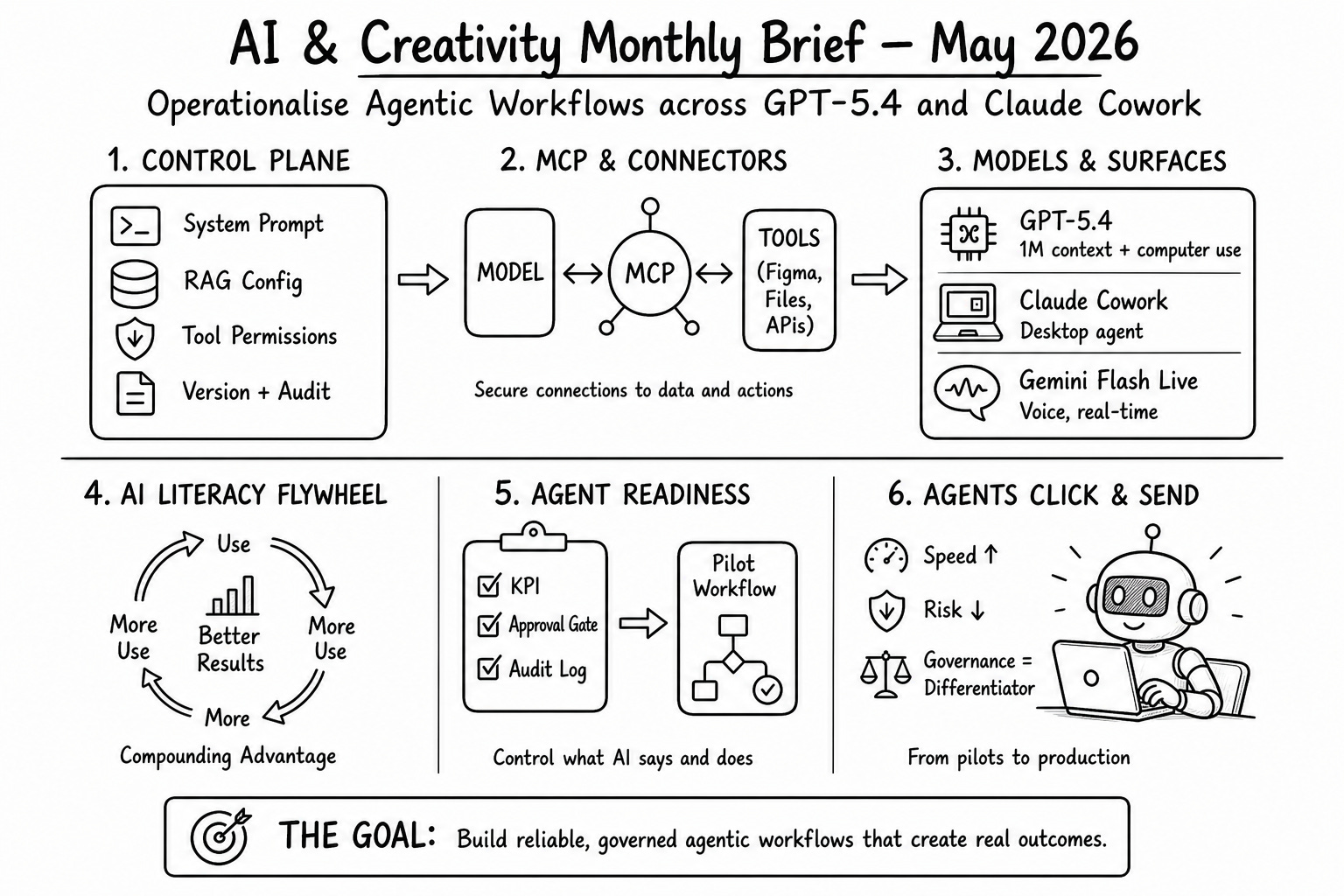
THIS MONTH’S SIGNALS
AI-first is becoming a management question: who decides, who reviews, who carries risk.
Compliance is moving from friction to the product layer, especially in Europe.
GEO, or Generative Engine Optimisation, means structuring content so search engines and AI systems can retrieve and cite it.
Synthetic media is shifting from demo culture to repeatable commercial workflows.
In brand and culture, automation is raising the value of distinctly human signals.
WHAT WE PUBLISHED
From the newsletter archive, four clusters stood out.
Operating models and governance
AI-First Workflows (18 Apr): AI is not a faster assistant; it is a new operating model that reallocates decisions, risk and accountability.
S&P 500 AI Strategy (14 Apr): enterprise AI is moving from pilots to production, with infrastructure and governance separating leaders from followers.
Interview: Pedro Alfama — Verdaio.ai EU Compliance (21 Apr): compliance is becoming AI’s killer use case because operators need regulation translated into action.
Interview: Pedro Alfama - Verdaio.ai EU Compliance

Pedro Alfama and I have known each other for more than fifteen years. We met in a different life, the kind where “product” meant metal, distribution, training, and sales targets, and we kept crossing paths as both our careers drifted toward technology.
GEO Playbook (1 Apr): if models mediate discovery, your content must become evidence, not marketing fog.
Human edge, brand and culture
Interview: Martin Lindstrom — Why Human Brands Will Beat AI Brands (28 Apr): as automation rises, authenticity and emotion become stronger brand assets.
Interview: Martin Lindstrom, Author of Buyology, Small Data and The Ministry of Common Sense — Why Human Brands Will Beat AI Brands

At the recent Branding & Business Summit, held at the Sala Tejo at MEO Arena in Lisbon, Portugal, a new forum dedicated to the future of brands, leadership, technology, and business strategy was launched. Organised by Imagens de Marca and Brands Community, in association with SIC Notícias, the summit brought together thinkers, CEOs, creatives, policymak…
Sporting CP vs SL Benfica: Why the Lisbon Derby Is Football’s Most Human Technology (20 Apr): ritual, memory and collective emotion still resist machine replication.
Altman’s Superintelligence Manifesto (8 Apr): “people first” narratives matter less than who accumulates power and policy influence.
Applied AI in market contexts
Calico Zillow Renovation Videos (10 Apr): a low-cost AI output becomes strategic when packaged as a repeatable, compliant service.
INSEAD AI Venture Lab Just Proved AI Can Grow Companies Faster (21 Apr): founders learned that AI advantage comes from execution discipline, not slogans.
Foundations for builders
AI Before Intelligence (7 Apr): a tiny perceptron is a useful reminder that modern systems still begin with simple decisions.
For a more hands-on view of how creative machines are built, explore our open sketches.
HOT TOPICS: AI × CREATIVITY
AI-first workflows
What changed this month: our April coverage reframed AI from assistant software to operating design.
Why leaders should care: this changes budgeting, approvals, team shape and accountability across creative workflows.
Example: S&P 500 AI Strategy and AI-First Workflows point to the same move — build governance and control layers before scaling output.
Compliance as infrastructure
What changed this month: compliance no longer appeared as a legal drag but as a practical product layer.
Why leaders should care: in regulated environments, AI governance now shapes speed-to-market and customer trust.
Example: Verdaio.ai suggests a path where regulation becomes an executable workflow rather than a late-stage blocker.
Synthetic media as a service
What changed this month: synthetic media moved from novelty to commercial packaging.
Why leaders should care: margin will sit less in the generation itself and more in review, rights, turnaround and distribution.
Example: the Calico/Zillow case shows how a simple video output can become a valuable service when wrapped in a process.
GEO and discoverability
What changed this month: discoverability broadened from SEO to model retrieval.
Why leaders should care: if assistants answer before users click, being citable matters as much as being rankable.
Example: the GEO playbook is a practical prompt for every executive page, explainer and product note.
MODELS & TOOLS TO WATCH
Verdaio.ai (EU compliance workflow layer) — why it matters: turns regulation into operational tasks that teams can execute.
Best-fit use case: regulated operators that need faster policy-to-process translation.
Risk/limitation: depends on legal interpretation and adoption.GEO Playbook (retrieval and citation method) — why it matters: improves how models find and reference your content.
Best-fit use case: thought leadership, explainers and product pages.
Risk/limitation: weak source material still stays weak.Claude Cowork (agentic workspace) — why it matters: pushes AI from chat towards execution.
Best-fit use case: coordinated task support across multi-step knowledge work.
Risk/limitation: autonomy can create opacity if oversight is weak.Perceptron (foundational learning model) — why it matters: shows how simple decisions scale into intelligence.
Best-fit use case: executive education, onboarding and demystifying AI systems.
Risk/limitation: too simple for production reality.
CHECK OTHER NEWSLETTERS
This month’s input included source links for Dr. Storm, Obsolete AI and Suma Positiva, but no pasted excerpts. Rather than speculate, we are holding specific claims.
WHAT TO DO NEXT
Re-map one end-to-end creative workflow this month: define where AI creates, where humans approve, and where compliance must intervene.
Audit your top five public pages for GEO readiness: make claims sourceable, definitions explicit and evidence easy for models to retrieve.
Prototype one synthetic media offer with disclosure, review steps, turnaround targets and margin assumptions.
CURIOSITIES
A perceptron can look trivial, but it is still one of the cleanest ways to explain why AI starts with weighted choices rather than magic.
The Lisbon derby may be a better case study in creativity than many product demos: ritual, context, and memory are still hard to automate.
A $15 renovation video is a useful executive lesson: the workflow around the output often matters more than the output itself.
Building Creative Machines covers AI, creativity, and society — articles, interviews, and open sketches. Explore the book.