

GEO (Generative Engine Optimisation): The New Battle for “Being the Answer”
For twenty years, digital visibility meant one thing: ranking on Google.
That era isn’t over, but it’s no longer the whole game. Discovery is migrating from lists of links to direct answers produced by large language models (LLMs): ChatGPT, Google’s AI Overviews, Perplexity, and whatever comes next.
This shift creates a new, urgent question:
How do you become the source an AI chooses to use — and cite — when it answers a customer’s question?
That is Generative Engine Optimisation (GEO): optimising your brand and content so generative systems can retrieve, trust, and reuse it in their responses. The concept has already been formalised in academic work under the GEO name. (arXiv)
The point is not to “game” models. The point is to make your information easy for machines to recognise as reliable, extractable, and up to date.
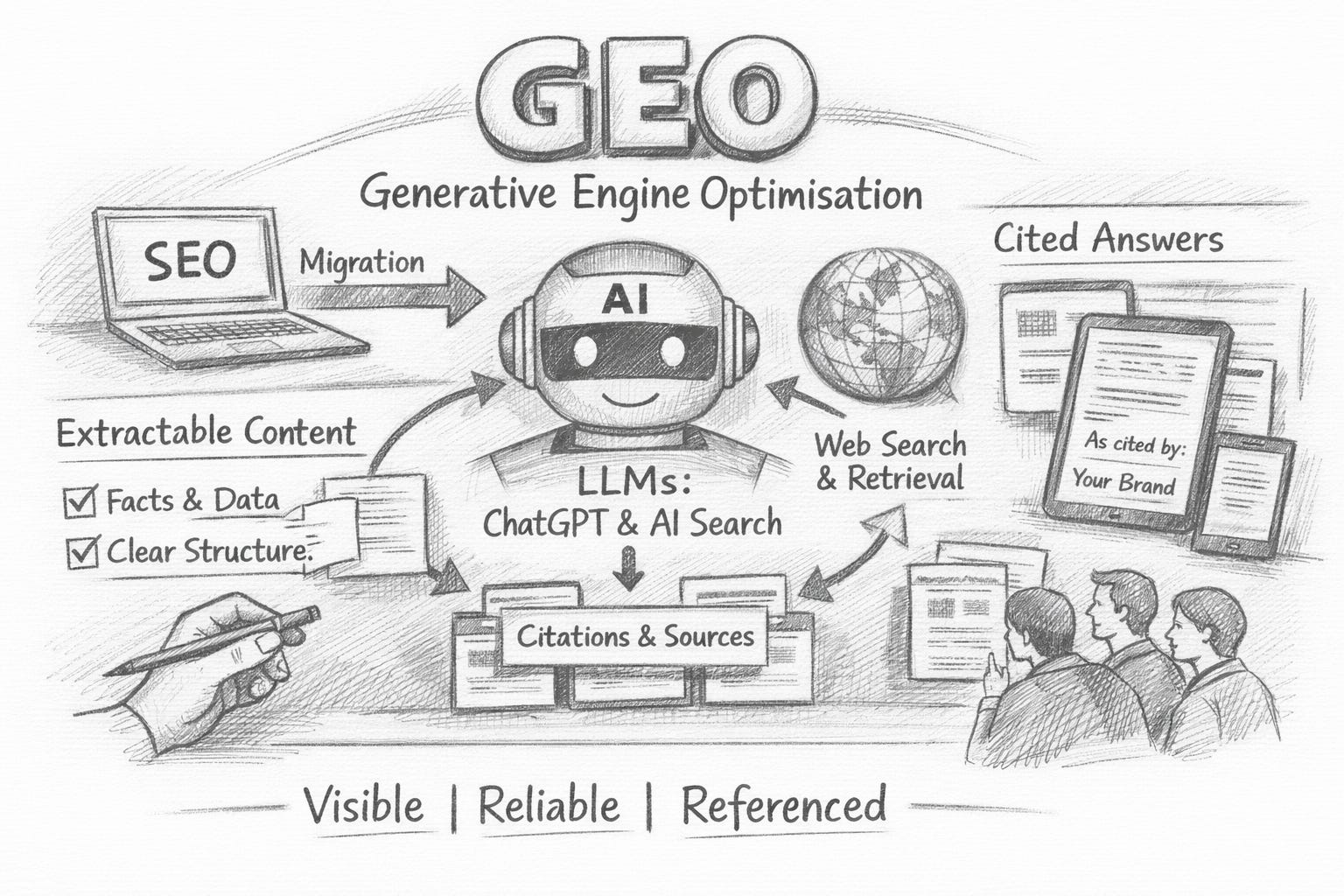
Why GEO is suddenly urgent
1) “Zero-click” becomes “zero-visit”
When Google shows AI-generated summaries, many users get what they need without having to click through. Independent analysis has linked AI Overviews to materially lower click-through rates for publishers and sites.
If fewer people reach your site, classic SEO metrics (sessions, CTR, top-3 rankings) become less predictive of business impact.
2) AI Overviews are expanding
Data reported in the trade press suggests the share of searches triggering AI Overviews has grown, alongside a rapid increase in the number of keywords that trigger those summaries.
Even if the exact percentage varies by market and query type, the direction is clear: more queries are being answered directly on the results page.
3) ChatGPT and “answer engines” now browse the web
ChatGPT can decide to search the web and return answers with cited sources; OpenAI describes this as a core capability of “ChatGPT search”.
So the visibility contest moves from:
“Can I rank?”
to:“Can I be retrieved, selected, and cited?”
How generative engines actually produce answers
To do GEO well, you need a simple mental model of what’s happening under the hood.
Step 1: The model is probabilistic — it writes by prediction
An LLM doesn’t “look up” a sentence in a database and paste it. It generates text token by token, choosing the most likely next token given the context and what it has learned during training.
That matters because:
LLMs prefer clear, common structures they’ve seen often.
They are sensitive to framing (definitions, comparisons, step-by-step instructions).
They can produce fluent text that still needs grounding.
Read our article “Why Is the Dog Truly Man’s Best Friend? What AI Prompt Testing Reveals” about the way LLMs use probabilities to create new content:
Why Is the Dog Truly Man’s Best Friend? What AI Prompt Testing Reveals

“Nothing improves without measurement” — Deming’s dictum finds new life in the world of generative language models. At the crossroads of open-source transparency and closed-system opacity lies a fundamental challenge: how do we measure, refine and trust the answers these machines provide? The key lies in statistical testing — and in prompts.
Step 2: The model is vectorial — it matches meaning, not keywords
Modern retrieval and ranking systems rely heavily on embeddings: turning text into vectors so systems can match semantic similarity (“what this means”) rather than exact words.
That means your page can be “about the right thing” even without the exact keyword — and still be retrieved.
It also means vague, marketing-heavy copy is harder to match precisely, because the semantics are fuzzy.
Step 3: For fresh facts, engines use retrieval (RAG) and citation
Most “answer engines” combine generation with retrieval: the system searches, ranks sources, pulls passages, then generates an answer grounded in those sources (often with citations).
OpenAI explicitly positions web search + citations as part of how ChatGPT delivers timely information.
So GEO is largely about winning three filters:
Retrieval: does your content get pulled into the candidate set?
Selection: does it look trustworthy and extractable compared to alternatives?
Reuse: can the engine quote/paraphrase it cleanly without distortion?
GEO vs SEO: what changes, what stays
What stays from SEO (and still matters)
Technical accessibility: crawlable pages, fast performance, stable rendering.
Authority signals: credible backlinks, brand mentions, consistent entity identity.
Content hygiene: clear IA, strong titles, structured internal linking.
GEO doesn’t replace SEO; it inherits the fundamentals.
What changes dramatically
1) You are optimising for “citability”, not “clickability”
A blue link competes on the headline and promise.
A cited source competes on:
precision
clarity
specificity
evidence
freshness
provenance (who said this, where, when)
2) The unit of value is a passage, not a page
Answer engines often extract snippets. A single paragraph or table can carry your brand into the answer even if the user never visits.
3) “Position #1” becomes “included in the synthesis”
You’re not trying to be first in a list.
You’re trying to become one of the few building blocks the model uses to construct the response.
Academic GEO framing focuses on increasing a creator’s visibility within generative outputs — a different objective from classic ranking.
The practical GEO playbook
1) Write “extractable truth”
Your best GEO asset is content that can be safely reused.
Do this:
Put definitions in the first 2–3 sentences (“X is…”).
Use short paragraphs with one claim each.
Prefer specific numbers and conditions (“works best when…”, “fails when…”).
Add dated context (“as of March 2026…”) where freshness matters.
Avoid:
throat-clearing intros
vague adjectives (“world-class”, “innovative”)
claims with no supporting detail
2) Make your brand an entity, not a slogan
LLMs and retrieval systems handle “things” (entities) better than vibes.
Action:
Standardise your brand name, product names, category terms, and key claims across the web.
Ensure your About/press pages clearly state who you are, who you serve, your proof points, locations, and leadership.
Use consistent terminology so that embedding similarity works in your favour.
3) Build “retrieval hooks” into your content
Think like an answer engine: it wants to answer specific questions.
Format ideas that perform well:
“What is X?”
“X vs Y”
“How to choose X”
“Common mistakes in X”
“Checklist for X”
“Pricing model for X” (even if you don’t publish prices, publish how pricing works)
Each is a retrieval-friendly pattern that the model can map to user intent.
4) Use a structure that machines love
You don’t need to worship schema markup to do GEO, but structure helps.
Include:
H2/H3 headings that mirror questions
bullet lists
step-by-step sequences
comparison tables
FAQs (written like real questions people ask)
This is not “writing for robots”. It’s writing so your best thinking survives extraction.
5) Spread authority across the open web
One uncomfortable truth: answer engines often trust the web’s consensus, not your homepage.
So you need credible third-party sources:
reputable industry publications
standards bodies
partner ecosystems
academic or technical references where relevant
Because when multiple independent sources repeat the same fact about you, retrieval systems see reinforcement.
6) Design for “source panels” and citations
ChatGPT search surfaces citations and a sources panel.
That changes behaviour: users can jump straight to sources, compare, and decide whom to trust.
So ask:
If my page is cited, what will the user see in the snippet?
Does it immediately establish credibility?
Does it answer cleanly without overclaiming?
Measuring GEO without pretending it’s solved
GEO measurement is still maturing. But you can start now with pragmatic proxies:
Visibility metrics
Share of AI answers that mention your brand for priority queries
Share of citations pointing to your domain (where tools allow tracking)
Inclusion in “best X” / “compare X” generative responses
Business metrics
Assisted conversions from “direct” and “dark” traffic (LLM referrals often look messy)
Brand search lift (people hear you in an answer, then search later)
Sales team signal: “I asked ChatGPT, and it mentioned you”
Treat GEO like early SEO in the 2000s: imperfect measurement, but massive compounding advantage for early movers.
Where this trend goes next
Three directional bets look safe:
More answers will be synthesised (Google, chatbots, browsers, OS-level assistants).
Citations will matter more because trust and accountability become product features.
Content will compete on reliability and structure, not just creativity and reach.
In that world, GEO is not a marketing hack. It’s a new layer of operational discipline: how your organisation publishes truth.
The companies that win won’t be the loudest. They’ll be the clearest, most referenceable, and most consistently verified across the web.
