

In 2025, I was selected to take part in the INSEAD AI Venture Lab accelerator, one of the most ambitious global programmes focused on helping founders build companies with artificial intelligence. It was more than an accelerator. It was a live experiment in how AI changes the way companies are created, scaled and financed.
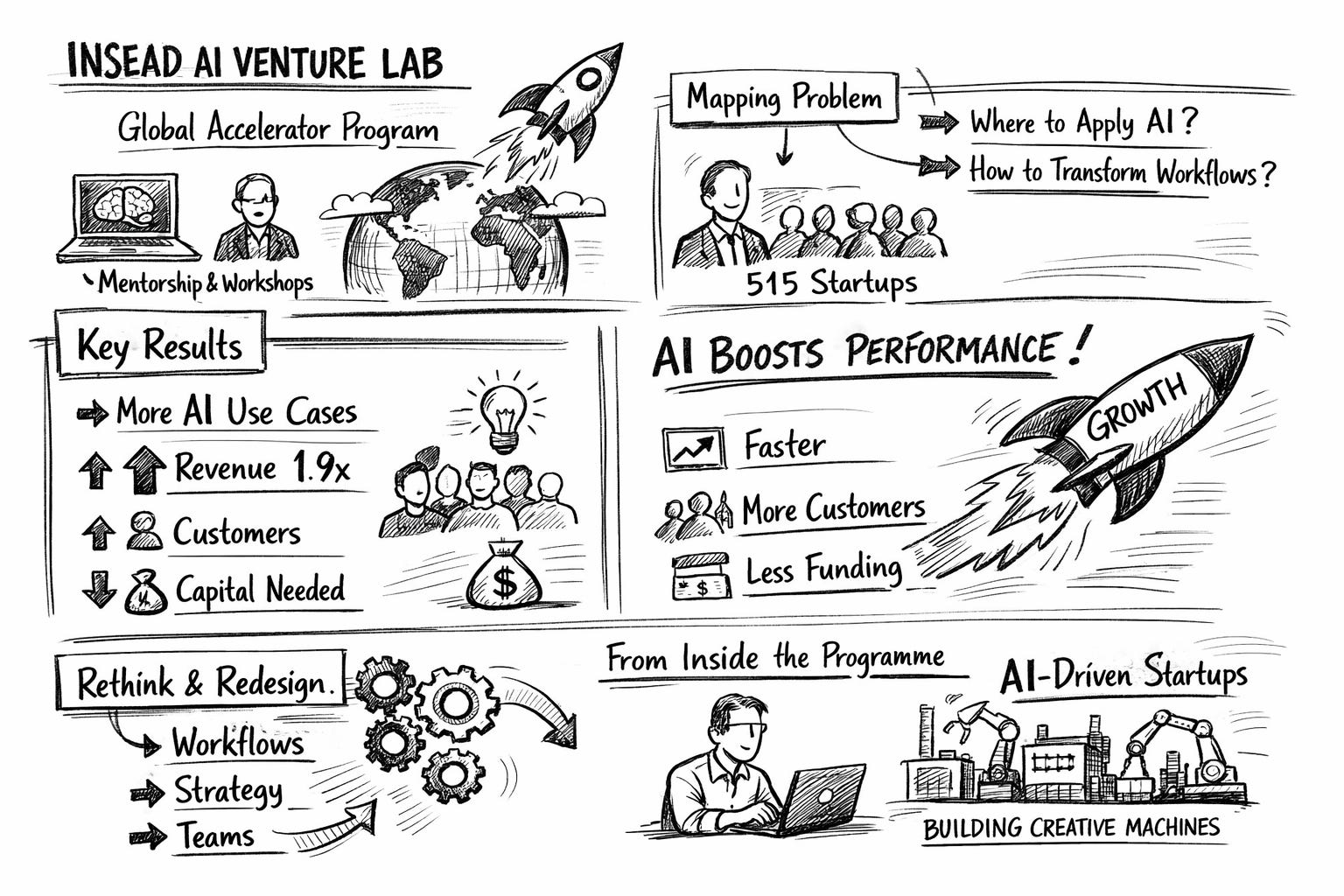
What followed is now reflected in a newly released academic working paper from INSEAD and Harvard Business School: “Mapping AI into Production: A Field Experiment on Firm Performance.” The paper studies 515 high-growth startups that participated in the programme and offers rare causal evidence that AI can improve real company performance, not just productivity on isolated tasks.
For anyone serious about AI strategy, entrepreneurship or the future of work, the findings deserve attention. Here is the paper, by Hyunjin Kim INSEAD, Dahyeon Kim INSEAD and Rembrand Koning Harvard Business School, to whom I much appreciate the time spent and the dedication to the program:

What Is the INSEAD AI Venture Lab?
The INSEAD AI Venture Lab is a global entrepreneurship initiative created by INSEAD, one of the world’s leading business schools.
The programme is designed to help early-stage founders build and scale ventures using artificial intelligence as a core capability. Unlike many startup accelerators that focus mostly on fundraising and pitch decks, the AI Venture Lab is deeply operational: it focuses on how founders can actually use AI to redesign products, workflows, teams and business models.
The 2025 cohort was global, remote-first (with time in Abu Dhabi and Singapore) and highly selective. Startups came from Europe, Asia-Pacific, the Americas, the Middle East and Africa. According to the paper, the median company was founded in 2024 and had a team of 4 people. Many already had products, customers or early revenue.
What Participants Received
The programme included six major pillars:
Access to frontier AI tools and API credits
Weekly technical training sessions
Founder workshops led by faculty and operators
Peer groups and mentor office hours
Investor exposure and demo days
Opportunities for non-dilutive funding prizes
Partners included Google Cloud, OpenAI, Manus, and NVIDIA.
This made the programme one of the most practical founder environments I have seen for testing AI in real business conditions.
Why This Accelerator Matters
There is endless discussion about AI tools increasing productivity. But most of the evidence so far has focused on individuals performing specific tasks faster: writing emails, coding, researching, or providing customer support.
That is useful, but incomplete.
The harder question is:
Does AI actually make companies perform better?
That means more customers, more revenue, faster execution, less capital required and stronger business outcomes.
This is exactly what the INSEAD research set out to measure.
The Core Idea: “The Mapping Problem”
The paper introduces a powerful concept: the mapping problem.
Many companies have access to AI tools. But access is not the real bottleneck.
The real challenge is discovering:
where AI creates value inside the business
which workflows should change
what tasks should be automated
how teams should reorganise
how products themselves should evolve
In simple terms, most companies know AI exists but do not know how to redesign their operations around it. That distinction is critical.
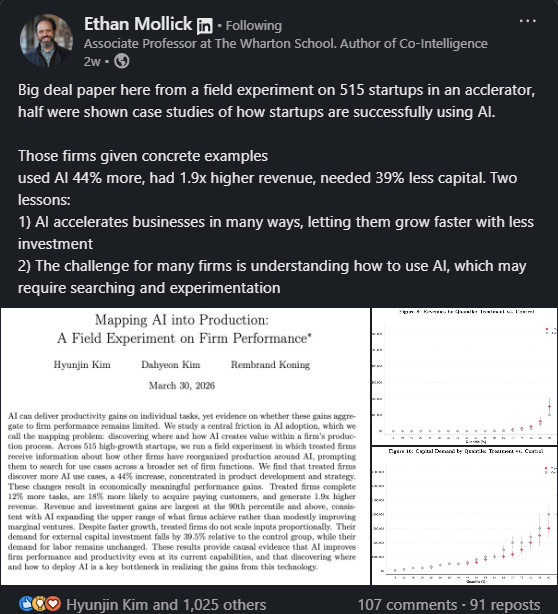
Image: Prof. Ethan Mollick was one of the researchers who boosted the cohort
What the Researchers Tested
During the accelerator, startups were randomly split into treatment and control groups.
Both groups received normal accelerator support.
But one group also received structured examples and case studies showing how other companies were reorganising production around AI.
This gave researchers a way to measure whether improved thinking about AI deployment affects business outcomes.
That is rare in entrepreneurship research, and even rarer in AI research.
Main Findings: AI Improved Real Company Performance
The results were striking.
1. Startups Found More AI Use Cases
Companies that received the additional AI mapping guidance identified 44% more AI use cases than the control group.
Not just chatbots or copywriting, but product development, operations, strategy and workflow redesign.
2. Teams Completed More Work
Treated firms completed 12% more tasks overall.
This suggests AI was increasing execution speed, especially on internal work.
3. More Paying Customers
They were 18% more likely to acquire paying customers.
This is one of the most important metrics in any startup.
4. Revenue Nearly Doubled
The treated group generated 1.9 times the revenue of control firms.
That moves AI from “interesting tool” to a real commercial lever.
5. Less Need for Capital
Perhaps the most underrated result:
Companies exposed to stronger AI operating models demanded 39.5% less external capital.
This could become one of the defining shifts of the AI era.
Why This Changes Startup Economics
Traditionally, startups scale through:
hiring more people
raising more money
extending the burn runway
slowly building products
AI changes this formula.
The paper suggests companies can:
ship faster
operate leaner
test more ideas
reach customers earlier
reduce dependence on fundraising
That is a structural change in entrepreneurship.
My Personal Experience Inside the Programme
Having participated in the 2025 cohort, I saw firsthand that this was not a superficial AI trend exercise.
The programme pushed founders to think beyond prompts and tools.
The real challenge was:
rethinking production systems
compressing decision cycles
removing internal bottlenecks
using AI across multiple functions simultaneously
building businesses that would have been too expensive or slow only a few years ago
This mirrors much of what we are building through Algorithm G and GAIA©: production-ready AI systems designed not as demos, but as operating leverage.
Why Corporations Should Pay Attention
This research is not only for startups.
Large organisations often have:
more data
more budget
more processes
more inefficiencies
more bureaucracy
Which means the upside may be even larger if they solve the mapping problem.
Buying licences for AI tools is not enough.
The real advantage comes from redesigning how the company works.
What Leaders Should Do
1. Audit Internal Bottlenecks
Where does work slow down today?
2. Map AI Across Functions
Not one department. Every function.
3. Redesign Workflows
AI layered onto broken processes creates limited gains.
4. Measure Commercial Outcomes
Revenue, customers, margin, speed.
5. Build Capability Early
The learning curve compounds.
Final Thought
The biggest misconception in AI today is that success comes from having access to the best models.
This paper suggests something more important:
Winners may be the organisations that best redesign themselves around AI.
That is a management challenge, not a technology challenge.
And from inside the INSEAD AI Venture Lab, it was clear this future is already underway.
Read more about the participants, the tech stream, the mentors and what happened at INSEAD AI Venture Lab:
SundAI: The MIT & Harvard Hacker Collective Redefining A.I. Innovation

From INSEAD to MIT: Encountering a New Kind of Venture Lab
Interview: Karin Del Rey — on Generative AI, Venture Building, and the Future of Impact Innovation

I recently had the pleasure of meeting Karin Del Rey through the INSEAD AI Venture Lab, where she serves as a mentor. Karin brings a wealth of experience as an investor, start-up builder, and sustainability advocate, having held leadership roles at McKinsey, Ula, Big Idea Ventures, and now Katapult Ocean. In our conversation, she shared
Interview: Caitlin Leksana — Insights from a YC S24 founder, Harvard MBA — from Bottleneck to Growth Driver

I first met Caitlin Leksana, CEO and Co-Founder of Fazeshift (YC S24), during her inspiring workshop at the INSEAD AI Venture Lab. What struck me most was her ability to make complex ideas about AI and finance feel both practical and urgent.