

Yesterday, I attended the Lisbon derby between Sporting CP and SL Benfica.
I did not go as a supporter.
I did not go searching for tactics, statistics, or controversy.
I went as an observer.
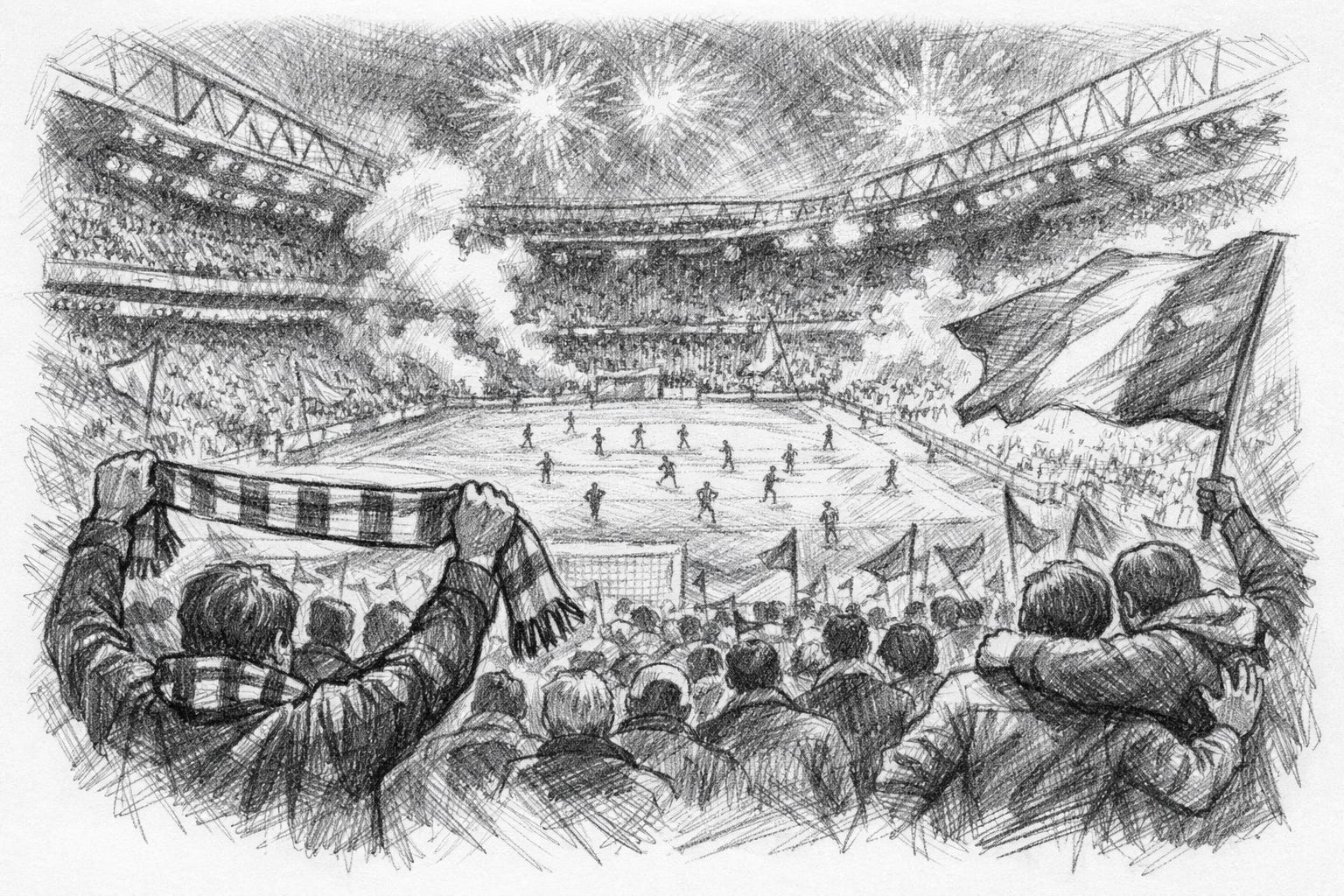
And from that distance, something became clear very quickly: the most important part of the evening was never confined to the pitch.
The match was only one layer of the event.
What unfolded around it was something far older, deeper, and more revealing about human nature.
Before the first whistle, the stadium was already alive. Fireworks cut through the Lisbon sky. Vast banners moved across the stands like ceremonial fabrics. Scarves rose in synchrony. Songs echoed from one side, answered by the other. Tens of thousands of people, many of whom had never met, behaved as if connected by a single nervous system.
Modern society often describes football as entertainment.
That definition feels far too small.
A derby of this scale is not simply entertainment. It is a form of collective meaning-making.
It is a ritual disguised as sport.
It is identity expressed through colour, sound, memory, and movement.
It is one of the few places left where strangers willingly gather to feel something together.
As the scoreline changed, so did the stadium's emotional climate. Confidence turned to anxiety. Relief turned to tension. Hope returned unexpectedly. Whole sections of the crowd fell silent at once, then erupted seconds later with explosive force.
The crowd did not merely watch the match.
The crowd became part of it.
This is where sport remains profoundly interesting in the age of artificial intelligence.
AI can analyse player positioning in real time.
It can predict probabilities of victory.
It can optimise substitutions.
It can personalise highlights.
It can monetise attention more efficiently than any broadcaster in history.
It can explain what happened.
But it cannot inhabit what happened.
It cannot inherit rivalry from a grandparent.
It cannot understand why a shirt colour can hold emotional weight across generations.
It cannot feel why one chant can contain thirty years of memory.
It cannot know why defeat ruins a weekend, or why victory makes strangers embrace.
Those things are irrational.
And precisely because they are irrational, they are deeply human.
At Building Creative Machines, we often return to a recurring principle: the most valuable dimensions of human intelligence are not always computational.
They emerge through context.
Through memory.
Through belonging.
Through contradiction.
Through emotion.
A derby is built from all five.
Context lives in every reference outsiders miss.
Memory lives in every supporter who remembers previous battles.
Belonging lives in every shared chant.
Contradiction lives in loving something that so often causes pain.
Emotion lives everywhere.
No machine arrives carrying childhood memories of a parent taking them to the stadium.
No model understands what it means to care without reason.
No system feels loyalty despite repeated disappointment.
That matters.
Because as more of life becomes automated, frictionless, personalised, and optimised, people may increasingly seek experiences that remain stubbornly analogue: collective tension, unpredictability, symbolism, tribal belonging, and emotional risk.
The derby offers all of these.
Not because football rejects technology, it does not. VAR, analytics, data science, and algorithmic media are already embedded in the game.
But because meaning still exceeds measurement.
When the evening ended, the results were entered into the databases instantly.
Statistics were updated.
Tables shifted.
Commentary multiplied online.
Yet none of those systems fully captured what actually happened.
What happened was that a city felt something together.
Thousands of bodies moved through cycles of fear, hope, pride, anger, joy, and relief in shared time.
That experience will be remembered far longer than the numbers.
And in an era increasingly shaped by machines, perhaps that is exactly why it matters so much.