TL;DR
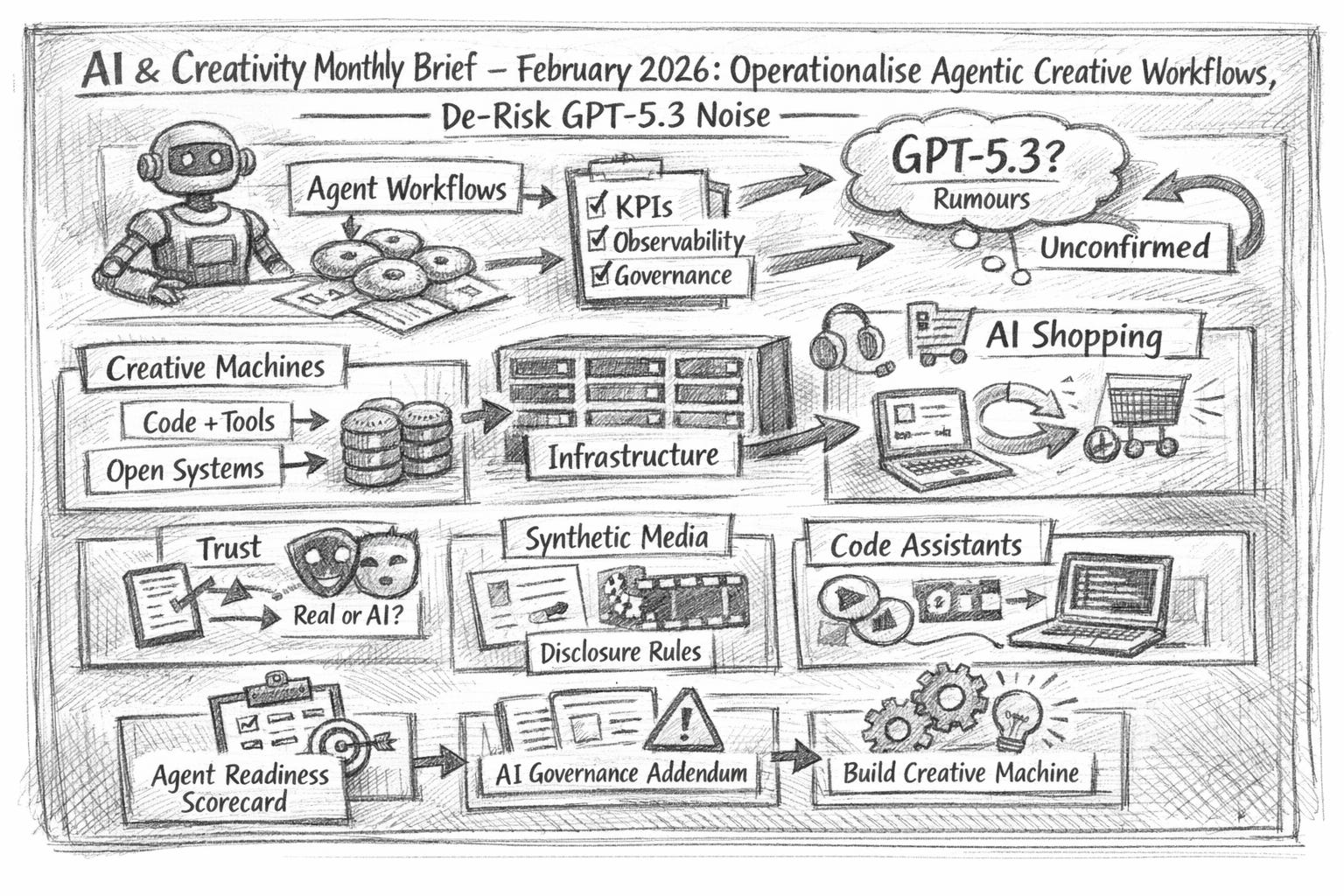
AI creativity is no longer just output generation; it is the design of systems where people, models, tools, and governance shape better work.
Generative design, creative tooling, and synthetic media are converging into agentic production stacks.
Leaders should optimise for workflow economics: smaller AI where possible, stronger controls where necessary, and human judgement everywhere.
THIS MONTH’S SIGNALS
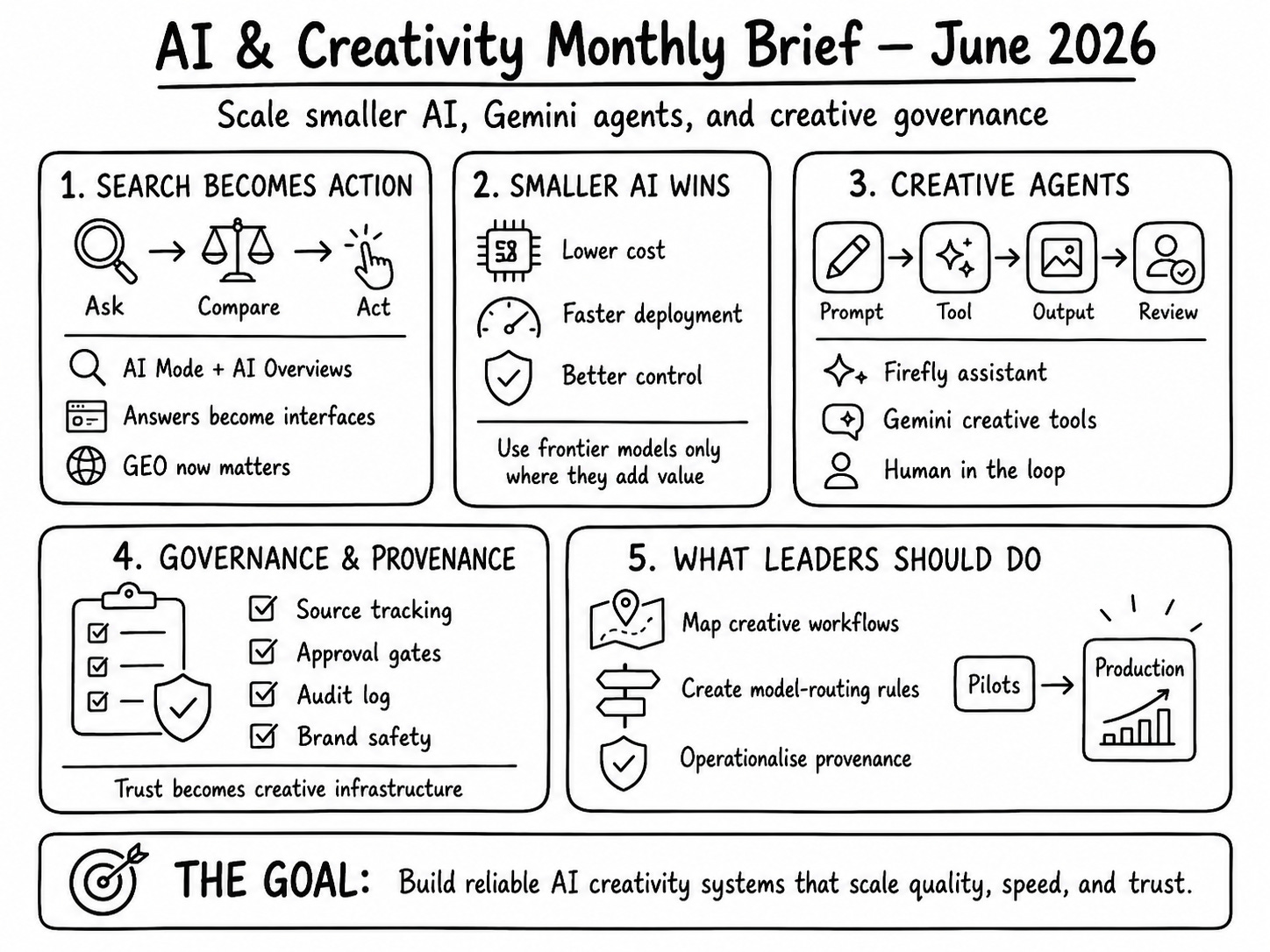
Google I/O 2026 pushed the market further into the agentic Gemini era, with AI Mode, AI Overviews, and new creative tools positioned as everyday interfaces rather than side experiments. Google says AI Overviews has more than 2.5 billion monthly active users, and AI Mode has surpassed 1 billion.
Google announced 100 I/O updates on 20 May, spanning models, agents, Search, Workspace, Android, and creative AI — a signal that AI strategy is now a full-stack product strategy.
Anthropic launched Claude Opus 4.8, with effort controls, faster/cheaper fast mode, and dynamic workflows for larger agentic tasks; useful for long-running professional work.
OpenAI updated GPT-5.5 Instant on 28 May for clearer, more natural, better-paced responses; important because everyday interface quality shapes enterprise adoption.
Adobe continued moving creative work into agents: Firefly AI Assistant entered public beta in late April, and Adobe announced a Gemini creativity connector on 19 May.
WHAT WE PUBLISHED
AI economics and operating models
Stop Paying for Brains You Don’t Use: Why Smaller AI Beats Bigger AI for Business — bigger models impress; focused models often win on speed, cost, safety, and deployment fit.
Generative AI Made Creation Cheap. Growth Is Still Expensive — creation is abundant; distribution, attention, and trust remain scarce.
Europe, infrastructure, and strategic capability
Interview: Mariona Sanz Ausàs, Barcelona Supercomputing Center — sovereign compute, MareNostrum 5, startups, and Europe’s path from research to industrial advantage.
Interview: Mariona Sanz Ausàs, Barcelona Supercomputing Center, Head of Innovation and Business Development

When I visited the Barcelona Supercomputing Center, I expected to see one of Europe’s most powerful scientific infrastructures. What I found was much more than a supercomputer (thanks to Kostiantyn Tsyvinskyi for the great tour).
Interview: Monique Hodges - The Human-Agent Contract: Leading Organisations Through the AI Shift — the real AI challenge is not technology. It is leadership.
Interview: Monique Hodges - The Human-Agent Contract: Leading Organisations Through the AI Shift

Today, we speak with Monique R. Hodges, whom I had the pleasure of meeting in Shangai during a GEMBA program on innovation opportunities in China delivered jointly by IESE Business School and China Europe International Business School. Our conversations there already reflected the themes that define Monique’s work today: organisational transformation, l…
Search, commerce, and agentic discovery
AI ends Checkout — agentic AI is compressing discovery, decision, and payment into conversational flows.
Explore the full archive: Building Creative Machines
Book: Building Creative Machines — the book
Open sketches: Explore and play
Also read: A short look at why Lisbon’s NFC Summit is becoming less like a tech conference and more like a cultural signal.
Inside NFC Summit 2026’s Art-First World

NFC Summit: the conference that stopped behaving like a conference
HOT TOPICS: AI × CREATIVITY
1. Google turns Search into an agentic interface
What changed this month: Google framed AI Mode as a major Search upgrade and tied it to agentic behaviour: ask, compare, decide, act.
Why leaders should care: search is becoming an answer-and-action layer, not just a traffic source.
Implication: brand, content, and commerce teams need GEO: generative engine optimisation means structuring content so AI systems can retrieve, trust, and cite it.
2. Creative agents move inside professional tools
What changed this month: Adobe’s Firefly AI Assistant and Gemini connector point to creative agents that orchestrate Photoshop, Premiere, Firefly, and multi-model generation.
Why leaders should care: creative tooling is shifting from app expertise to intent, supervision, and workflow design.
Implication: the new creative director manages constraints, provenance, brand rules, and taste — not just prompts.
3. Smaller AI becomes a boardroom cost question
What changed this month: model updates from Google, OpenAI, and Anthropic all emphasised usability, speed, cost, and effort controls.
Why leaders should care: AI margin will depend on routing the right task to the right model.
Implication: create a model portfolio: small models for repeatable work, frontier models for ambiguity, and human review for judgment.
4. Synthetic media risk is becoming measurable
What changed this month: new research on multimodal misinformation found AI-generated content can achieve disproportionate virality, while detectors degrade as generation improves.
Why leaders should care: trust, brand safety, and provenance are now part of the creative infrastructure.
Implication: watermarking, audit trails, approval logs, and source discipline should sit inside content operations.
MODELS & TOOLS TO WATCH
Google AI Mode and Gemini agents
One-line description: Search and Gemini are becoming action-oriented interfaces for research, comparison, and task completion.
Best-fit use case: customer journeys, product discovery, knowledge work.
Risk/limitation: source visibility and publisher impact remain contested.Google Pics with Nano Banana
One-line description: AI image creation and editing with object-level creative controls.
Best-fit use case: rapid visual iteration, campaign mock-ups, design exploration.
Risk/limitation: brand consistency and rights management need review.Claude Opus 4.8
One-line description: Anthropic’s Opus-class model for coding, agentic tasks, and professional workflows.
Best-fit use case: complex builds, code review, multi-step execution.
Risk/limitation: long-running agents need cost and verification controls.GPT-5.5 Instant
One-line description: OpenAI’s faster everyday model updated for clearer, more natural responses.
Best-fit use case: enterprise assistants, drafting, support, structured work.
Risk/limitation: quality still depends on context, retrieval, and governance.Adobe Firefly AI Assistant
One-line description: A conversational creative agent across Adobe’s professional creative stack.
Best-fit use case: production workflows across image, video, audio, and design.
Risk/limitation: teams must define approval gates and creative ownership.
WHAT TO DO NEXT
Map your creative workflows. Identify where AI saves time, where it changes quality, and where human judgment must remain explicit.
Create a model-routing policy. Match task risk, cost, latency, privacy, and quality to the right model tier.
Operationalise provenance. Track sources, prompts, edits, approvals, and generated assets before synthetic media risk becomes a crisis.
CURIOSITIES
Researchers proposed treating generative AI as an “active creative medium”, not just a recommendation engine; the human role becomes disruption, shaping, and curation.
Architecture students who used local generative AI tools reported greater creative fluency and confidence in AI-supported design processes.
The most strategic creative skill may now be knowing when not to generate: attention, taste, and trust still do not scale automatically.
Building Creative Machines covers AI, creativity, and society — articles, interviews, and open sketches. Explore the book.
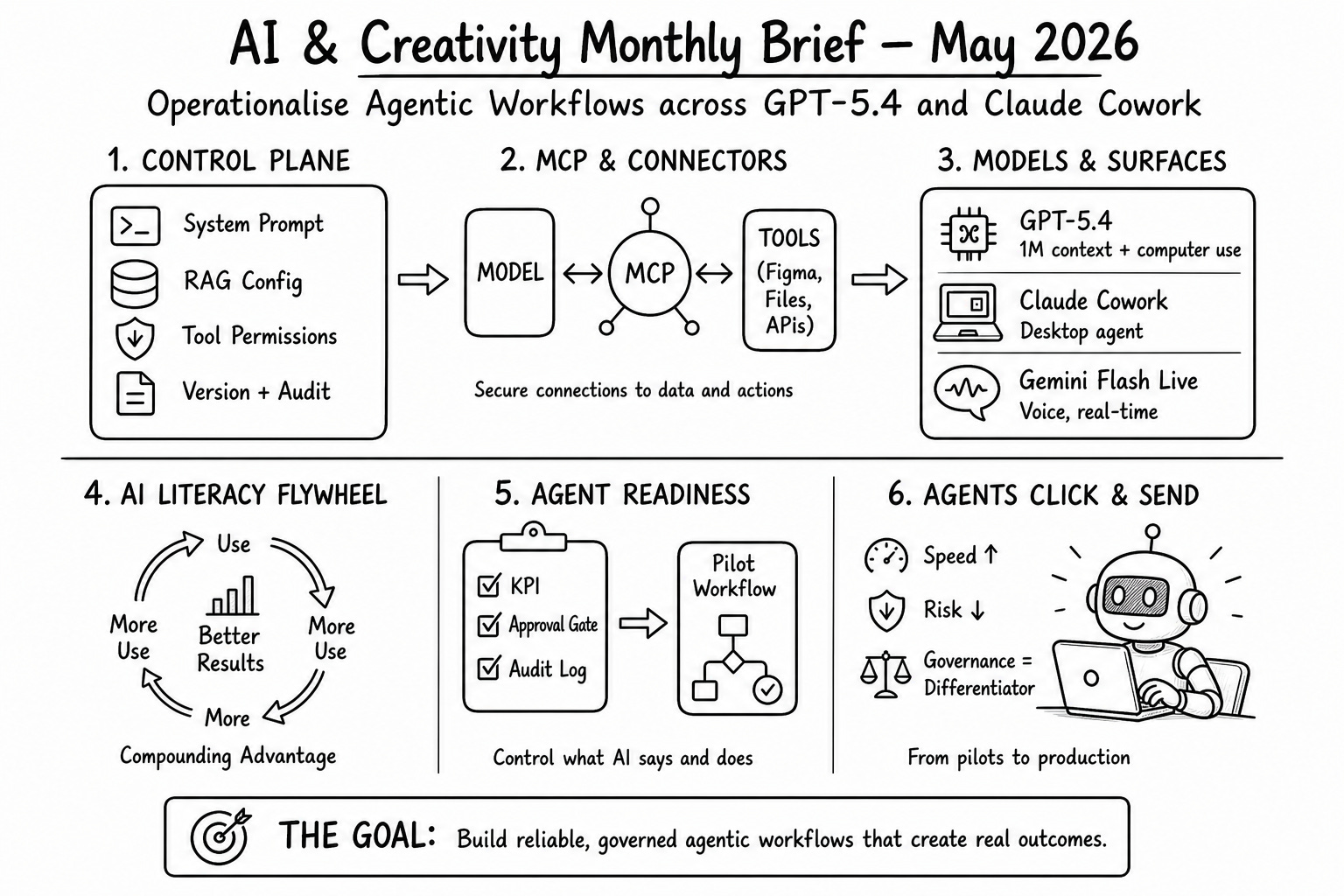
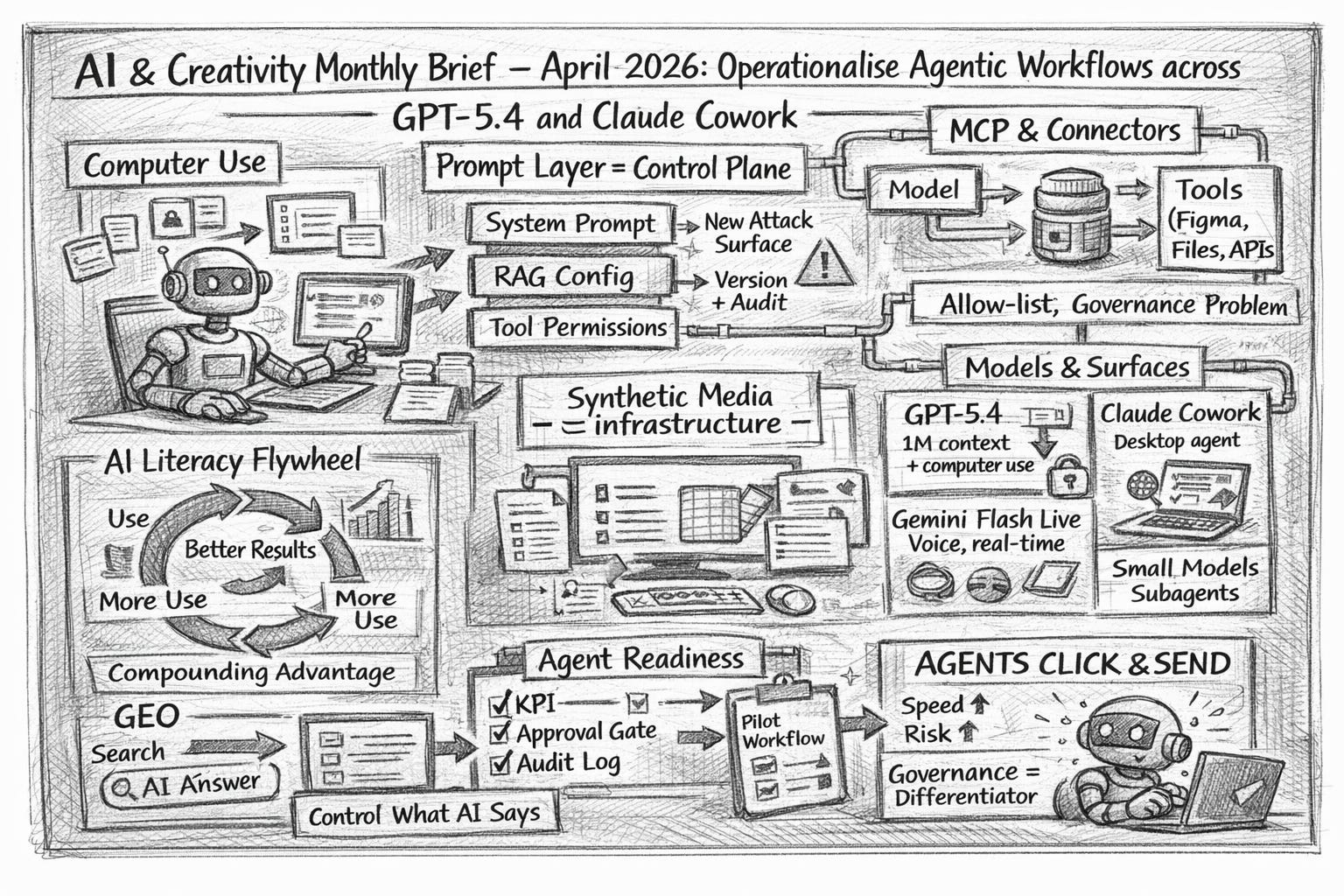
Our previous 2026 AI & Creativity Monthly Briefs:
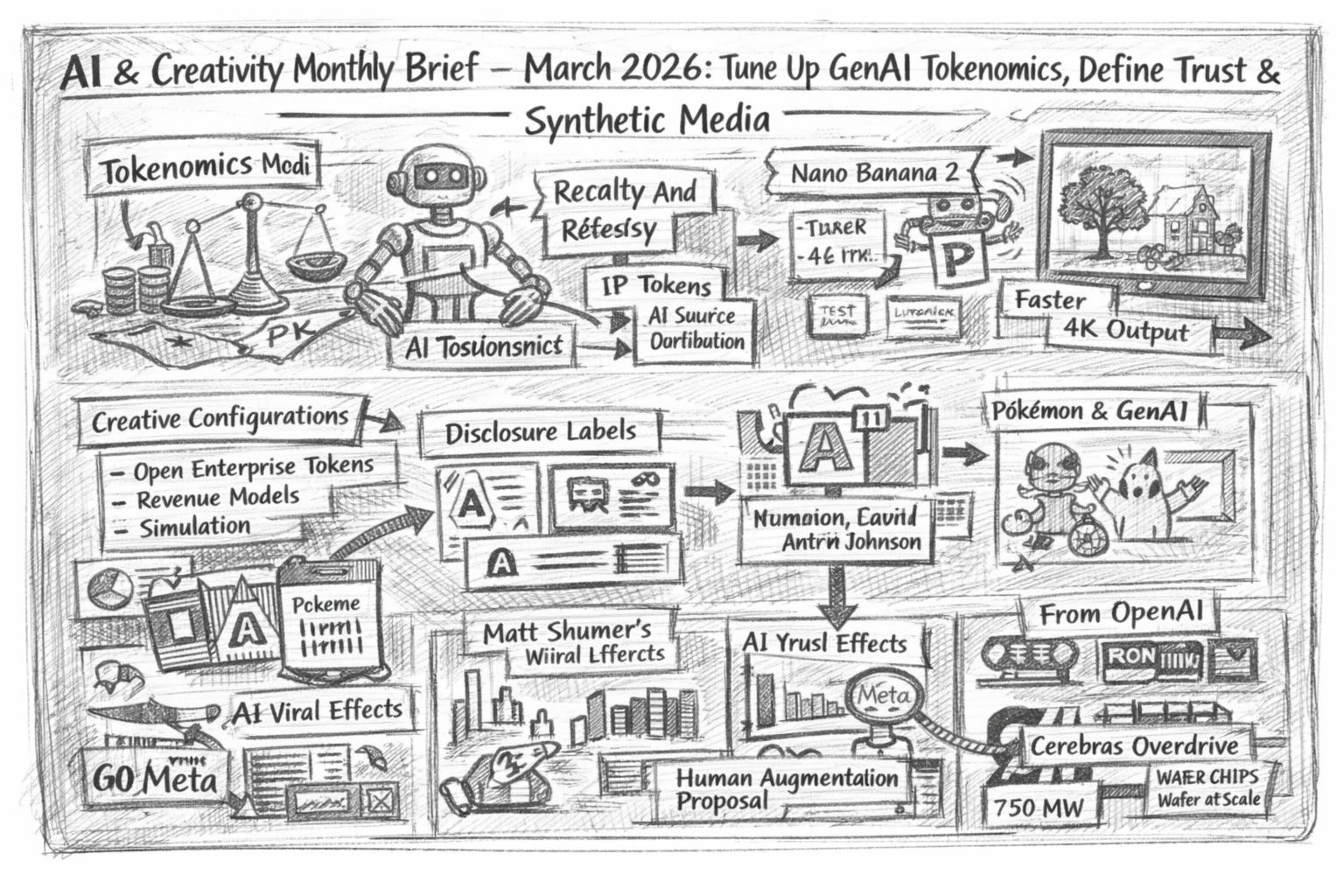
AI & Creativity Monthly Brief — March 2026