

Generative AI has changed something fundamental:
What used to take months can now take hours.
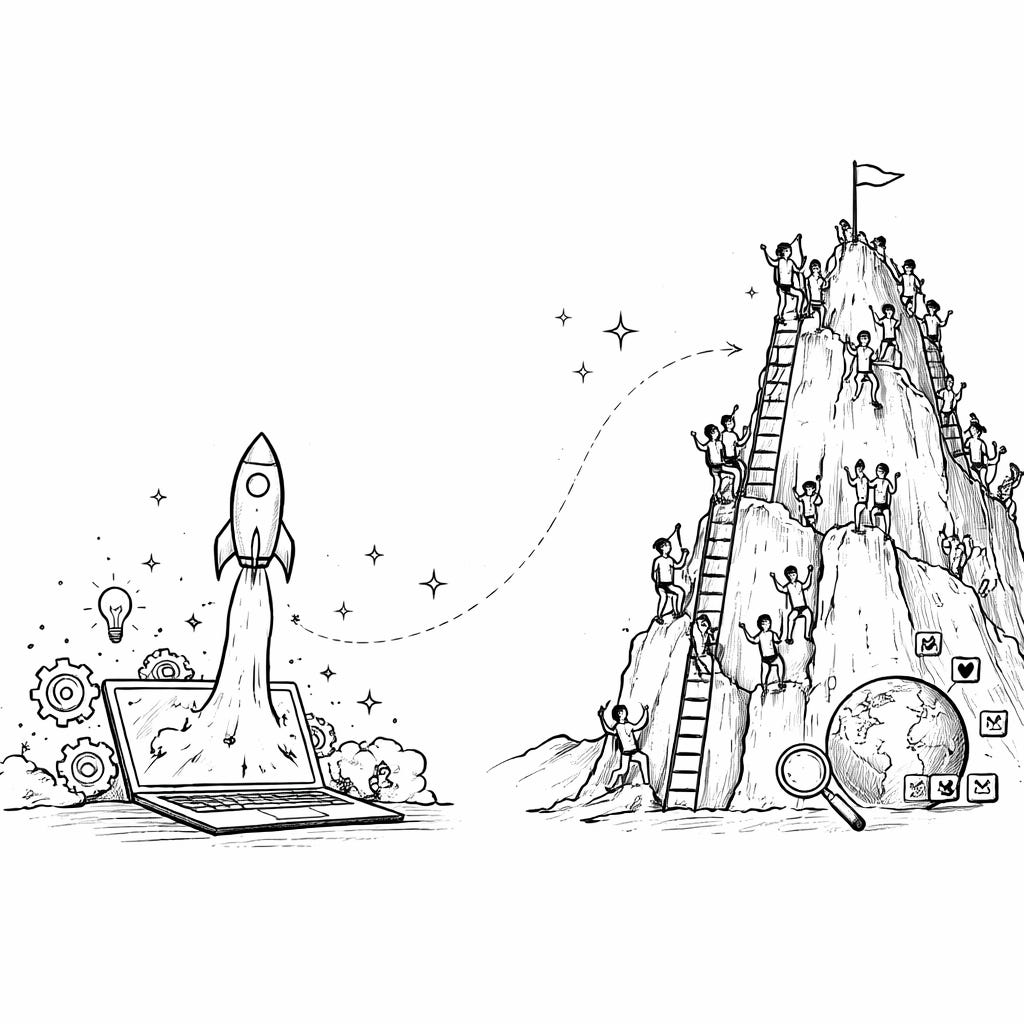
Websites, apps, images, videos, marketing copy, prototypes, and even complete product concepts can all be produced at unprecedented speed and low cost. For founders and innovation teams, this feels like a golden age. Production bottlenecks no longer trap ideas.
But a paradox lies at the heart of this productivity boom.
While creation has become dramatically easier, growth has not.
And in some ways, growth may have become even harder.
The Market Did Not Expand at the Same Speed
AI multiplied supply.
It did not multiply demand.
Customers still have the same:
number of hours in a day
attention span
budgets
cognitive capacity to evaluate new options
Executives may now be pitched ten AI-powered tools a week instead of one a month. Consumers scroll past hundreds of new brands, apps and products every day. Distribution channels are more crowded, not less.
So while the number of digital products exploded, the number of eyeballs did not.
This means competition is not just higher, it is structurally different.
From Scarcity of Builders to Scarcity of Attention
For years, building was the hard part.
You needed:
developers
designers
infrastructure
capital
time
Now, a small team, or even a single person, can launch something that looks like a whole company in a weekend.
The constraint has shifted.
Today, the absolute scarcity is:
trust
relevance
distribution
timing
credibility
These are not things AI can easily automate.
In fact, when everything looks “good enough”, differentiation becomes harder, not easier.
Why Faster Creation Lowers the Odds of Success
Here is the uncomfortable truth:
If everyone can build more, then more things will fail.
Not because they are bad, but because:
customers cannot evaluate everything
procurement cycles are slow
switching costs remain
brand still matters
risk aversion still exists
So we enter a strange loop:
AI makes it easy to create
This increases optimism and experimentation
More products enter the market
Attention becomes even more fragmented
Growth becomes harder
The probability of breakout success drops
From the outside, it looks like innovation is accelerating.
From the inside, it feels like running faster on a treadmill that keeps speeding up.
Go-To-Market Is Now the Real Product
Many teams still behave as if:
“If we can just build faster, growth will follow.”
That assumption no longer holds.
Today, go-to-market is not a phase after building.
It is the core strategic problem from day one.
Questions that matter more than ever:
Who will trust this product first?
What existing workflow does it replace?
Why would someone switch now rather than later?
What distribution channel is actually under-leveraged?
What emotional or reputational risk does adoption carry?
These are not technical questions.
They are organisational, behavioural and economic.
AI does not remove them.
It exposes them.
Confusing Output with Impact
For leadership teams, there is a subtle risk.
Dashboards may show:
more experiments
more pilots
more MVPs
more internal tools
But business impact may remain flat.
Because activity has increased, but market pull has not.
This can lead to false confidence:
“We are innovating more than ever.”
When the real question should be:
“Are we converting innovation into sustained demand?”
In an AI-rich world, shipping is no longer the bottleneck.
Adoption is.
What This Means Strategically
Generative AI does not reduce the importance of:
brand
relationships
partnerships
distribution power
customer insight
It increases it.
As products become easier to copy, context becomes the advantage:
understanding real customer pain
being embedded in existing ecosystems
having credibility in regulated or complex industries
controlling a channel, not just a feature
In other words, the winners will not just be the fastest builders.
They will be the best positioned.
Creation Is Democratised, Success Is Not
AI is an extraordinary equaliser in production.
But markets were never fair, and they are not becoming fairer.
If anything, we may see:
more experimentation
more visible failure
fewer breakout winners
stronger power laws in attention and revenue
Which leads to the final paradox:
AI makes it easier than ever to start.
It may be harder than ever to scale.
Generative AI did not remove the laws of economics, psychology or competition.
It simply accelerated the front end of the innovation funnel.
For leaders, the strategic shift is clear:
Stop asking,
“What can we build now?”
Start asking,
“How will this actually earn attention, trust and commitment in an overcrowded world?”
Because in the age of infinite creation, growth — not technology — is the real differentiator.