

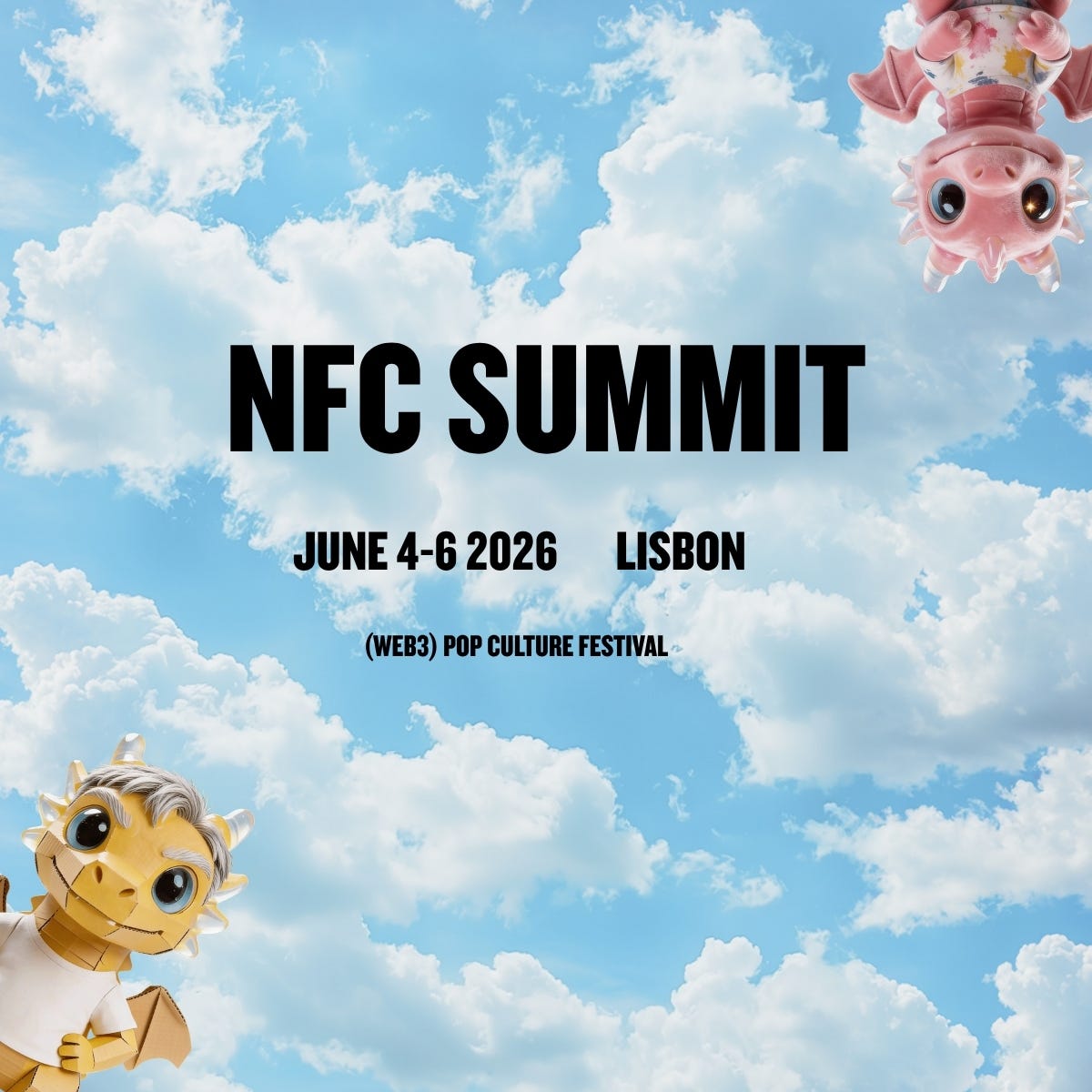
NFC Summit: the conference that stopped behaving like a conference
Most conferences still run the same old playbook:
Big venue. Bigger screens. Bigger claims.
A “main stage” that feels like a factory line for opinions.
Then you walk out with a tote bag and a vague sense you should “do something with AI”.
NFC Summit is different. And in 2026, it’s doubling down on the thing that makes it work: art isn’t the entertainment — it’s the structure. (nfcsummit.com)
I’ve attended every edition so far. This will be the 5th. And if you’re trying to understand where Web3, AI, digital ownership, and modern culture are actually heading (not just where panels say they are heading), NFC has quietly become one of Europe’s best signals.
Not because it’s the biggest. Because it’s built like a living prototype.
2026 is the “art-first” pivot (and that matters more than it sounds)
NFC Summit 2026 runs June 4–6 in Lisbon, moving into Unicorn Factory Lisboa in Beato — a setting that already carries “new economy” energy, but without the generic corporate gloss. (Beato Innovation District)
The headline shift is simple:
A three-day festival where digital art is the central spine.
And this isn’t marketing fluff. The art programme is co-organised by Arab Bank Switzerland and curated with Fanny Lakoubay and the 100 Collectors Collective. That combination is the tell: this is not “art as decoration”. It’s art as governance — taste, selection, context, and the social mechanics of collecting.
If you’ve ever wondered why so many “innovation conferences” feel sterile, here’s a blunt answer:
They optimise for information transfer when people actually show up for belief transfer.
Art is a belief infrastructure.
And NFC is building a conference format that openly uses that truth.
The venue is the message: an industrial machine repurposed for cultural compute
Unicorn Factory Lisboa isn’t a random upgrade. It’s a statement: Lisbon wants the future built inside real places, with real history.
The summit’s art backbone sits in the Fábrica de Moagem (a former flour mill), preserved as industrial architecture and machinery — exactly the kind of environment where “systems thinking” becomes physical.
That matters because AI + Web3 + art is ultimately about systems:
systems that generate (models, algorithms, prompts)
systems that verify (ledgers, provenance, signatures)
systems that distribute (platforms, marketplaces, networks)
systems that finance (treasury design, stablecoins, patronage)
systems that create meaning (memes, aesthetics, cultural consensus)
Most events talk about systems.
NFC puts you inside one.
“Kilometer Zero”: the conference layout as a social operating system
At the centre of the venue, the “Central Plaza” becomes Kilometer Zero — a literal convergence point designed for collisions: collectors bumping into artists, builders bumping into curators, investors bumping into the why behind the product.
Anchoring this is a monumental installation by Dmitri Cherniak, described as a continuous, real-time generative system.
Here’s the non-obvious part: this kind of central artwork changes behaviour.
People don’t just “move between talks”.
They orbit.
They pause, return, compare interpretations, and bring others back.
That loop creates repeated contact — the thing every business developer wants and almost no conference design actually supports.
Think of it like this:
Most conferences are a playlist. NFC is a town square.
And that’s why deals, collaborations, and real network effects happen faster.
The Art Building: four floors that make “digital” feel physical again
The 2026 art programme turns the old mill into a vertical exhibition journey.
The most strategically interesting floor is the Arab Bank Switzerland exhibition: SYSTEMS, curated by Nina Roehrs. The concept explicitly explores how artists engage with systems — from generative algorithms and AI models to blockchain infrastructure and financial mechanisms.
This is where NFC stops being “Web3 culture” and starts being something institutions can take seriously without apologising.
Because the moment a bank co-organises and curates properly, the conversation shifts:
from hype to acquisition logic
from “community vibes” to curatorial standards
from speculation to cultural assets and long-term value
The exhibition ties finalists of the ABS Digital Art Prize 2026 into dialogue with recognised names in digital and generative art.
If you work anywhere near capital allocation — brand, media, funds, banking, corporate venture — this is the part to watch. Not as “NFTs are back”, but as:
Digital art is becoming a serious interface between wealth, identity, and technology.
“Built for collectors” is a business strategy, not just an art statement
NFC’s curatorial framing is unusually blunt: it’s designed for real encounters between artists, galleries, and collectors.
That sounds niche until you translate it into business language:
Collectors are the event’s high-intent buyers.
In most conferences, the highest-intent people are hidden in VIP rooms. NFC does something smarter: it designs public spaces and programmed moments that make high-intent behaviour visible and socially acceptable.
That’s why the side moments matter:
artist-led brunches
private vernissages
late-night immersive events
live mural activations
This is basically relationship design — the same logic you see in luxury, high-end real estate, or private banking: fewer random leads, more contextual trust.
And it scales better than you’d think, because the “content” isn’t just speakers. The content is the people watching the art together.
The eight-track format: why NFC keeps pulling in new tribes
NFC Summit 2026 lists 8 distinct events and 350+ speakers, with thousands of daily attendees expected.
But the real story isn’t volume. It’s range — and the fact that the range feels coherent.
The new thematic formats are telling:
ACAI for Kids (hands-on AI creativity)
Kawaii Summit (Japanese pop culture, collectables)
Longevity Day (lifespan, wellbeing, research + founders)
Stablecoins Day (institutions meeting Web3-native economics)
Vibe Coding Hackathon (coding + creativity + culture)
This is NFC’s special trick: it treats “serious topics” and “play culture” as the same economy.
Because they are.
In 2026, the most powerful products are not just useful — they’re collectable.
The most powerful brands are not just trusted — they’re remixed.
The most powerful tech isn't just adopted—it’s put into practice.
NFC is essentially a festival for that new reality.
Why Lisbon keeps winning this genre
A quick Lisbon observation (especially for anyone flying in):
Lisbon has become a natural habitat for this kind of conference because it sits in a productive tension:
Old city, new systems
European pace, global crowd
Creative chaos, serious builders
Sunlight + scepticism (a rare mix)
Put NFC inside Beato’s innovation district infrastructure, and you get something that feels less like an expo and more like a cultural lab.
Three practical takeaways you can steal (even if you don’t care about NFTs)
1) Stop selling “technology”. Start shipping “culture containers”.
If your AI strategy is all tooling and no taste, you’ll get adoption without loyalty.
NFC succeeds because it wraps emerging tech inside experiences people want to belong to.
2) Design your events like products: loops, not funnels.
Most events are “registration → sessions → goodbye”.
NFC builds loops: central anchors, repeat encounters, shared reference points (artworks), and night formats that create memory.
Memory is what converts into follow-up.
3) Treat collectors as a template for high-intent users.
Collectors are power users with identity at stake. They’re early, opinionated, and willing to spend — but they demand context.
If you can design for collectors, you can design for premium customers in almost any market.
The simplest way to describe NFC Summit 2026
NFC Summit is becoming a reference conference format because it refuses to pick one box.
It’s not “Web3”.
It’s not “AI”.
It’s not “art”.
It’s the messy, electric overlap — where the future actually forms.
In 2026, with the art programme pushed to the centre, NFC is effectively saying:
The next interface for technology is culture, and culture needs better stages.
If you want to understand what people will value next, you don’t start with predictions.
You start with the rooms where taste is being negotiated in real time.
And in early June, one of those rooms is in Beato.
NFC 2026 is the world’s first Digital Art pop-culture festival. June 4–6 in Lisbon, it unites 5,000+ attendees to explore the intersection of digital art, AI, gaming, and culture through eight experiences.
Read our NFC articles from 2025:

NFC Lisbon 2025: The Electric Heartbeat of Digital and Pop Culture

As the sun sets on Lisbon’s iconic Parque Eduardo VII and the final echoes of the closing beach party fade into the Atlantic breeze, one thing is clear: NFC Lisbon 2025 wasn’t just another Web3 conference — it was the celebration of creativity, culture, and the future of digital expression.