

For most of e-commerce history, checkout has been the moment of truth and friction.
Carts abandoned. Forms half-filled. Passwords forgotten. Payment pages that feel like crossing a border.
What Google just outlined with its push toward agentic commerce hints at something much bigger than better shopping bots. It points to a structural change in how commerce works at all.
We are moving toward the end of checkout as a distinct step.
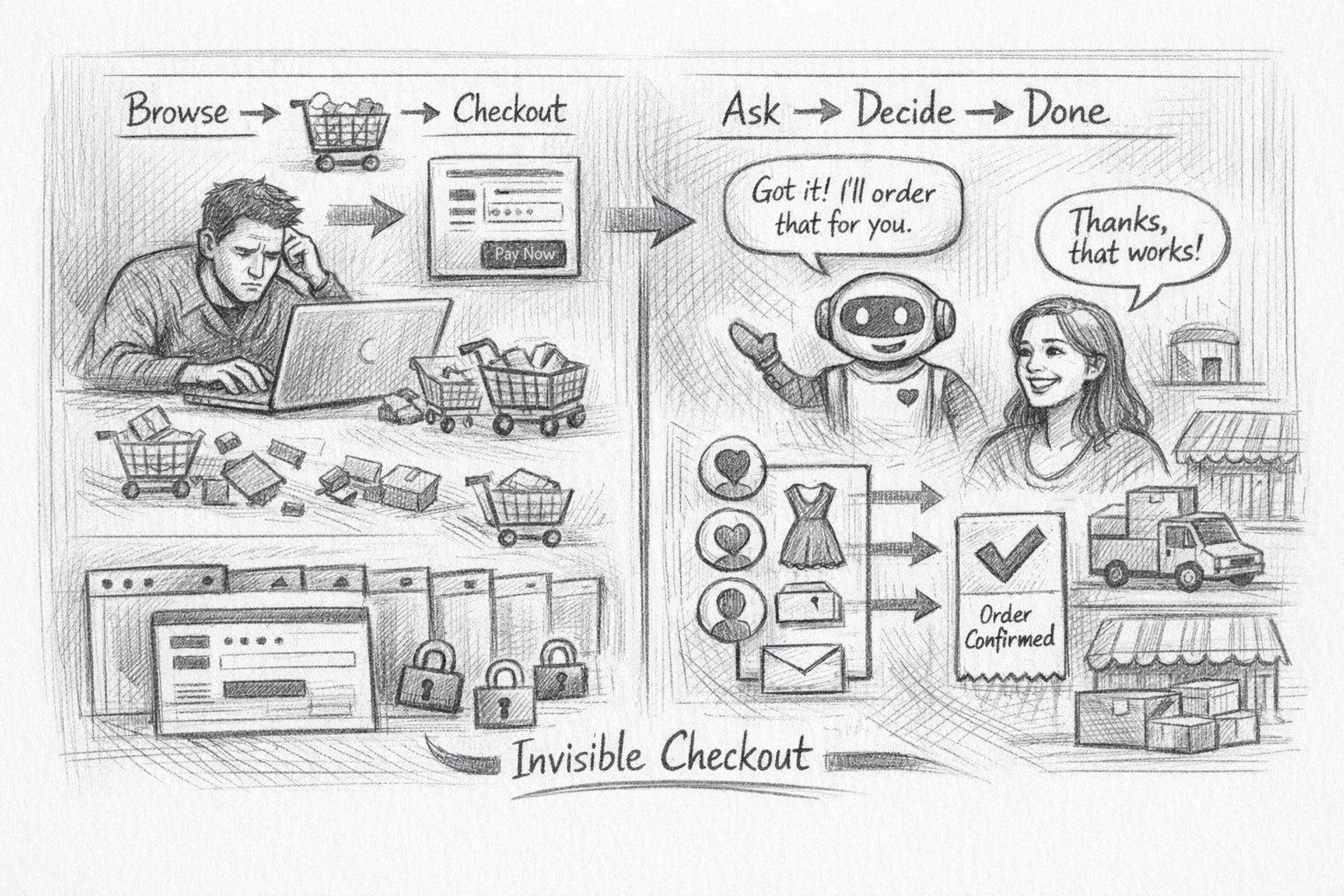
From “browse → cart → checkout” to “ask → decide → done”
Large language models are quietly collapsing the entire e-commerce funnel.
Discovery no longer starts with keywords, filters, and pagination. It begins with intent expressed in natural language.
A decision no longer means comparing 10 tabs. It means agents narrowing choices instantly.
And checkout? It’s becoming an invisible system call.
When Google talks about agents completing purchases without leaving the conversation, that’s not a UX improvement; it’s a category shift.
Checkout isn’t disappearing.
The agent is absorbing it.
Zero clicks doesn’t mean zero commerce
We’ve spent two decades optimising for clicks: CTRs, funnels, conversion rates. But agentic commerce flips the metric entirely.
0 clicks → more sales is not a paradox anymore.
In an agent-driven world:
The “page” is a conversation
The “storefront” is context
The “CTA” is trust
If an AI agent already knows:
who the customer is
what they’ve bought before
their preferences, size, budget, loyalty status
their payment credentials
Then the highest-converting interface is… no interface at all.
Just confirmation.
“Yes, that works.”
That’s it. Sale completed.
Merchants still matter, but differently
A common fear is that platforms will own the customer and squeeze retailers out. What’s interesting about Google’s direction is the opposite emphasis: merchant-of-record stays with the retailer.
That’s crucial.
In agentic commerce, power shifts from traffic ownership to relationship ownership:
Customer history
Loyalty logic
Personal pricing
Bundling intelligence
Post-purchase experience
Retailers who understand this will stop obsessing over homepage design and start obsessing over:
clean product data with Generative Engine Optimisation (GEO) on top of SEO
real-time inventory
composable pricing rules
agent-readable APIs
Your best “store designer” will be an LLM.
Payments become background infrastructure
Once agents handle intent and identity, payments become plumbing.
Think about what’s happening:
Wallets already store cards
Platforms already authenticate users
Agents already act on behalf of customers
The logical outcome is ambient payments:
No forms
No redirects
No explicit checkout page
Just consent.
This is why protocols matter. Agentic commerce only works if identity, inventory, pricing, and payments speak the same language. That’s what these new standards are really about. Not features, but coordination at scale.
Physical retail isn’t immune; it’s merging
This shift doesn’t stop online.
In-store associates are becoming agents.
Apps are becoming personal shoppers.
Stores are becoming fulfilment nodes in an AI-orchestrated network.
Imagine:
walking into a store where your agent already knows why you’re there
inventory dynamically adjusted to predicted intent
delivery options decided before you ask
Retail becomes continuous, not channel-based.
What changes now for e-commerce teams
The stack is forming quickly.
Practical shifts happening right now:
SEO gives way to answer optimisation, or Generative Engine Optimisation (GEO)
PDPs give way to structured product knowledge
CRO gives way to agent success rates
UX gives way to conversation quality
Checkout optimisation gives way to trust optimisation
The brands that win won’t be the loudest; they’ll be the most legible to machines.
Takeaway
Agentic AI isn’t just improving e-commerce.
It’s ending the era where buying is a process.
Buying becomes a moment inside a conversation.
Sales happen without clicks.
Checkout becomes invisible.
And the fastest-growing storefront in the world won’t have a URL; it will have an API.
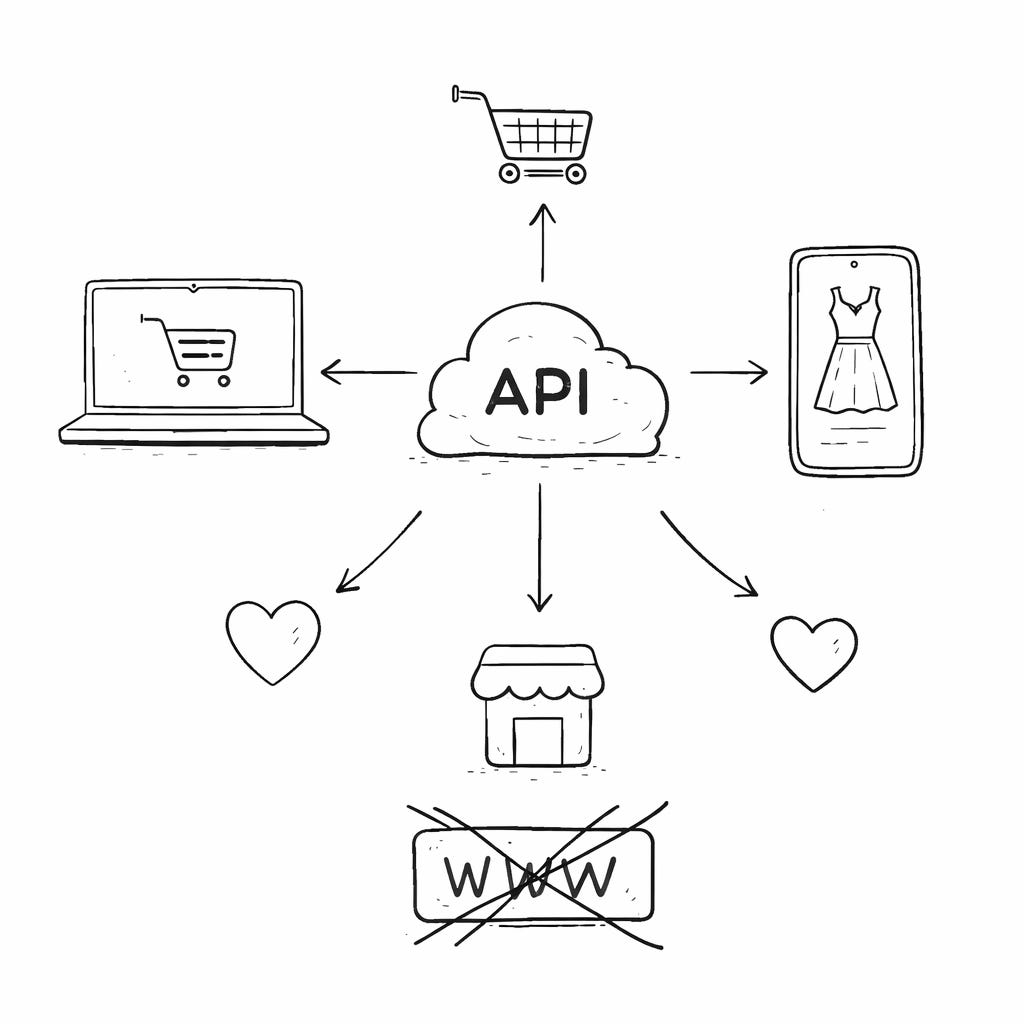
The question for retailers isn’t if this happens.
It’s whether your business is ready to sell when no one ever visits your site again.
The merchant-of-record point is a strong anchor because it shifts the conversation from interface novelty to economic control. If agents absorb discovery and purchase flow, the real moat moves into product data quality, identity resolution, pricing logic, and post-purchase trust. I would add returns to the framework too. Agentic commerce gets very powerful when the same system that buys on your behalf can also handle fit feedback, exchanges, refunds, and replenishment timing. That makes the relationship compounding on both sides of the transaction. Purchase automation is the opening chapter; service automation is where long-term loyalty likely gets decided.