

Many companies think the biggest AI models are always the best. They are not.
For specific business tasks, smaller, focused language models often outperform large ones because they are:
Faster
Cheaper to run
Easier to control
Safer for company data
More accurate for narrow jobs
Just as you would not hire a Michelin-star chef to run a tyre complaint desk, you do not need a general-purpose AI trained on everything to solve focused business problems.
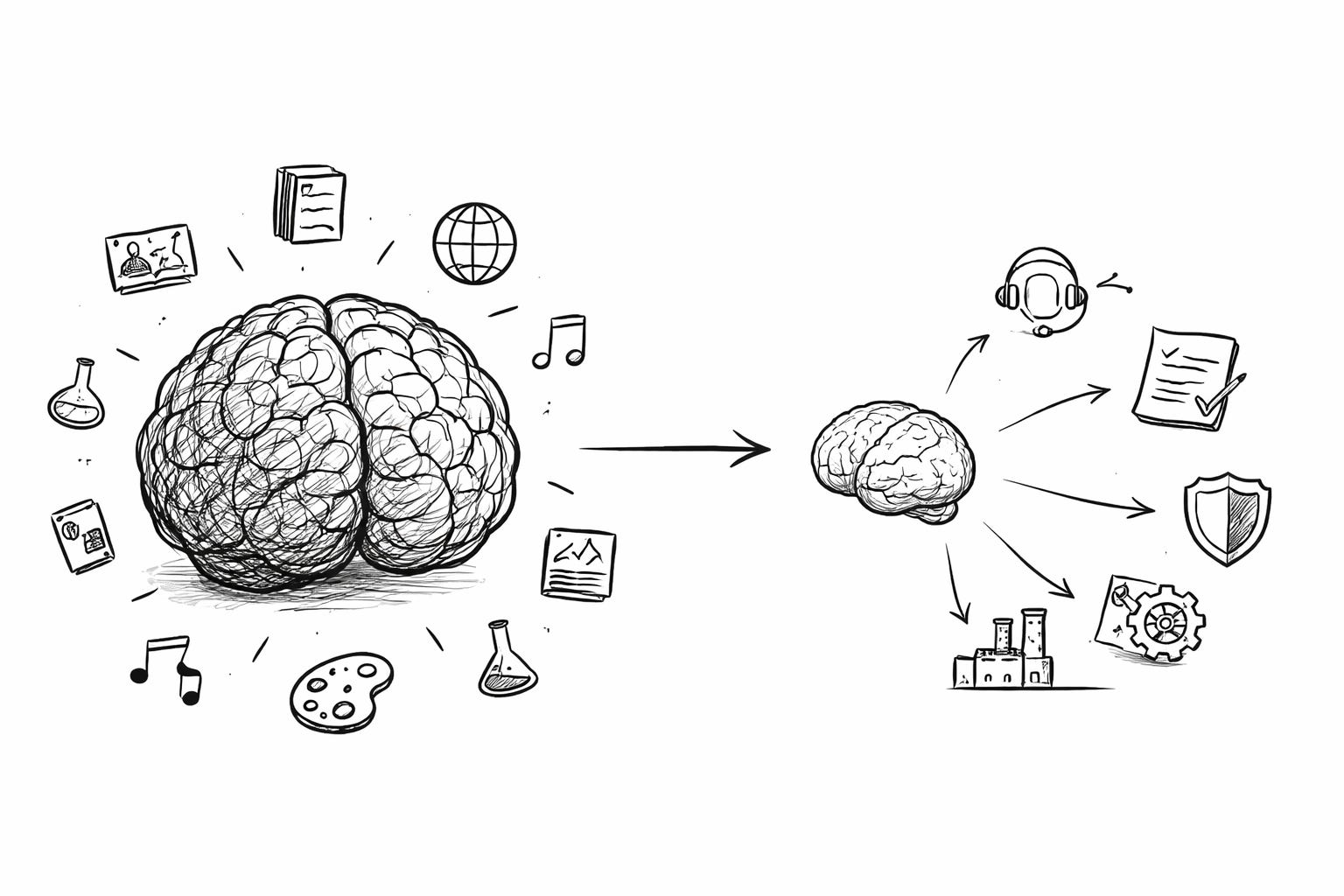
1. Why “bigger” sounds attractive — and why it’s misleading
Large Language Models (LLMs) are trained on vast amounts of internet text: books, news, code, recipes, travel blogs, and more.
They can talk about almost anything.
That sounds powerful. But in business, most use cases are not “almost anything”. They are precise:
Answer customer tickets
Classify documents
Check compliance rules
Summarise contracts
Support technicians
Assist sales teams with product facts
A large model brings a lot of knowledge you will never use, but you still pay for it in:
Higher cloud costs
Slower responses
More complex integration
Greater risk of wrong or creative answers
In business, creativity is rarely the goal. Reliability is.
2. What is a “small” language model, really?
“Small” does not mean weak. It means specialised and focused.
There are three main ways companies make models smaller and better for specific jobs:
A. Training only on what matters
Instead of learning the whole internet, the model learns only:
Your products
Your policies
Your procedures
Your technical manuals
Your past cases
This removes noise and improves accuracy for your domain.
B. Controlling behaviour with clear boundaries
Through strong system instructions (software rules), the model is told:
What it can answer
What it must refuse
How formal it should be
Which sources it must rely on
This makes behaviour predictable and compliant. It is the technique we use in GAIA, a way to control the consistency, compliance, Safety, and Relevance of answers in an environment where infrastructure and costs are zero.
C. Compressing models for efficiency
Modern techniques allow models to be compressed and optimised so they:
Run on smaller servers
Sometimes even runs on company hardware
Costs a fraction per request
You keep useful intelligence, but cut waste. It is the technique used by Multiverse, for example.
3. Why small models often perform better for business tasks
1. They are faster
Smaller models process requests more quickly.
This matters for:
Call centres
Live chat
Internal tools are used all day
Slow AI frustrates staff and customers.
2. They are cheaper at scale
Large models are affordable for demos.
They become expensive when used by:
Thousands of employees
Millions of customers
24/7 automated systems
Smaller models dramatically reduce operating costs, making AI financially sustainable.
3. They are easier to trust
Big models are trained on public data.
That means they may:
Invent facts
Use wording that does not fit your brand
Suggest actions that break policy
Smaller models trained on your data and rules are far easier to align with:
Compliance
Legal requirements
Internal standards
This is critical in regulated industries.
4. They protect your data better
With smaller, targeted models, companies can:
Run AI inside their own cloud
Sometimes on their own servers
Keep sensitive data out of public systems
In sectors like finance, healthcare, and manufacturing, this is not optional; it is essential.
4. Industry examples: where “small beats big”
🚗 Automotive: tyre and service support
Use case: answering dealer and customer questions about tyres, warranties, and service rules.
A large model knows about:
Cooking
Travel
History
Coding
Poetry
None of that helps answer:
“Is this tyre covered under warranty?”
“Which pressure applies to this model?”
A small model trained on:
Product catalogues
Warranty policies
Technical bulletins
will be:
More accurate
More consistent
Much cheaper to run
🏦 Banking: compliance checks
Use case: reviewing communications and flagging risky language.
Banks do not want creativity.
They want strict rule-following.
Small models trained on:
Regulations
Internal policies
Approved phrases
can outperform large models that try to be helpful but sometimes become “too imaginative”.
🏭 Manufacturing: technician support
Use case: helping engineers diagnose faults.
What matters is:
Equipment manuals
Known failure patterns
Safety steps
A focused model trained on those documents will:
Give precise instructions
Avoid unsafe suggestions
Work even in low-connectivity environments
No need for global general knowledge.
🏥 Healthcare administration: patient communications
Use case: appointment scheduling, forms, and instructions.
The model should:
Use approved wording
Avoid medical advice
Follow strict workflows
Small, controlled models reduce risk and legal exposure.
5. When big models still make sense
Large models are helpful when you need:
Broad research
Creative writing
Exploration of new topics
Complex reasoning across many domains
They are excellent thinking partners.
But they are rarely the best choice for:
Repetitive business processes
High-volume customer service
Compliance-driven tasks
Embedded operational tools
Most enterprise AI workloads fall into the second category.
6. A better strategy: one brain is not enough
Innovative organisations are moving towards:
Big models for exploration and innovation
Small models for daily operations
Think of it like this:
Big AI = strategy consultant
Small AI = trained specialist staff
You would not ask your consultant to answer every customer email.
And you would not ask your helpdesk to design corporate strategy.
AI should follow the same logic.
7. What executives should do next
1. Start from the business problem, not the model
Ask:
What exact task are we automating?
What knowledge is truly required?
What mistakes are unacceptable?
Then select the smallest model that can do the job well.
2. Measure total cost, not demo cost
Look beyond:
Per-request pricing
Consider:
Infrastructure
Security
Integration
Long-term usage volume
Small models often win over time.
3. Demand controllability
Ensure your AI can be:
Constrained
Audited
Updated with new rules
This is far easier with focused models.
4. Build AI like you build teams
You would not hire one person to do every job.
Do not hire one model to solve every problem.
Specialisation scales better than generalisation.
Bigger AI feels safer because it looks more powerful.
In reality, focused intelligence is what creates business value.
When the task is specific, when accuracy matters more than cleverness, and when costs and risks must be controlled, small is not just beautiful — small is better.