

TL;DR
Creative AI is leaving the prompt box and entering the canvas, workflow, team chat, and content supply chain.
Figma, Adobe, Runway, Anthropic and OpenAI all pushed AI further into everyday creative and enterprise production systems. (Figma)
The bottleneck is shifting from generation to filtering, provenance, rights, brand governance and human taste.
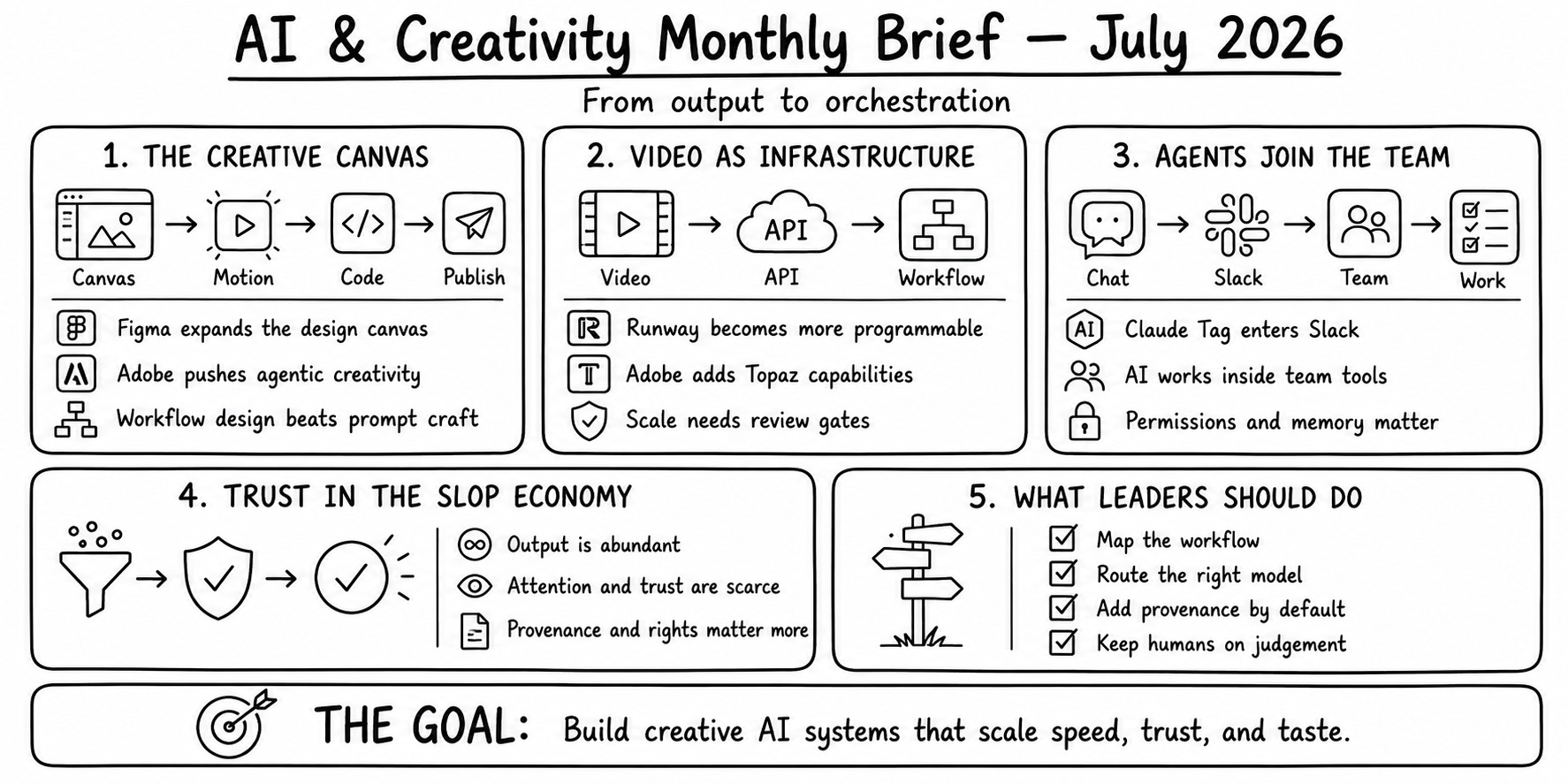
THIS MONTH’S SIGNALS
The design canvas became more agentic. At Config 2026, Figma introduced or expanded tools including Figma Motion, shader effects, generative plugins, Weave tools, Code Layers and Figma agent updates. (Figma)
Adobe moved deeper into agentic creativity. At Cannes Lions, Adobe framed itself as an agentic infrastructure layer for creativity, marketing, and customer experience; later in June, it announced plans to acquire Topaz Labs to strengthen its AI image and video enhancement capabilities. (news.adobe.com)
OpenAI previewed a tiered frontier model strategy. GPT-5.6 Sol, Terra and Luna point to a future where model choice is not just “best model”, but a routing decision across intelligence, cost, speed and risk. (OpenAI)
Agents entered the team chat. Anthropic launched Claude Tag in beta for Slack, allowing teams to tag Claude in work conversations and grant it selected access to channels, tools, and data. (Anthropic)
Video generation became more programmable. Runway added Aleph 2.0 and Seedance 2.0 Fast to its API, pushing generative video from standalone experiments toward production pipelines. (Runway API)
The rights debate kept heating up. Jamendo sued Nvidia over the alleged unauthorised use of audio files and metadata to train AI audio systems, another sign that creative rights are moving from a background issue to a boardroom risk. (Reuters)
WHAT WE PUBLISHED
AI governance & compliance
Interview: Ritesh Singhania, CEO of Zango AI — The financial scandal that hasn’t happened yet
AI in financial services has moved from adoption to supervision. The real question is no longer whether institutions use AI, but whether they can see, govern and explain it before something breaks.
Interview: Ritesh Singhania, CEO of Zango AI — The financial scandal that hasn’t happened yet

For years, the debate around artificial intelligence in financial services was framed as a question of adoption. When would banks, insurers, asset managers and fintechs move beyond experimentation and start using AI at scale?
Content abundance & trust
The (AI) Slop Economy
Production is becoming cheap. Attention is not. The new strategic skill is deciding what deserves to exist, what deserves to be distributed and what should be deleted.
The (AI) Slop Economy

The internet has always rewarded volume. More pages. More posts. More apps. More music. More books. More submissions. More everything.
Culture as a living lab
Rock in Rio’s smartest headliner is not on stage
The Smart City of Rock reframes a festival as a compressed urban system: a real-world lab for mobility, data, accessibility, energy and crowd experience.
Rock in Rio’s smartest headliner is not on stage

Halfway through Rock in Rio Lisboa 2026, the most interesting story at Parque Tejo may not be on the main stage at all.
Social media, provenance & privacy
Interview: Carlos Betancourt, CEO of MeWe — Why the Anti-Facebook Wants to Rebuild Social Media for the AI Age
As AI makes content easier to create and harder to trust, social platforms face a strategic question: can they use AI without turning users into the product?
Interview: Carlos Betancourt, CEO of MeWe — Why the Anti-Facebook Wants to Rebuild Social Media for the AI Age

At NFC Summit Lisbon 2026, one of Web3’s most culture-driven gatherings, MeWe arrived with a clear message: the future of social media should not be built around surveillance, addictive feeds or users being treated as products.
HOT TOPICS: AI × CREATIVITY
1. The creative canvas becomes the operating system
What changed: Figma moved motion, shaders, code, generative plugins and agentic workflows closer to the design surface. Adobe pushed a similar idea at enterprise scale: AI embedded across content supply chains, agencies and customer experience systems.
Why leaders should care: Creative tools are becoming orchestration environments rather than isolated apps.
Implication: The next creative advantage is not only better prompts. It is a better workflow design.
2. Video generation moves into infrastructure
What changed: Runway’s API updates and Adobe’s acquisition of Topaz Labs both point in the same direction: AI video is shifting from impressive clips to repeatable generation, editing, enhancement, and restoration. (Runway API)
Why leaders should care: Campaign variants, social assets, localisation and prototyping can become faster — but review, rights and consistency become harder.
Implication: Build approval gates before scaling video output.
3. Agents join the team
What changed: Claude Tag brings AI into Slack as a collaborator that can be mentioned, briefed and given selected context. (Anthropic)
Why leaders should care: Agents will not live only in chatbots. They will sit inside the tools where teams already coordinate.
Implication: Permissions, memory, audit trails and ownership become management design questions.
4. Copyright and provenance become creative infrastructure
What changed: The Jamendo v Nvidia case adds to the growing pressure around training data, music rights and AI-generated audio. (Reuters)
Why leaders should care: Legal uncertainty is now part of creative technology strategy.
Implication: For brand work, use traceable tools, keep source logs and separate experimentation from publishable assets.
MODELS & TOOLS TO WATCH
Figma Motion, Shaders & Weave
One-line: AI-assisted motion, visual effects and repeatable generation inside the design canvas. (help.figma.com)
Best-fit: Brand systems, campaign visuals, prototypes, social assets.
Risk: Beta maturity, governance and design consistency.
Adobe + Topaz Labs
One-line: Professional AI enhancement, restoration and on-device creative AI moving deeper into Creative Cloud. (news.adobe.com)
Best-fit: Video cleanup, archival restoration, hybrid captured/generated workflows.
Risk: Integration, pricing and rights workflows still need watching.
Claude Tag
One-line: Claude as a tagged teammate inside Slack. (Anthropic)
Best-fit: Research, team coordination, creative operations, product support.
Risk: Context access must be designed carefully.
OpenAI GPT-5.6 Sol / Terra / Luna
One-line: A tiered model family for frontier, everyday and lower-cost work. (OpenAI)
Best-fit: Complex knowledge work, coding, agentic workflows and high-ambiguity tasks.
Risk: Routing decisions become more complex.
Runway API: Aleph 2.0 & Seedance 2.0 Fast
One-line: Generative video editing and generation become more programmable. (Runway API)
Best-fit: Rapid video prototyping, campaign variants, creator tools.
Risk: Quality control, rights and consistency at scale.
WHAT TO DO NEXT
Map one creative workflow from brief to final asset. Mark where AI generates, edits, enhances, approves, stores and publishes.
Create a “no slop” rule: every AI-assisted output must either improve decision quality, reduce uncertainty or be deleted.
Build a model-routing policy: cheap and fast for drafts, frontier models for ambiguity, specialist tools for media, humans for judgement.
Add provenance by default: sources, prompts, versions, rights status and approvals.
Treat creative governance as an enabler, not a blocker.
CURIOSITIES
Deleting may become a more valuable creative act than generating.
Big creative suites are starting to look like operating systems.
Festivals, agencies and social networks are becoming live tests for AI governance.
The most human creative skill this month looked less like making everything and more like knowing what deserves to exist, for example, check our conversation with Anna Drobkha:
Interview: Anna Drobakha - Ex-Google and Ex-Apple Strategist on Why CEOs Must Stop Delegating AI
·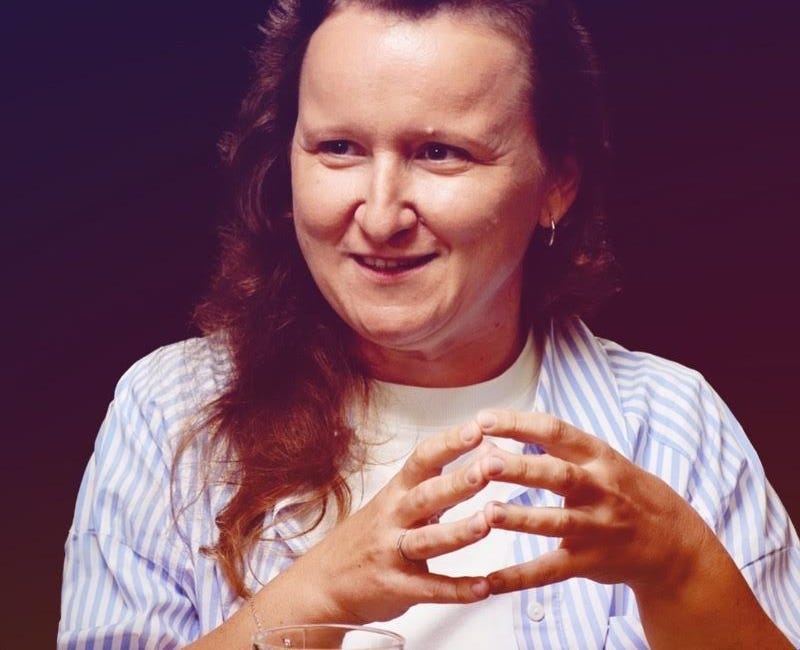
I met Anna Drobakha through a common friend from the INSEAD AI Venture Lab, and it quickly became clear why her perspective on AI transformation is so relevant for today’s executive teams.

Building Creative Machines covers AI, creativity and society — articles, interviews and open sketches on how intelligent tools are changing the way we make, manage and imagine.