

The internet has always rewarded volume. More pages. More posts. More apps. More music. More books. More submissions. More everything.
But something different is now happening.
The content machine has moved from industrial speed to automated speed. The constraint is no longer labour. It is no longer writing, coding, composing, drafting, translating or formatting. The constraint is attention. Then judgment. Then trust.
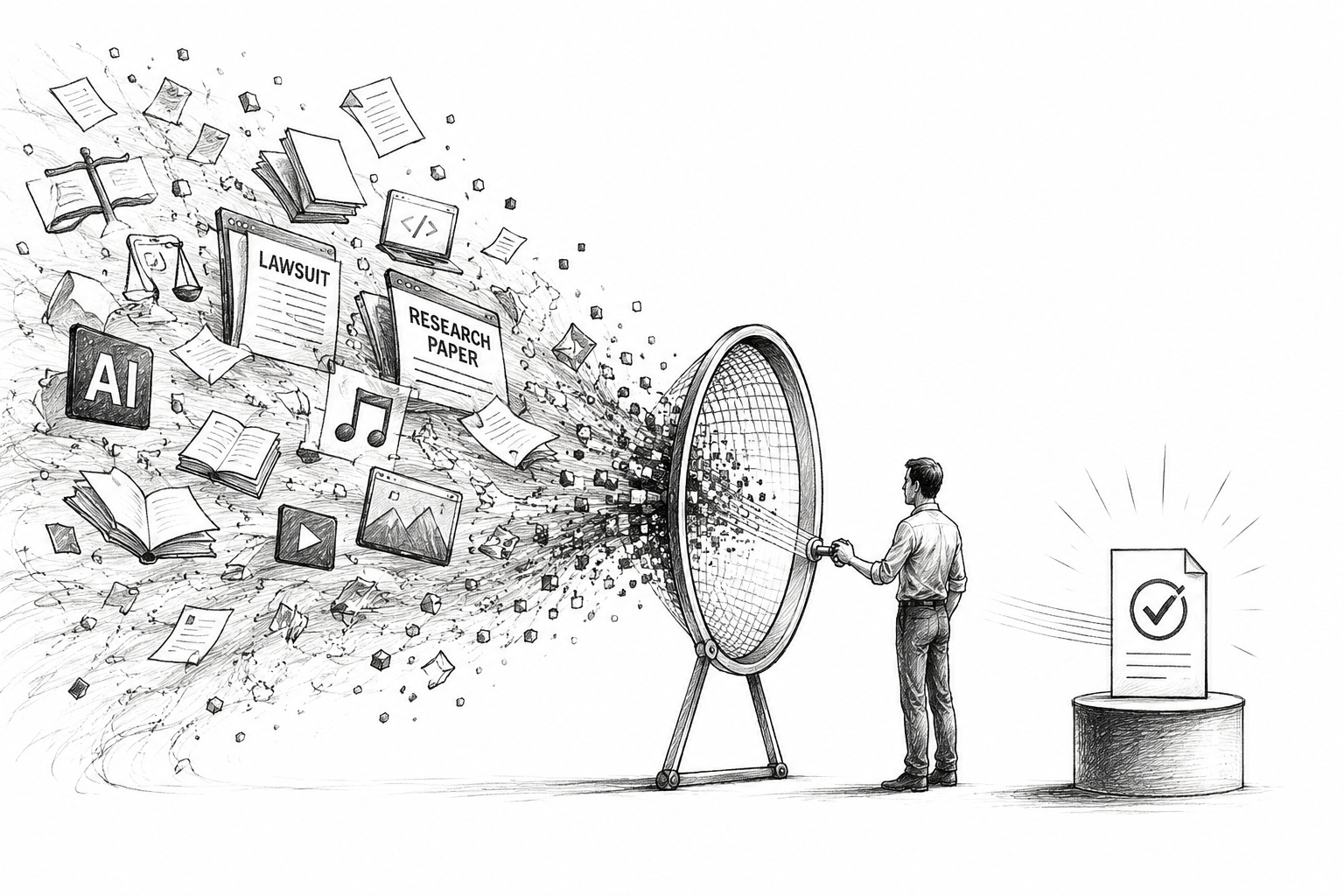
That is the real shift behind the latest numbers reported by The Economist: AI is increasing output across books, legal filings, academic papers, apps and music at a pace that human review systems were not built to absorb. E-books, lawsuits, research submissions, app releases and synthetic songs are not isolated stories. They are symptoms of the same economic event: creation has been unbundled from effort. (The Economist)
For companies, this matters more than the usual “AI will transform work” narrative.
The practical question is no longer: Can we produce more?
It is: What happens when everyone can produce more?
Because when supply explodes, value moves elsewhere.
Not to the person who makes the most.
To the person who filters best.
To the platform that can rank reliably.
To the brand that is still trusted.
To the organisation that knows what not to publish, ship or believe.
This is the beginning of the slop economy.
Not because all AI content is bad. Much of it is useful. Some of it is excellent. But because the marginal cost of producing plausible content is collapsing towards zero. And when plausible things become infinite, plausibility itself loses value.
A book that looks like a book is no longer enough.
A legal complaint that looks like a legal complaint is no longer enough.
A research paper that looks like research is no longer enough.
An app that looks like software is no longer enough.
A song that sounds like music is no longer enough.
The new premium is proof.
Proof of authorship. Proof of quality. Proof of relevance. Proof of accountability. Proof that someone competent has made a decision.
This is a very different internet from the one most businesses built for.
For the past fifteen years, the operating model was simple: create content, optimise for search, distribute across platforms, collect attention, repeat. SEO rewarded volume. Social reward frequency. Marketplaces rewarded catalogue depth. App stores rewarded experimentation. Streaming rewarded an endless supply.
AI takes that logic to its absurd conclusion.
If quantity was the game, machines win.
Deezer’s latest figures clearly show the direction. The company says nearly 75,000 AI-generated tracks are now uploaded every day, representing 44% of all new music uploaded to the platform. Deezer also says it tags AI-generated music and excludes it from some recommendation surfaces. (Deezer Newsroom)
That last detail is more important than the number.
The platform is not just asking, “How much content do we have?”
It is asking, “What should we allow into the recommendation system?”
That is the strategic question every company will face.
In a world of infinite output, distribution becomes governance.
This applies far beyond music. Every business has its own version of a recommendation system. It may be an internal knowledge base, a sales enablement library, a procurement process, a research function, a due diligence workflow, a risk model, a CRM, a product roadmap, or a board pack.
Once AI enters the system, the volume of “acceptable-looking” material rises fast.
More market maps. More investment memos. More customer insights. More policy drafts. More competitor summaries. More synthetic personas. More pitch decks. More code. More documentation. More analysis.
At first, this feels like productivity.
Then it becomes noise.
The dangerous part is that the noise is not obviously stupid. It is fluent. It is structured. It uses the right words. It appears professional. It can cite things. It can create a feeling of completeness.
This is why AI slop is more dangerous than old spam.
Spam looked cheap.
AI slop looks reasonable.
That is a problem for decision-making. Senior teams do not suffer from a lack of documents. They suffer from a lack of sharp, reliable interpretation. AI can produce a ten-page strategy memo in seconds. But the board still needs to know whether the memo is true, whether it matters, what has been missed, and what decision follows.
So the advantage moves from production capacity to editorial (curation) capacity.
The best companies will not be the ones where everyone uses AI to generate more material. They will be the ones who build strong filters around AI output.
This requires a different management discipline.
First, companies need to separate generation from publication.
AI can draft. AI can explore. AI can compare. AI can generate options. But publication — to customers, investors, regulators, employees or the market — should remain a controlled act. The more automation enters the production layer, the more deliberate the approval layer must become.
This sounds obvious. It is not how many organisations are behaving.
Much of the AI adoption is currently happening sideways. Employees use tools because they are useful. Teams quietly automate parts of their work. Agencies deliver more output at the same price. Vendors add AI features to existing products. Content volume rises, but governance does not.
That creates a hidden operational risk: the company begins to speak, decide and act through material that no one fully owns.
Second, companies need to define what must be human.
This should not be ideological. It should be practical.
Humans do not need to write every first draft. They do need to own judgement, taste, accountability, context and final responsibility.
In legal contexts, this is already visible. A recent empirical paper on US federal civil self-representation found a post-GenAI rise in self-filed civil litigation and identified AI-consistent drafting patterns in a share of complaints. The paper also found that AI-flagged complaints were not associated with improved win rates and were more likely to be dismissed earlier. (arXiv)
That is the lesson.
AI can improve access to form. It does not automatically improve access to competence.
The same applies in business. AI can make a weak strategy look formatted. It can make a shallow insight look researched. It can make a risky product spec look complete. It can make a mediocre brand sound polished.
Form is getting cheaper.
Substance is not.
Third, leaders need to stop measuring productivity only by output.
More code is not the same as better software. More campaigns are not the same as stronger demand. More reports are not the same as better intelligence. More leads are not the same as a better pipeline. More content is not the same as stronger authority.
In an AI-heavy organisation, output metrics can become misleading.
A team can look busier while creating more review burden for everyone else. A marketing function can increase publishing frequency while weakening brand distinctiveness. A product team can prototype more features while making the roadmap less coherent. A research team can produce more summaries while reducing confidence in what is actually known.
The better metric is not volume.
It is decision quality per unit of attention.
How much human attention did this consume?
Did it improve the decision?
Did it reduce uncertainty?
Did it create trust?
Did it make the next action clearer?
This is where the next wave of competitive advantage will sit.
The companies that win will build what might be called trust infrastructure.
That means labelled AI use where it matters. Clear ownership of outputs. Source discipline. Internal review standards. Audit trails. Data provenance. Strong retrieval systems. Human sign-off for high-stakes communications. And, perhaps most importantly, a culture where deleting weak output is respected.
Deletion will become a strategic skill.
The temptation with AI is to keep everything because everything was cheap to make. But cheap creation can create expensive clutter. Every unnecessary document becomes a future search result. Every mediocre deck becomes a possible reference point. Every unverified claim becomes organisational residue.
The internet is learning this at a planetary scale. Companies will experience it internally.
Knowledge bases will fill with synthetic summaries. Slack channels will fill with AI-assisted answers. Sales teams will generate endless personalised messages. Product teams will create synthetic customer feedback. Strategy teams will ask models to generate scenarios. Legal teams will review AI-assisted drafts. HR teams will produce policies, training and performance language at scale.
The question is not whether this will happen.
It is whether anyone is curating the result.
This is why the editorial function is about to become much more important inside companies. Not editorial in the narrow sense of copy-editing. Editorial as a management capability: deciding what is true enough, useful enough, distinctive enough and important enough to enter the organisation’s memory.
In the old internet, the scarce asset was content.
In the AI internet, the scarce asset is confidence.
That changes the role of brands, too.
A strong brand is no longer just a demand-generation asset. It is a filter. It tells customers, employees, partners and investors: this has been selected, checked and shaped by people with standards.
As AI content rises, the market will punish generic communication more quickly. Anything that sounds like it could have been generated by anyone will be valued as if it were. Which is to say: not much.
The irony is that AI will make human taste more commercially valuable.
Not human labour in the old sense. Not typing. Not formatting. Not producing endless first drafts. But taste: the ability to choose, reject, simplify, frame and stand behind a point of view.
The slop economy will reward firms that are slower in the right places.
Fast to explore.
Fast to draft.
Fast to test.
But slow to publish.
Slow to approve.
Slow to trust.
That balance will be hard. It runs counter to the instinct of most digital transformation programmes, which tend to equate speed with maturity. But in an environment flooded with synthetic output, speed without filtration becomes a liability.
The next management challenge is not adopting AI.
It is absorbing abundance without losing judgment.
That is the non-obvious part of the current moment. AI does not just increase productivity. It increases the cost of knowing what deserves attention.
Every executive should assume that their market is about to receive more content, more competitors, more claims, more products, more noise and more apparent expertise. Many of those things will look credible. Some will be credible. Most will not matter.
The winners will not be anti-AI.
They will be anti-slop.
They will use AI aggressively in private and selectively in public. They will generate many options and publish a few. They will automate production but protect judgment. They will treat attention as capital. They will understand that trust, not content, is the bottleneck.
The internet’s content machine has hit turbo mode.
The next advantage belongs to those who build the brakes.