

Halfway through Rock in Rio Lisboa 2026, the most interesting story at Parque Tejo may not be on the main stage at all.
It may be in the operating logic around it: in the dashboards, the pilot projects, the mobility experiments, the data layers, the university prototypes, the environmental monitoring, the waste systems, the accessibility tools, and the attempt to turn one of Europe’s biggest entertainment events into something else entirely — a temporary city, instrumented and observed in real time.
This year, Rock in Rio Lisboa is hosting the first edition of the Smart City of Rock, a new layer in the festival’s identity that reframes the event as a living laboratory for urban innovation. The idea is deceptively simple: if a city is, at heart, a machine for moving people, energy, information, waste, security and attention through a shared space, then a festival that concentrates around 100,000 people per day into a temporary urban environment is not merely a cultural event. It is a compressed civic system. A city under pressure. A test environment with very little room for abstraction.
That is the wager Rock in Rio is making in Lisbon.
Rather than treating technology as a spectacle bolted onto entertainment, the Smart City of Rock proposes something more operational: using the festival as a real-world experimentation platform where startups, public institutions, corporate partners and academic teams can test solutions in front of, and, crucially, with the general public. Rock in Rio and its partners have described the ambition in unusually expansive terms: to build a large-scale platform for experimentation around the future of cities, with potential relevance beyond the event itself.
That ambition matters because it shifts the question. The point is no longer “what tech activations are at the festival?” but what kinds of urban systems can be meaningfully prototyped in a temporary city of this scale? And just as importantly, what counts as evidence when a festival starts behaving like a civic laboratory?
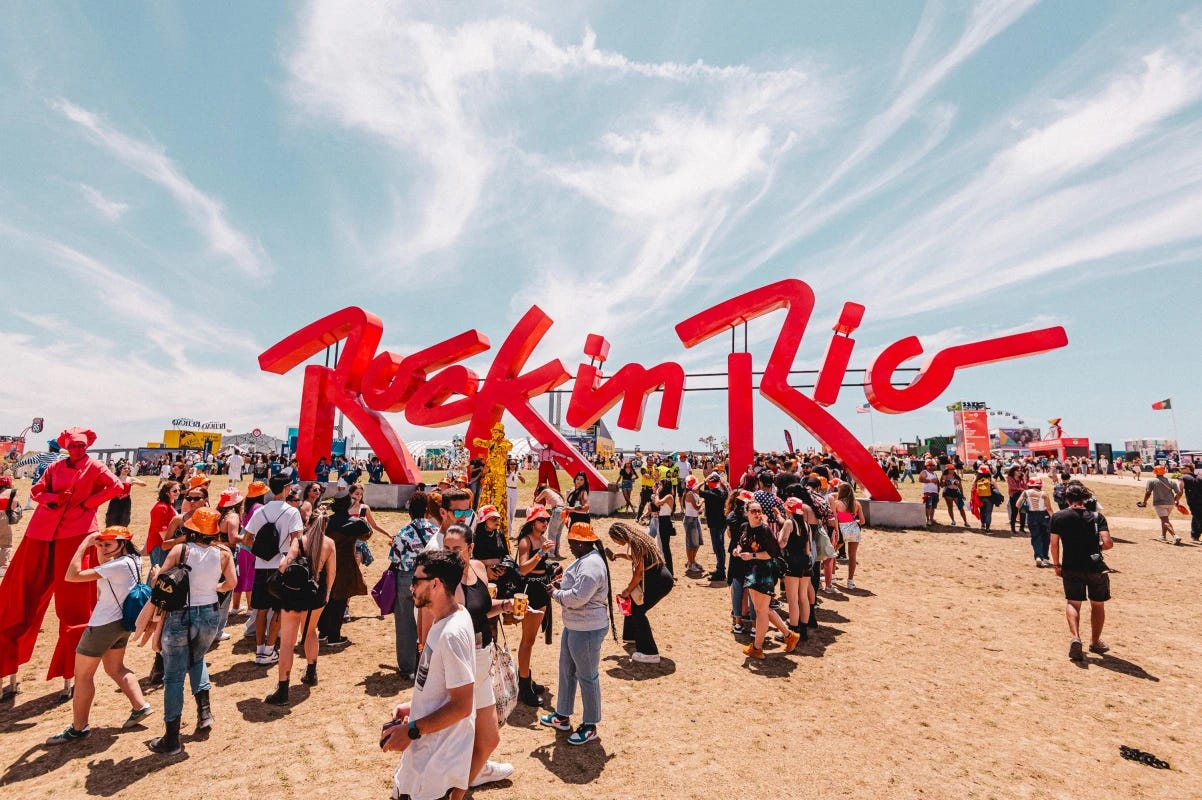
Image: Credits Rock in Rio 2026
A festival as city, not metaphor but infrastructure
Rock in Rio Lisboa 2026 runs across 20, 21, 27 and 28 June at Parque Tejo, but the Smart City of Rock asks us to look at the site through a different lens. In this framing, the Cidade do Rock is not a branded metaphor for a venue; it is a temporary urban environment with familiar metropolitan problems compressed into a few intense days: crowd flows, ingress and egress, transport coordination, public information, energy management, environmental conditions, waste, accessibility, security, operational visibility and service delivery.
This is precisely why the project is interesting.
Cities usually modernise in fragments: a mobility pilot here, a dashboard there, a sensor layer somewhere else, often isolated from public scrutiny and disconnected from a lived user experience. Festivals, by contrast, force systems to interact in public. They are dense, emotional, messy and highly time-sensitive. If something fails — signage, routing, communications, accessibility, crowd management, environmental comfort — the failure is felt immediately, physically and collectively. That makes them unusually unforgiving environments for experimentation. It also makes them unusually revealing ones.
The Smart City of Rock is being developed by Rock in Rio Lisboa with Liquid Innovation Co., with MEO Empresas as the official co-creator of this first edition, and with an ecosystem that includes Lisbon City Council, ULisboa, Unicorn Factory Lisboa, startups and technology partners. The public framing is consistent across the project’s different announcements: the festival is being used as a “living lab” in which solutions for the cities of the future can be tested at a real scale rather than simulated in a conference deck.
That distinction, between demonstration and operation, is everything.
What is actually being tested?
The Smart City of Rock is not a single technology or a single stand. It is better understood as a portfolio of pilots and operational experiments distributed across the festival ecosystem.
In April, the initiative and Lisbon City Council outlined a set of projects designed to converge data, technology and urban operations before, during and after the event. Among the most significant elements publicly described are:
an Integrated Operations Room;
a Digital Twin of the Cidade do Rock;
human flow management tools;
a public dashboard;
door-to-door accessibility initiatives;
an Urban Smart Energy Centre;
smart enforcement/monitoring mechanisms;
and urban mobility solutions aimed at optimising resources, reducing environmental impact and improving operational efficiency.
Taken together, these projects suggest that the Smart City of Rock is not only about front-of-house audience experience. It is also about the invisible municipal logic of a city: seeing, anticipating, coordinating and responding.
The digital twin is especially emblematic. In the abstract, digital twins are often sold as a glossy future-facing concept: a virtual model of a physical environment used to simulate, monitor and optimise systems. In practice, their value depends entirely on whether they help people make better decisions under pressure. At a festival scale, that pressure is real. Can a digital representation of the venue improve the management of crowd flows, mobility bottlenecks or security responses? Can it make operations more anticipatory rather than merely reactive? Those are not theoretical questions when tens of thousands of people are moving through the same space over a compressed time window.
Likewise, the emphasis on human flow management and public dashboards is revealing. Smart-city rhetoric often defaults to efficiency as an end in itself, but the most meaningful test is whether better visibility produces a better lived experience: less uncertainty, more predictability, clearer movement, more accessible navigation, faster decision-making and, ideally, less friction between operational needs and human comfort.
The project’s own language points in that direction. Lisbon City Council’s collaboration through the Centro de Gestão Integrada Urbana de Lisboa (CGIUL) positions the initiative as a practical extension of the city’s urban governance agenda, with the possibility that validated solutions could later be replicated elsewhere in Lisbon or in other cities.
That is the key strategic move here: the festival is being treated not as a one-off activation, but as a testbed with transfer value.
MEO Empresas and the politics of the stand
MEO Empresas, the official co-creator of this first Smart City of Rock, plays a central role in the project's public architecture. At the core of that role is the Smart City of Rock stand, co-created with Lisbon City Council, Unicorn Factory Lisboa, startups and technology partners. According to the partnership material, the space is designed not merely as an exhibition zone but as a multifunctional environment for demonstrations, B2B meetings, real-time content production, and the Smart Rock Tour, a guided experience through the technologies on display at the festival.
That matters because it reveals a tension at the heart of any “smart city” project staged inside a major event: Is the technology there to perform innovation or to support an operating environment? The answer, in reality, is usually both. But the credibility of the Smart City of Rock will depend on whether it can push beyond the aesthetics of innovation theatre.
The seven technology partners publicly named by MEO Empresas point to the breadth of the urban agenda being assembled inside the festival perimeter:
EVOX for smart waste management and monitoring;
Qart for environmental monitoring and urban quality analysis;
Kido for geoanalytics and territorial data visualisation;
Soltráfego for soft mobility and smart bicycles;
GEMA for immersive AR/VR experiences about Lisbon;
Inov for fire monitoring and prevention systems;
Focus for integrated smart urban management and operations.
There is a temptation, when looking at such a list, to treat it as a catalogue of verticals. Waste, mobility, environment, geoanalytics, immersive media, fire prevention, operations. But the more interesting reading is systemic. A city is not a stack of sectors; it is a coordination problem. The question is whether these layers can speak to one another in a meaningful operational loop — whether monitoring informs decisions, whether decisions change flows, whether flows alter environmental pressure, whether accessibility and information improve inclusion, whether waste systems and mobility systems are understood as part of the same urban metabolism rather than separate product categories.
In other words, the challenge is not whether the Smart City of Rock has enough technology. It is whether it can produce coherence.
The university is infrastructure, not decoration
One of the strongest aspects of this first edition is the involvement of the University of Lisbon (ULisboa) as the project’s first University Partner. That matters not because universities confer prestige, but because they can change the texture of a project: from branded demonstration to a more plural ecosystem of research, experimentation and public engagement.
ULisboa’s participation brings the language of smart cities back to concrete societal questions: energy, water, health, climate, accessibility, robotics, entrepreneurship and public-facing science. Throughout the festival, the university is presenting projects from its faculties and research ecosystem, explicitly using the event as a context for a broad public to encounter prototypes and ideas.
Ciências ULisboa is listed as participating in Smart City of Rock 2026 with the following projects:
Agrovoltaico, combining photovoltaic electricity generation with plant and animal production and smart irrigation systems;
BinBot, an autonomous robot designed to collect litter at large public events;
Phair-Earth, combining physical and AI-based algorithms to predict extreme weather events;
AquaInSilico, software for the efficient management of wastewater treatment plants and related infrastructures;
SATO, a platform for smart domestic energy control and management;
CityPark, integrating mobile-device and sensor data to generate indicators related to cognitive and motor functions;
and Boxing for the visually impaired, an inclusive game using 3D audio and haptic feedback.
This list is more than a showcase of university ingenuity. It exposes a deeper point about the Smart City of Rock: the city of the future is not a single sectoral problem. It is a bundle of interlocking questions about energy, climate resilience, waste, water, health, inclusion and information design. By bringing research projects into a festival setting, Rock in Rio is effectively testing another proposition, too: that public understanding of urban innovation does not have to occur in municipal reports, startup demo days, or policy conferences. It can happen in a mass cultural event, in public, in contact with people who did not arrive expecting a seminar on wastewater optimisation or climate prediction.
That is not a trivial cultural shift. It is one of the more compelling aspects of the whole experiment.
The city as audience, the audience as dataset
Smart-city discourse often struggles with a central contradiction: it talks about people, but it is usually built from a systems perspective. Rock in Rio complicates that in useful ways because a festival audience is not an abstract “citizen layer”; it is a moving, sweating, queueing, waiting, spending, searching, deciding public. It behaves collectively, but not predictably. It is there for pleasure, not compliance. It will not tolerate friction simply because the dashboard looks elegant.
This is why the festival is such a hard test environment.
The Smart City of Rock operates in a context where logistics, comfort, inclusion, and emotion are tightly coupled. Mobility is not a spreadsheet problem when tens of thousands of people arrive and depart on the same day. Waste is not a sustainability slogan when bins overflow in a high-density environment. Accessibility is not a policy checkbox when a venue must actually work for different bodies under time pressure. Real-time information is not a nice-to-have when uncertainty can compound stress, delays or unsafe crowding.
The project’s language around public dashboards, flow management and accessibility suggests an awareness of this. But the real significance lies in the method: the audience is not just watching a smart-city demonstration; it is, in effect, participating in a city-scale experiment in usability and operations.
That should also make us cautious.
The phrase “living lab” has become a familiar one in innovation circles, often used so loosely that it loses meaning. A living lab is not simply a place where technology is present while people are nearby. It should imply a more demanding compact: real-world testing, observable use, feedback loops, measurable learning, and some clarity about what success and failure look like. If the Smart City of Rock wants to matter beyond festival PR, that is the bar it will ultimately need to meet.
What success would actually look like?
At the halfway point of the festival, it is too early to claim outcomes that have not yet been publicly evidenced. That matters. Smart-city projects are often oversold in advance and under-evaluated afterwards. The most useful stance, for now, is not hype but scrutiny.
So what should we be looking for when the lights go down on the final day?
Not a generic statement that innovation happened. Not a reel of activations. Not the familiar language of disruption.
The more meaningful questions are narrower and harder:
Did the operational tools materially improve the management of crowd flows, mobility, accessibility or service response?
Did the digital twin and integrated operations capability help teams make better real-time decisions?
Did the public-facing layer — dashboards, tours, interfaces, experiences — actually help visitors understand or navigate the environment more effectively?
Did startups and research teams obtain usable validation, rather than mere exposure?
Did the collaboration between the festival, the municipality, academia, and corporate partners produce insights that are plausibly transferable to Lisbon beyond the festival perimeter?
And perhaps most importantly: what will be published, shared or learned once the festival ends?
That final question is where many innovation narratives quietly collapse. A testbed only matters if the testing generates knowledge that survives the event.
A different kind of festival ambition
Rock in Rio has always understood scale. What is more interesting in 2026 is its attempt to convert scale into urban relevance.
The Smart City of Rock is, at one level, an extension of the festival economy’s familiar logic: partnerships, brand platforms, audience engagement, cultural visibility. But at another level, it is trying to do something more difficult. It is asking whether a festival can become a serious urban prototype — a place where city technologies are not just advertised but trialled, where research leaves the campus, where municipal logic becomes legible to the public, and where entertainment infrastructure becomes a site for thinking about how cities actually work.
There is something fitting about this happening in Lisbon, a city that has spent the past decade refining its international identity through tourism, entrepreneurship, tech events and urban reinvention, while also facing the harder structural questions that all cities face: mobility, resilience, inclusion, public services, environmental pressure and the governance of rapid change. The Smart City of Rock does not solve those questions. No festival could. But it does offer a sharper proposition than the average branded innovation zone: what if the city of the future is not first imagined in a white paper, but stress-tested in public?
At its best, that is what this first edition could become.
Not a futuristic backdrop for a music festival, but a civic rehearsal space: a place where urban systems are made visible, where prototypes are exposed to real conditions, where public institutions, researchers, startups and operators share the same temporary terrain, and where the city is understood not as a static backdrop for culture, but as a living system that culture can help prototype.
Halfway through Rock in Rio Lisboa 2026, that remains the most ambitious idea on site.
And unlike a headline act, it is still on stage next weekend.
Reporting note: This article is based on public information available during Rock in Rio Lisboa 2026 and on interviews conducted last weekend in person during the event, while the festival is still underway. It reflects the announced structure, partners and pilot initiatives of the Smart City of Rock, rather than post-event impact claims, which should be evaluated once the full festival cycle is complete.