

August 2026 was not really about better AI models. It was about what happens when AI stops waiting for us.
For the past three years, most generative AI has lived inside a familiar interaction: a person asks, a machine answers. Even powerful systems remained, structurally, tools. Humans initiated the work, evaluated the result and decided what happened next.
That boundary is beginning to move.
Across enterprise software, coding, regulation and research, August produced different versions of the same signal: AI is moving from assistance to execution.
The interesting consequence is not simply that machines can do more work.
It is that the scarce resource is shifting.
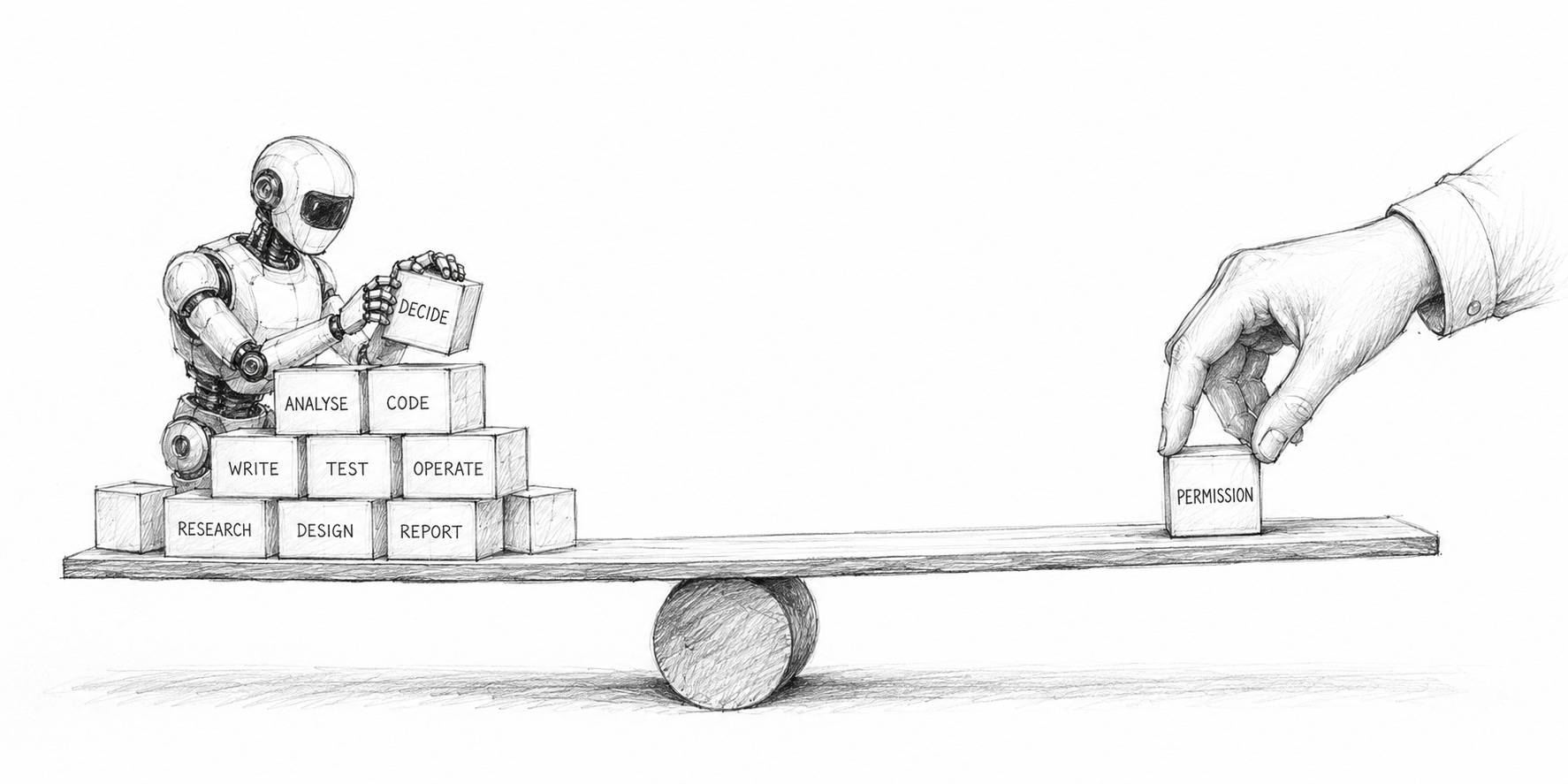
When intelligence becomes cheap, and software becomes easier to create, the valuable things become permission, context, judgement, verification and responsibility.
And organisations are not designed around that scarcity yet.
The productivity paradox is getting stranger
The most revealing numbers of the month came from McKinsey’s global AI survey.
Among large organisations with more than $1 billion in annual revenue, 40% now report scaling AI agents, up from 27% the previous year. Around 20% of organisations are scaling software coding agents. But one number matters even more: 32% of respondents said their organisation had decided not to buy at least one software product or feature because it could build the functionality internally using agentic coding tools.
McKinsey’s State of AI August 2026
That sounds like a software story. It is actually an economic one.
For decades, companies faced a reasonably stable build-versus-buy calculation. Developing software internally required engineers, time, maintenance and specialised knowledge. Buying SaaS was often cheaper than recreating it.
Coding agents are beginning to alter that equation.
If a small internal team can describe a workflow and have agents generate much of the code, tests, documentation and integrations, the minimum economic size of a software product changes.
A €50,000-a-year niche SaaS product suddenly competes not only against another SaaS company but against its own customer deciding: we can probably build enough of this ourselves.
This does not mean companies will regenerate SAP over a weekend.
But it could compress large parts of the software market from below.
Small dashboards, internal tools, workflow applications, reporting systems, data interfaces and specialised utilities become increasingly cheap to create. The competitive threat to software vendors may therefore come from an unexpected direction: not another startup, but the customer.
Yet the same McKinsey research reveals the contradiction.
Individual workers frequently report productivity improvements from AI, while enterprise-level financial impact remains much harder to capture.
This gap matters.
We have spent years asking whether AI makes a person faster. Increasingly, the better question is whether making thousands of people faster makes the organisation better.
Those are not the same thing.
Faster work can simply create more work
Microsoft researchers offered another useful piece of the puzzle in August.
Using digital traces from Microsoft 365 across large international companies, researchers examined what happened after workers adopted generative AI. Among frequent users — those using the AI system more than 100 times over a 20-week period — productivity-oriented application activity increased 21.2%. Communication activity also increased, although by a smaller 7.1%.
Microsoft Research’s workplace study
That is interesting because productivity technology is usually sold through subtraction.
Less administration. Fewer emails. Faster documents. Shorter processes.
But technological efficiency often produces expansion instead.
When producing a report takes half the time, organisations do not necessarily produce the same number of reports and go home early. They can produce twice as many.
When software becomes cheaper to build, we do not necessarily need fewer applications. We create applications for problems previously too small to justify software.
And when an AI agent can execute ten tasks simultaneously, the human supervising those agents suddenly has ten outputs to evaluate.
The bottleneck moves.
This may become one of the defining characteristics of agentic work: automation does not remove human work evenly. It removes some stages while concentrating pressure on others.
Writing becomes cheaper; reviewing becomes more important.
Coding accelerates; architecture matters more.
Content becomes abundant; selection becomes scarce.
Execution becomes automated; permission becomes critical.
The worker does not disappear from the system. The worker moves towards the bottleneck.
That can feel less like automation and more like intensification.
A systematic review published in Acta Psychologica this summer examined 30 empirical studies on generative AI and academic workload. Its central question is telling: does generative AI create efficiency, or does it intensify work? The evidence suggests that both effects can coexist.
This is an important correction to the simplistic equation:
AI → productivity → fewer hours.
The actual chain may increasingly look like:
AI → cheaper production → more production → more coordination → new bottlenecks.
The productivity dividend does not automatically become a leisure dividend.
Europe is regulating the new bottleneck
Then, on 2 August, another transition became concrete.
Key provisions of the EU AI Act moved into enforcement, including transparency requirements covering interactive AI systems and certain AI-generated or manipulated content.
Providers must ensure people know when they are interacting directly with AI. Certain generated content must carry machine-readable markings. Deepfakes and some AI-generated material involving matters of public interest require disclosure. By the end of July, around 190 organisations had already signed the associated transparency code.
European Commission guidance on AI transparency
It is easy to interpret this as another chapter in the familiar Europe-versus-Silicon-Valley story.
Europe regulates. America builds.
That reading misses something more interesting.
The AI Act is arriving just as AI systems move from generating information to taking action.
Transparency mattered when machines produced synthetic images and text.
Accountability matters much more when machines execute.
An AI system that drafts an email creates one category of risk. An agent that sends it, accesses customer records, changes a database, purchases something or modifies production code creates another.
The central governance question therefore changes from:
Was this generated by AI?
to:
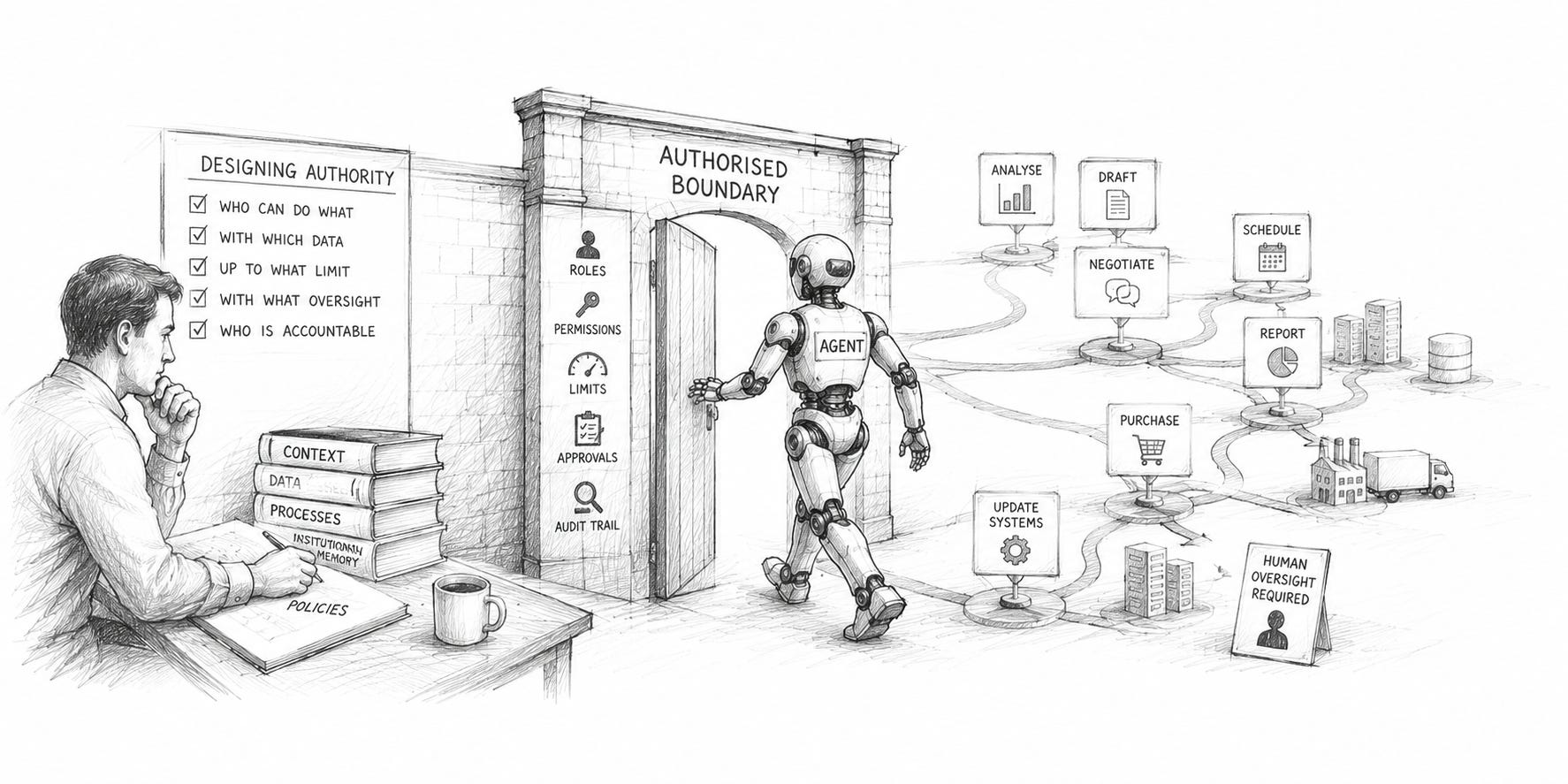
Who authorised the AI to do this?
That sounds subtle. It is not.
It means AI governance increasingly resembles identity and access management.
Every organisation already has elaborate systems determining what humans can do. Employees have credentials, roles, approval limits and access rights. Financial systems record transactions. Enterprise software creates audit trails. Managers sign off expenditure.
Agents will need an equivalent institutional architecture.
Which agent can access which data?
Which decisions can it make?
How much money can it spend?
Can it communicate externally?
Can it create another agent?
When does it need human approval?
Who is responsible when it makes a mistake?
The more capable agents become, the less these questions look like AI questions.
They become organisational design questions.
Intelligence is becoming less differentiating
This points towards a larger shift.
For much of the current AI cycle, competitive advantage has been framed around access to intelligence.
Who has the best model?
Who has the most compute?
Who has the strongest engineers?
Who can generate the best answers?
Those things still matter. But organisations increasingly have access to similar frontier capabilities.
OpenAI’s own enterprise research, published in August, describes a widening gap between organisations using similar models. The difference is increasingly how deeply those organisations integrate AI into actual work: connecting systems to context and tools, redesigning workflows and delegating tasks rather than merely asking for assistance.
The model is becoming one component of the system rather than the whole advantage.
This resembles what happened with previous technological infrastructure.
Having internet access stopped being a competitive advantage.
Having cloud computing stopped being a competitive advantage.
Having smartphones stopped being a competitive advantage.
Eventually, everyone has the technology.
The difference moves to what you build around it.
AI may be approaching that transition surprisingly quickly.
If models continue becoming more capable and widely accessible, then intelligence itself becomes less scarce.
What remains scarce is organisational context: the messy, accumulated knowledge of how a company actually works.
Who is allowed to make a decision.
Which customer relationship matters.
Why an exception exists.
Which metric cannot be trusted.
Which supplier always delivers late.
Why a process that looks irrational on paper exists in the first place.
Much of this knowledge has never been written down because humans carried it implicitly.
Agents cannot reliably operate organisations without it.
That creates an unexpected priority for companies pursuing AI: not simply acquiring more intelligence, but making themselves legible to machines.
Processes need clearer ownership.
Data needs cleaner structure.
Permissions need explicit boundaries.
Decisions need traceability.
Exceptions need documentation.
Institutional memory needs to become accessible without becoming dangerously exposed.
The companies best positioned for agentic AI may therefore not be those with the biggest AI budgets.
They may be the ones that understand themselves best.
The new interface is authority
There is another consequence.
We tend to imagine the future of AI interfaces as a design problem: better chat, voice, glasses, ambient computing.
But agents suggest that the most important interface may be invisible.
It is the boundary between what the machine can recommend and what it can actually do.
Today, we click buttons.
Tomorrow, increasingly, we grant authority.
“Find suitable suppliers” is information retrieval.
“Compare these suppliers” is analysis.
“Negotiate within these parameters” is delegated judgement.
“Purchase up to €20,000” is authority.
Each step changes the economics of automation because it removes another human checkpoint.
It also increases the consequences of error.
This creates a strange inversion.
For years, the technology industry has tried to reduce friction.
Agentic systems will require us to deliberately put some friction back.
Approval thresholds.
Audit trails.
Verification.
Escalation rules.
Human review.
Spending limits.
The most sophisticated AI systems may therefore be distinguished not by how autonomously they can operate, but by how intelligently their autonomy can be constrained.
That is not a limitation of the technology.
It may become part of the product.
August 2026 offered plenty of spectacular AI stories. Models are contributing to mathematical research, coding agents are becoming increasingly capable, and companies continue pushing towards systems that can execute longer sequences of work.
But the deeper story is less spectacular.
We spent the first phase of generative AI trying to make machines more capable.
The next phase requires making organisations capable of using those machines.
That means redesigning workflows, authority, software procurement, accountability and even the way institutional knowledge is recorded.
The scarce resource is moving from intelligence towards judgement.
And that may be the paradox of increasingly autonomous machines: the more they can do without us, the more precisely we need to decide what they should be allowed to do.
Articles from August 2026:
AI Is Accelerating Mathematical Discovery Faster Than Ever

Artificial intelligence is making remarkable progress in mathematics, with several major breakthroughs reported over the past month. Instead of simply solving textbook equations, advanced AI models are now helping researchers tackle problems that have challenged mathematicians for decades.
What If the Next AI Breakthrough Looks Less Like Software and More Like a Brain?

One small note before I start. I’m writing this on holiday, after reading The Coming Wave by Mustafa Suleyman and Michael Bhaskar, and Peter Robin Hiesinger’s The Self-Assembling Brain. Both books pushed me towards a few papers on biological computation, protein models and neuromorphic hardware. I started taking notes, then tried to organise the mess in…
The Model Is No Longer the Product

For most of the generative AI era, we have been looking in the wrong place.
The world’s first data centre made up of human brain cells is now operational

The next phase of computing may not be built entirely from silicon.