

For most of the generative AI era, we have been looking in the wrong place.
We looked at the model.
Which one is smarter?
Which one writes better?
Which one reasons longer, generates faster, costs less, has more parameters, a larger context window, better benchmarks?
Those questions mattered.
They still do.
But increasingly, they are not the questions that decide whether AI creates any value at all.
A company can have access to an extraordinary model and still build a terrible AI system.
A creator can have the best image generator in the market and still make forgettable work.
An agent can reason brilliantly and still send the wrong email.
A business can automate thousands of tasks and still have no idea whether the output is accurate.
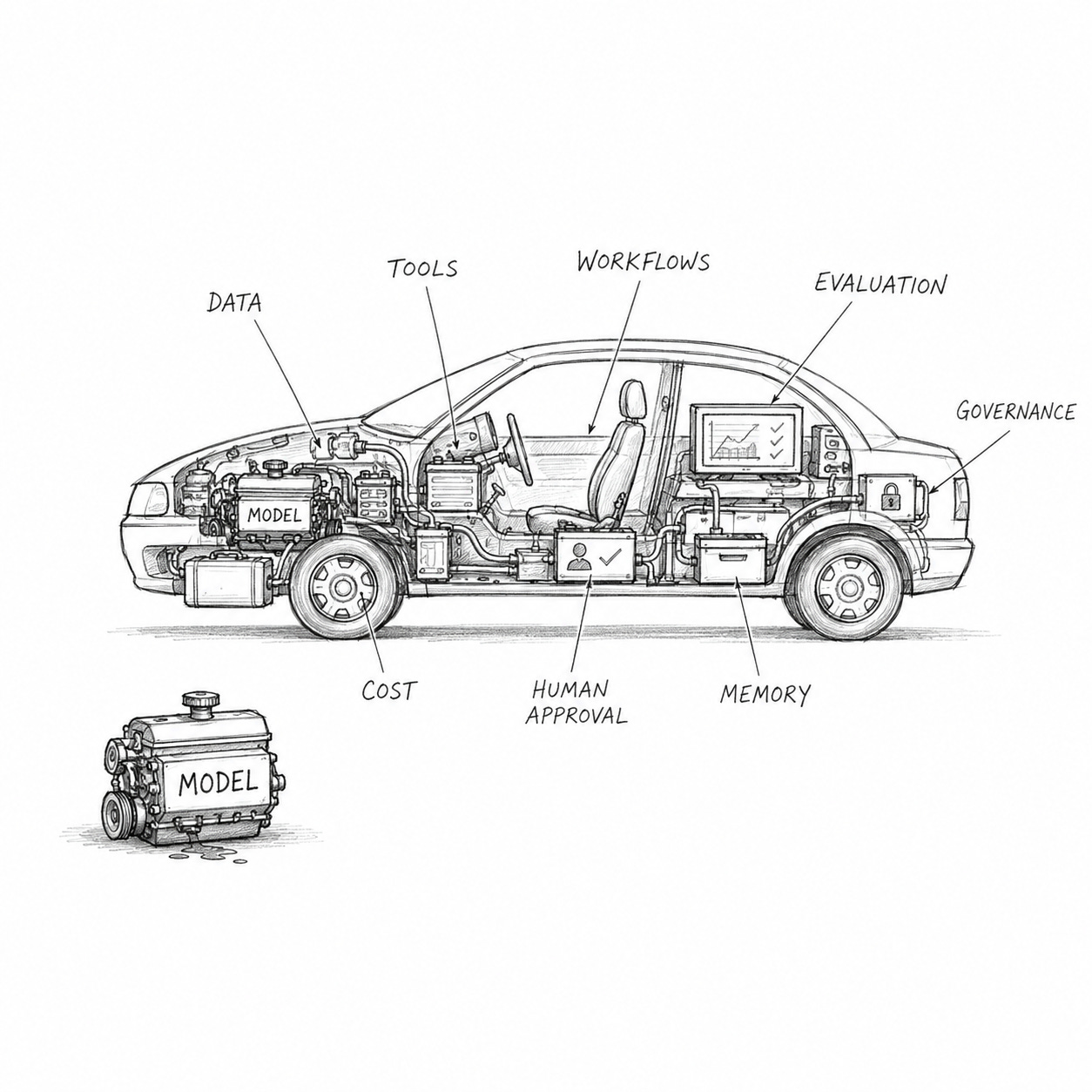
The model is becoming one component inside something much bigger.
And that changes almost everything.
We spent three years confusing intelligence with the product
ChatGPT made the confusion understandable.
You typed something.
Intelligence appeared.
The interface and the model felt almost like the same thing.
Then the industry started pulling them apart.
Models became APIs.
APIs became agents.
Agents received tools.
Tools connected to company data.
Company data connected to workflows.
Workflows connected to customers, payments, contracts, designs, campaigns and decisions.
Suddenly, model quality was only one variable.
Now the questions sound different.
What information can the AI access?
What happens when that information is wrong?
Which actions can it take?
Who approves them?
What does one successful task cost?
How do you know when performance deteriorates?
What happens after a failure?
Who is accountable?
These sound like boring questions compared with artificial general intelligence.
They are also the questions that determine whether the thing works.
The AI stack is swallowing the model
Look at what has happened across AI in 2026.
The interesting movement is no longer confined to bigger frontier models.
Small models are becoming useful because many business problems do not require a synthetic Einstein.
Self-hosted systems matter because control can be more valuable than raw intelligence.
Agents matter because AI is moving from answering questions to performing work.
MCP and other connection layers matter because intelligence without access to tools remains trapped inside a conversation.
Compute matters because latency, throughput and cost eventually arrive on somebody’s budget.
Governance matters because autonomous execution increases both output and blast radius.
Evaluation matters because a model producing a plausible answer is not the same thing as a system producing a correct result.
And provenance matters because when machines can produce almost anything, knowing where something came from becomes part of its value.
None of these developments makes the model irrelevant.
They put it in its proper place.
The model is the engine.
Nobody buys a car because the engine exists.
Intelligence is cheap. Consequences are expensive.
This may be the more useful way to understand the current phase of AI.
Generating has become cheap.
Writing is cheap.
Images are cheap.
Code is cheaper.
Music is getting cheaper.
Analysis is getting cheaper.
Experiments are cheaper.
Even starting a company can be cheaper.
But the world on the other side of that generation has not become cheap.
Attention remains scarce.
Trust remains slow.
Distribution remains difficult.
Customers remain unpredictable.
Regulation still exists.
Reputation can still disappear in an afternoon.
A bad contract clause still matters.
A false financial number still matters.
An offensive campaign still matters.
A security breach definitely still matters.
AI dramatically reduces the cost of producing an action.
It does not necessarily reduce the cost of that action being wrong.
In some cases, it does the opposite.
Automation gives mistakes distribution.
This is why the smallest model can beat the smartest one
Technology has an instinct to buy maximum capability.
If Model A scores higher than Model B, use Model A.
That is increasingly poor system design.
Imagine a company processing one million simple classifications every month.
The best model in the world may perform the task beautifully.
A smaller model may do it just as well.
But faster.
Locally.
At a fraction of the cost.
With predictable latency.
Perhaps with better privacy.
The important benchmark is no longer simply:
Which model is best?
It is:
Which system produces the required outcome, reliably, at an acceptable cost and risk?
That sentence is much less exciting.
It is also how technology becomes infrastructure.
We did not build the internet by running every computation on the most powerful computer available.
AI will not scale that way either.
Agents make this impossible to ignore
A chatbot can be wrong and annoy you.
An agent can be wrong and do something.
That distinction deserves more attention than another leaderboard.
Once AI can browse, buy, publish, edit files, call APIs, contact suppliers, write code or move information between systems, intelligence acquires consequences.
Now permissions become product design.
Logs become product design.
Escalation becomes product design.
Memory becomes product design.
Human approval becomes product design.
Even knowing when not to use AI becomes product design.
The most impressive agent demo is therefore often the least interesting part of an agent deployment.
The interesting part begins the following morning.
Did it complete the job?
Did it complete the right job?
How much did it cost?
What did it touch?
What changed?
Can someone explain why?
Would you allow it to do the same thing 100,000 times?
That last question is useful.
If the answer is uncomfortable, you probably have a demo, not a system.
The same rule applies to creativity
Creative AI initially looked like a production revolution.
And it is one.
We can make more images, videos, songs, interfaces, campaigns and variations than any creative team could reasonably consume.
Which creates a strange outcome.
Production becomes less valuable precisely because we can produce so much.
The scarce layer moves elsewhere.
Taste.
Selection.
Direction.
Memory.
Context.
Restraint.
A sense of what deserves to exist.
This is why AI slop is not simply a quality problem.
It is a system problem.
If a creative machine is optimised to generate more, it will generate more.
If a marketing organisation rewards volume, AI will give it extraordinary volume.
If an algorithm rewards engagement, machines will learn to feed the algorithm.
Nothing in that loop necessarily rewards meaning.
The problem is not that AI has no creativity.
The problem is that abundance has no editor.
Brands face exactly the same problem
A brand used to control a relatively small number of surfaces.
Its website.
Its stores.
Its advertising.
Its packaging.
Its social channels.
Now an increasing part of the relationship between a company and the world is mediated by machines.
An AI may describe your product.
Compare it with a competitor.
Recommend it.
Reject it.
Summarise customer reviews.
Explain its price.
Answer questions about its sustainability claims.
Eventually, it may purchase it.
This is where GEO becomes more interesting than an SEO acronym.
Generative Engine Optimisation is really an information architecture problem.
Is your organisation understandable to machines?
Are your facts consistent?
Can claims be verified?
Can a model distinguish current information from something published three years ago?
Does the web contain enough reliable evidence for an AI system to represent your company accurately?
For twenty years, brands tried to make themselves visible to search engines.
Now they also need to make themselves legible to reasoning systems.
That is a bigger change.
Europe’s AI question is also a systems question
The same pattern appears at continental scale.
It is tempting to reduce the AI race to models.
Who has the European OpenAI?
Where is Europe’s Gemini?
But models sit on infrastructure.
Infrastructure sits on energy, chips, capital, regulation, research, talent, data and institutions.
That is why supercomputers such as MareNostrum matter.
Not because 5,000 GPUs make a good photograph.
Because access to compute determines which experiments can exist.
Sovereign AI is not simply about putting a flag on a language model.
It is about having enough of the stack to make meaningful choices.
The same is true in India, where local-first systems make an important point: “best model” is meaningless without asking best for whom, for what language, for what documents, under what conditions.
Global intelligence still meets local reality.
Local reality usually wins.
AI governance is not the department that says no
This also explains why governance has become such a persistent theme.
Governance is often presented as friction.
A committee.
A policy document.
A compliance requirement.
Something added after innovation has happened.
That view becomes absurd once AI starts acting inside real systems.
Good governance is part of the machine.
It determines what an agent can access.
What requires human approval.
Which data can leave an organisation.
How outputs are evaluated.
How incidents are recorded.
When systems should stop.
Who carries responsibility.
If you remove those things, you have not created a more innovative system.
You have created an incomplete one.
Brakes do not make cars slower inventions.
They make speed usable.
AI governance has a similar job.
Humans are moving up one level
Another thread connects all of this.
People are not disappearing from these systems.
Their position is changing.
When execution was expensive, humans spent enormous amounts of time executing.
Writing the document.
Formatting the presentation.
Searching the database.
Producing ten concepts.
Sending updates.
Checking spreadsheets.
Creating variations.
AI can absorb pieces of that work.
What remains is less visible but more consequential.
Choosing the objective.
Defining the constraints.
Designing the loop.
Deciding what good looks like.
Recognising when the metric is wrong.
Understanding the customer.
Taking responsibility.
Saying no.
Changing direction.
Having taste.
This is not automatically good news for every job.
Some roles will shrink.
Some tasks will disappear.
Some organisations will need fewer people to produce the same amount of work.
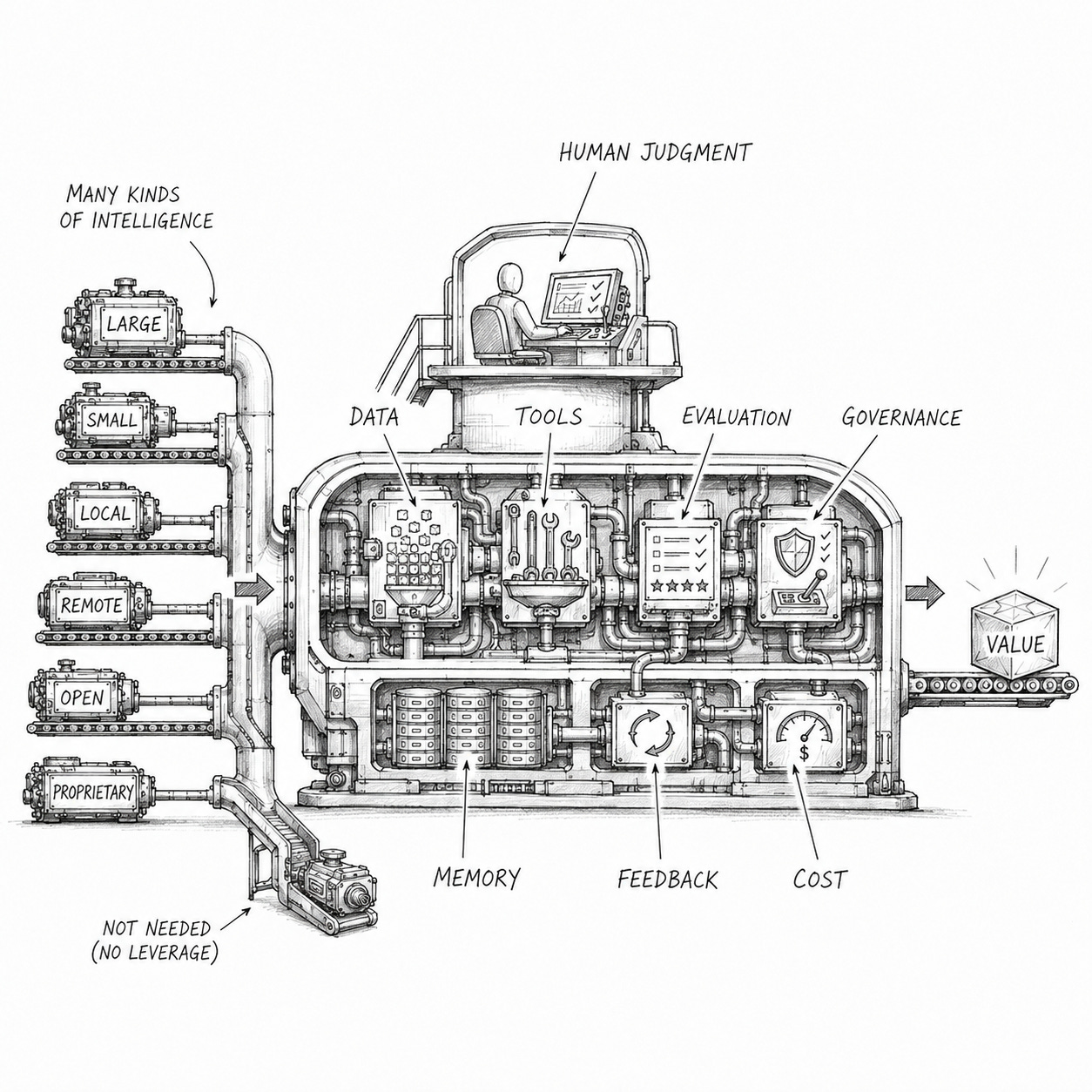
But “human versus machine” is increasingly the wrong diagram.
A better diagram is a system containing both.
The interesting question is where each belongs.
Even biology points in the same direction
There is something fitting about looking at biological intelligence now.
Brains remind us that intelligence does not exist separately from architecture.
Memory, processing, energy, adaptation, sensing and physical structure are intertwined.
The brain is impressive not because each neuron is a frontier model.
Individual neurons are remarkably modest.
The intelligence comes from organisation.
Connections.
Feedback.
Specialisation.
Adaptation.
Memory.
Signals.
Constraints.
A system.
Perhaps there is a lesson here that extends beyond neuromorphic computing.
We have spent several years asking how intelligent an AI model can become.
The next phase may be defined by a different question:
How intelligently can we organise intelligence?
That may be the real AI race
The winners may not have the smartest model.
They may use several models.
Some large.
Some tiny.
Some local.
Some remote.
Some open.
Some proprietary.
They will connect them to good data.
Give them narrowly designed tools.
Evaluate their output.
Control their permissions.
Understand their costs.
Build feedback loops.
Know where humans should intervene.
And remove AI entirely from places where it adds nothing.
That last part matters.
A mature AI organisation will not be the organisation using AI everywhere.
It will be the one that knows exactly where intelligence creates leverage.
We started this technological cycle fascinated by generation.
Then came agents.
Now comes architecture.
The model race will continue, benchmarks will move, context windows will grow, new interfaces will appear, and another spectacular demo will arrive next week.
But underneath all of it, a quieter competition has already started.
It is the competition to build systems that can turn abundant intelligence into scarce value.
That is a much harder problem.
It is also where the real work begins.
Also read:
Stop Paying for Brains You Don’t Use: Why Smaller AI Beats Bigger AI for Business

Many companies think the biggest AI models are always the best. They are not.