

The next phase of computing may not be built entirely from silicon.
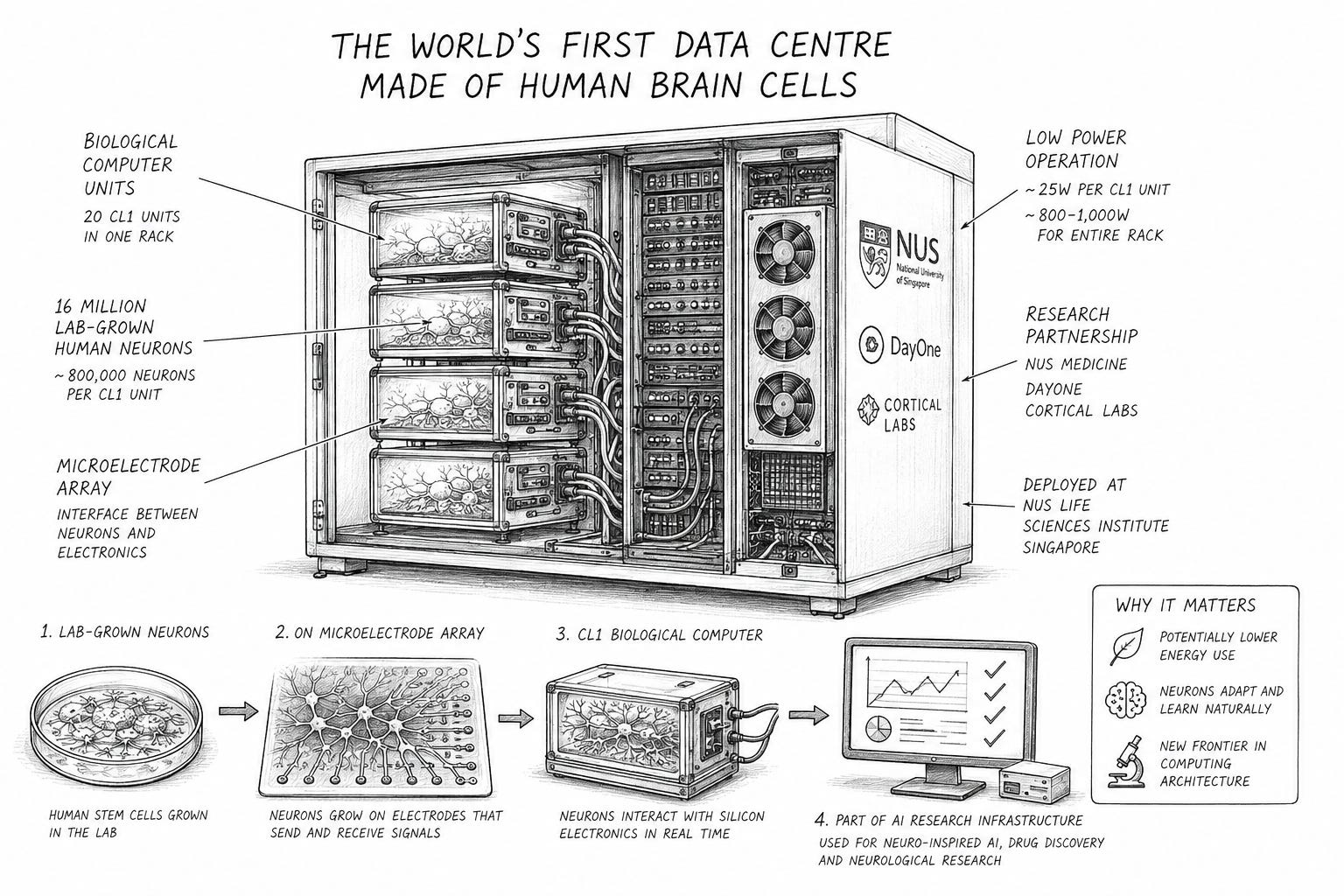
At the National University of Singapore (NUS), researchers and technology companies have deployed what they describe as the world’s first independently operated, biologically integrated server rack. The prototype brings living human neurons into the kind of infrastructure normally associated with conventional computing. (source: biospectrumasia.com)
The system was developed by NUS Medicine, Singapore-headquartered data-centre operator DayOne and Australian biological computing company Cortical Labs. It consists of 20 CL1 biological computers operating in a live research environment at the NUS Life Sciences Institute. (source: datacenterdynamics.com)
Each CL1 combines roughly 800,000 lab-grown human neurons with silicon electronics. Across 20 units, that implies approximately 16 million neurons. The cells are derived from human stem-cell lines and grown on microelectrode arrays that allow computers to send electrical signals to the neurons and read their responses. (source: Startup Selfie)
This is not a human brain inside a computer. Nor is it a replacement for today’s data centres. It is a research prototype testing whether biological neural networks can become a useful computing substrate alongside silicon.
From AI models to AI systems
The development matters because artificial intelligence is moving beyond individual models.
Today’s frontier is increasingly about AI systems: models connected to memory, tools, data, sensors and other models, operating continuously and adapting to changing environments. As these systems become larger and more capable, the computing infrastructure behind them becomes increasingly important.
Biological computing explores a fundamentally different approach to that infrastructure.
Conventional AI attempts to reproduce aspects of intelligence mathematically, running artificial neural networks on silicon processors. Biological computing asks another question:
what if living neurons themselves become part of the computing system?
Neurons naturally receive signals, reorganise their connections and adapt through experience. Cortical Labs has previously demonstrated neural cultures interacting with a simulated version of the game Pong. The Singapore deployment takes the technology from individual experiments toward a multi-unit computing environment. (source: The Times of India)
Why biology is attracting attention
One motivation is energy.
The human brain demonstrates that highly complex information processing can happen with remarkably low energy consumption. Modern AI infrastructure, by contrast, requires large quantities of electricity for computation and cooling.
Cortical Labs says an individual CL1 operates at around 25 watts, while the complete rack requires roughly 800 to 1,000 watts. These figures are promising, but they should be treated carefully: the Singapore prototype has not yet produced evidence showing that biological computing can outperform conventional AI infrastructure on an equivalent workload at commercial scale. (source: TNW)
Its immediate importance is therefore not efficiency already achieved, but a new computing architecture being tested.
The partners are exploring applications including neuro-inspired AI, biomedical modelling, drug discovery and neurological disease research. (source: biospectrumasia.com)
Does this bring AI closer to human intelligence?
Not by itself.
There is a major distinction between using human neurons for computation and creating human-like intelligence.
The Singapore system contains millions of neurons; a human brain contains roughly 86 billion. More importantly, intelligence emerges from extraordinarily complex biological structures and interactions, not simply from the number of neurons available.
There is also no evidence that these systems are conscious. Using living human neurons does not demonstrate awareness, subjective experience or anything resembling a human mind.
What the technology does introduce is a new possibility.
For decades, the computing industry has tried to make machines behave more like brains by designing increasingly sophisticated software and silicon architectures. Biological computing approaches the problem from the opposite direction: rather than only imitating neural behaviour, it incorporates actual neurons into the computing stack.
If the technology can eventually scale, the future of AI infrastructure could therefore become hybrid: silicon for reliable high-speed digital computation, AI models for reasoning and language, and biological neural systems for forms of learning and adaptation where living networks prove useful.
For corporate leaders, that is the development worth watching.
The immediate story is a 20-unit research prototype in Singapore. The larger question is whether the evolution of AI—from models into increasingly autonomous and adaptive systems—will eventually require computing architectures that borrow more directly from biology.
For the first time, that possibility is no longer confined to a single laboratory experiment. It is operating at server-rack scale.
Also read:
The Model Is No Longer the Product

For most of the generative AI era, we have been looking in the wrong place.
What If the Next AI Breakthrough Looks Less Like Software and More Like a Brain?

One small note before I start. I’m writing this on holiday, after reading The Coming Wave by Mustafa Suleyman and Michael Bhaskar, and Peter Robin Hiesinger’s The Self-Assembling Brain. Both books pushed me towards a few papers on biological computation, protein models and neuromorphic hardware. I started taking notes, then tried to organise the mess in…