

One small note before I start. I’m writing this on holiday, after reading The Coming Wave by Mustafa Suleyman and Michael Bhaskar, and Peter Robin Hiesinger’s The Self-Assembling Brain. Both books pushed me towards a few papers on biological computation, protein models and neuromorphic hardware. I started taking notes, then tried to organise the mess into an argument. AI helped with that part, of course. The connections and conclusions below are the ones I found interesting enough to keep.
There is something slightly strange about the way we talk about artificial intelligence.
For decades, we have borrowed words from biology. Neural networks have neurons. They learn. They remember. They form representations. More recently, we have started asking whether models reason.
The language suggests that our machines are slowly becoming brain-like.
Physically, they are not.
A large generative model today still runs on a computing architecture that would be recognisable, in its basic logic, to engineers from another era. Data sits in memory. Processors fetch it. Numbers are moved around at extraordinary speed. Vast amounts of multiplication happen. The result can be astonishing, but the machinery underneath remains deeply conventional.
A brain is built differently.
There is no clean border between processor and memory inside your head. Neurons do not simply execute instructions and then look elsewhere for stored information. The same physical system is sensing, storing, changing, predicting and responding.
And it does so on roughly the power consumption of a dim light bulb.
That comparison is often used as a fun fact about the brain. I think it is more interesting than that.
It may be a clue.
For the last decade, the dominant story in AI has been largely about scale: more data, larger models, more chips and more computation.
What if another part of the story is architecture?
What if AI becomes more capable not only by becoming larger, but by becoming slightly more biological?
That idea starts to look less speculative when you notice two things happening at the same time.
The first is that generative models are increasingly being trained on the raw information of life: DNA, RNA, proteins and molecular structures.
The second is that engineers are building computers inspired more directly by how nervous systems process information.
These are still different research worlds. But put them next to each other and an unusual possibility appears.
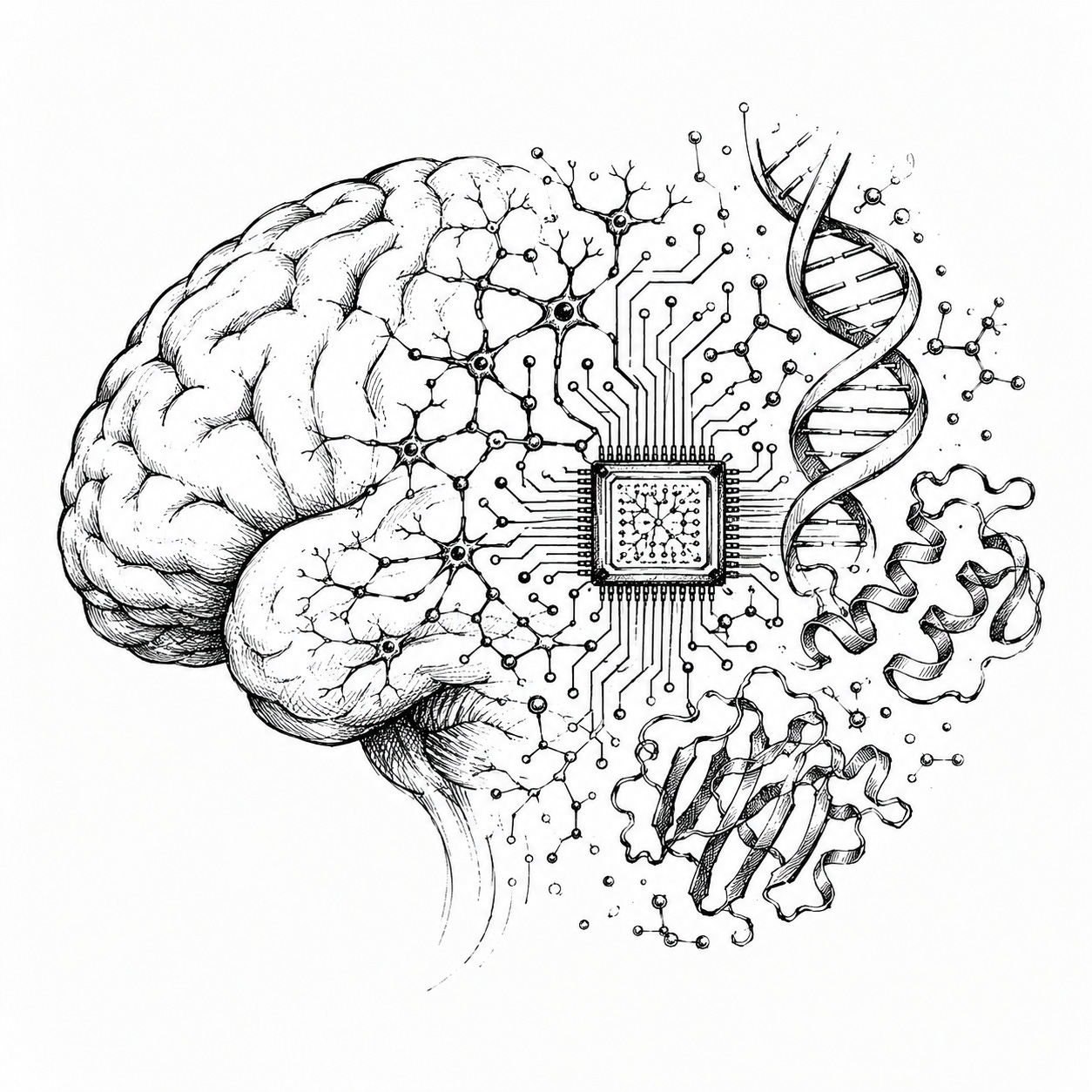
Generative AI could begin to become biological in two senses at once: in what it learns from and in how it computes.
Biology has its own languages
The easiest way to understand this starts with language models.
A large language model learns by looking at enormous quantities of text and discovering statistical structure. Certain words tend to appear near other words. Grammar has patterns. Concepts have relationships. Long before the model can produce a good paragraph, it has learned a complicated map of what tends to go with what.
Biology also contains sequences.
DNA is written with a small chemical alphabet. Proteins are chains of amino acids. Those sequences are obviously not sentences, but they are not random either.
A protein sequence carries a history.
Some arrangements fold correctly. Others do not. Some survive inside cells. Some bind to particular molecules. Some perform useful biological work. Most imaginable protein sequences never appeared in nature at all.
Evolution has been filtering this space for billions of years.
That makes biological sequences unusually rich training data.
A model can be given millions of protein sequences and asked to learn their structure in much the same broad way that a language model learns patterns in text.
It does not need to begin with a complete theory of protein chemistry. It can start by asking a simpler statistical question: given what appears here, what tends to appear next?
At first, this sounds almost disappointingly mechanical.
Then the interesting part begins.
When these models become large enough and their training data becomes broad enough, they can learn relationships that are useful for predicting structure, function and biological behaviour. They can also generate sequences that do not exist in the original dataset.
This is where generative biology starts to become more than biological search.
The model is no longer only finding things evolution already made.
It can propose things evolution did not.
Nature is a much harsher critic than language
Calling these systems “language models for proteins” is helpful up to a point.
Then the analogy breaks.
A sentence can be strange and still exist.
A protein has to survive physics.
It has to fold into a plausible three-dimensional shape. It may need to remain stable under specific conditions. It may need to interact with one target and avoid another. Inside a living cell, it enters an environment filled with other molecules, competing reactions, temperature changes and noise.
There is no forgiving reader on the other side.
There is chemistry.
This means that generative biology is gradually forcing AI towards something that text generation can sometimes avoid: grounding.
A model can generate a convincing paragraph that happens to be wrong.
A generated molecule that does not fold properly simply fails.
That difference matters.
Researchers are therefore trying to connect biological models not only to sequence data but to structure, molecular dynamics, energy and real experimental feedback.
This creates a very different kind of generative loop.
The model proposes something.
The proposal is built.
Nature tests it.
The result comes back.
The model learns.
There is something almost evolutionary about this arrangement, although compressed into laboratory time.
And this is where I started wondering whether biology may end up changing AI more deeply than we expect.
Not only because AI can help us design proteins.
Because biology may be teaching us what computation can look like.
The computer running all this is still very unbiological
There is an irony here.
We can train a model on millions of years of evolutionary information while running it on hardware organised around principles that are almost the opposite of biology.
Modern GPUs are extraordinary machines. None of this is an argument against them.
But they solve the problem through force and precision.
They move huge quantities of data. They perform enormous numbers of numerical operations. They consume considerable energy doing it.
Brains take a different route.
Neurons are comparatively slow. Their signals are noisy. Activity is distributed. Much of the brain is not firing at full speed all the time. Computation happens through changes in networks, timing, electrical spikes and chemistry.
Memory is not sitting somewhere else waiting to be fetched.
The network itself changes.
That simple fact has inspired a field called neuromorphic computing.
The name sounds intimidating. The basic idea is not.
Neuromorphic computing is an attempt to build machines that borrow some of the operating principles of nervous systems.
Not to recreate a human brain transistor by transistor.
That would be the wrong mental image.
The idea is to ask which parts of the brain’s architecture are useful enough to steal.
A computer that behaves a little more like a nervous system
Traditional computers generally separate memory from processing.
That separation has worked brilliantly for decades. But moving data between the two costs time and energy, especially when the amount of data becomes enormous.
Neuromorphic systems try different arrangements.
Some bring memory and computation much closer together.
Some use artificial neurons that communicate through spikes rather than continuously passing large numerical values.
Some are event-driven, which means parts of the machine become active when something actually happens instead of constantly performing operations.
Different designs take different approaches, and “neuromorphic” covers a surprisingly wide family of technologies.
But the common intuition is easy to understand.
Brains do not seem efficient because individual neurons are wonderful processors.
They seem efficient because of how the whole system is organised.
That may be the lesson worth copying.
Consider vision.
A conventional AI system can process a camera feed as a stream of complete images, frame after frame after frame.
A more brain-inspired system might pay far more attention to change.
Something moved.
A boundary appeared.
Light changed here.
Nothing happened there, so there is less reason to compute.
This sounds small until you remember that biological intelligence lives under severe energy limits.
Brains cannot simply add another data centre when a problem becomes difficult.
Evolution had to find other solutions.
Now put the two trends together
This is the part I find most interesting.
Imagine a generative model trained primarily on biological information: proteins, DNA, molecular structures and the relationships between them.
Then imagine parts of that model running on hardware designed around more biological principles: sparse activity, local memory, event-driven computation, adaptable connections.
The data is biological.
The computational architecture is becoming more biological.
The result is not a living machine. It is not an artificial brain. And we should probably resist both phrases because they make the science sound more dramatic than it is.
But it is a change in direction.
For most of computing history, we have forced problems into the architecture of the computer.
Perhaps some future systems will do the reverse.
They will change the architecture of the computer to better fit the problem.
Biology is an obvious place to look because it has already produced systems capable of learning, adapting and operating with remarkable energy efficiency.
Including us.
AI has spent years borrowing the appearance of the brain
Artificial neural networks have always been inspired by biology.
But the inspiration is thin.
The “neurons” inside a transformer are not tiny digital versions of biological neurons. The similarity is mostly historical and mathematical.
That has not stopped neural networks from becoming extraordinarily powerful.
It does, however, leave a question open.
How much of biological intelligence have we ignored because it was inconvenient to reproduce in software?
Real brains are constantly changing.
A conversation changes them.
Sleep changes them.
Stress changes them.
Learning is not a separate mode that happens in a data centre overnight. Learning is part of normal operation.
The distinction between hardware and software also becomes fuzzy in biology.
Your memories are not files stored on some internal drive.
They are partly reflected in the physical organisation and strength of connections inside a living network.
The substrate matters.
That idea sits awkwardly beside the way we normally imagine AI.
We tend to think that intelligence is primarily the algorithm and that the hardware underneath it is interchangeable machinery.
Biology suggests this may be too simple.
Perhaps the physical form of a computing system influences the kinds of intelligence it can efficiently produce.
The brain is not software running on meat
This is where the subject becomes philosophically interesting, but we can keep the argument simple.
The human brain is not a generic processor that happens to be made from cells.
Its material properties are part of how it works.
Electrical activity matters. Chemistry matters. Timing matters. The shape of neurons matters. The way synapses change matters. Blood supply and metabolism matter.
Strip all of this away and what remains is not obviously “the same intelligence” waiting to be run somewhere else.
That does not prove that minds cannot be reproduced in silicon.
It simply means we should be careful with the assumption that intelligence is completely independent of the machinery that produces it.
AI research has largely succeeded by abstracting away from biology.
Maybe the next stage will involve selectively putting some biology back.
Not by growing brains in computers, but by borrowing principles that evolution discovered first.
Local adaptation.
Distributed memory.
Sparse computation.
Continuous learning.
Robustness to noise.
Energy constraints.
Self-organisation.
These are not exotic features in nature.
They are normal.
In computing, many of them remain difficult.
Biology may be more than an application area for AI
Most discussions about AI and biology focus on what AI can do for biology.
Drug discovery.
Protein design.
Genomic analysis.
Disease prediction.
All of these are important, and some could become enormous industries.
But there is another direction to the relationship.
What can biology do for AI?
The answer may eventually be: quite a lot.
Life is a form of organised information processing that existed long before computers.
Cells sense their environment.
They maintain internal states.
They respond to signals.
They correct errors.
Populations adapt.
Nervous systems learn.
Brains predict.
None of these processes is identical to digital computation, and forcing the comparison too far quickly becomes silly.
Still, nature has clearly discovered ways of processing information that are robust, adaptive and efficient.
Computer engineering has good reasons to pay attention.
A useful way to think about this is that the first wave of AI borrowed metaphors from the brain.
The next wave may borrow architecture.
Scale is powerful. It may not be the whole answer.
The recent history of AI makes it very tempting to believe that scale solves everything.
Make the model larger.
Feed it more data.
Give it more computation.
Performance improves.
So far, this has been a remarkably productive strategy.
But every engineering regime eventually runs into costs.
Energy is one.
Chip manufacturing is another.
Latency matters.
Data movement matters.
There are also tasks where a gigantic general-purpose model may simply be the wrong architecture.
When that happens, progress does not necessarily stop.
Sometimes engineers change the machine.
Aviation improved when people stopped trying to reproduce birds literally and started understanding lift.
Modern computing emerged by abandoning one hardware technology after another.
The most interesting future of AI may therefore be messier than a straight line towards ever-larger models.
Some systems will grow.
Others will specialise.
Some will operate on conventional chips.
Others may use radically different hardware.
And biological computation may influence several of those paths at once.
So, is this “organic Generative AI”?
I use the phrase loosely.
Not because these systems are organic in the biological sense.
They are not alive.
A neural chip is still a chip. A protein model remains software. Training an AI system on DNA does not give the machine a metabolism.
What feels organic is the direction of travel.
The information comes increasingly from living systems.
The architecture starts borrowing more deeply from nervous systems.
The learning loop may involve physical experiments rather than static datasets.
And the boundary between storing information and processing it may become less rigid.
That combination is different enough to deserve attention.
We spent years trying to make software imitate the outputs of intelligence.
Write this.
Draw that.
Answer this question.
Generate this image.
The deeper challenge may now be to understand the machinery that makes biological intelligence possible in the first place.
The question I keep coming back to
After reading about protein models, neuromorphic chips and biological computation, I keep coming back to one question.
What has evolution discovered about intelligence that computer science has not?
It is probably not one thing.
There will not be a hidden biological trick that suddenly gives us vastly better AI.
Brains are complicated because intelligence is complicated.
But there may be principles worth extracting.
Perhaps intelligence works better when memory and processing are not treated as strangers.
Perhaps continuous adaptation matters more than we think.
Perhaps sparse systems can outperform brute-force ones in the right environments.
Perhaps noise is not always an engineering defect.
Perhaps the body, the substrate and the physical world are more important to intelligence than our software metaphors suggest.
And perhaps training on the products of evolution will teach models patterns that human-generated data never could.
None of this means that generative AI is about to turn into a brain.
The more interesting possibility is subtler.
AI may gradually stop treating the brain as a metaphor and start treating it as an engineering reference.
That would be a meaningful change.
For seventy years, computing has mostly asked how much intelligence we can produce from machines.
The next question may be how much better our machines become when we allow them to learn from the way intelligence already exists in nature.