

Artificial intelligence is making remarkable progress in mathematics, with several major breakthroughs reported over the past month. Instead of simply solving textbook equations, advanced AI models are now helping researchers tackle problems that have challenged mathematicians for decades.
One of the biggest developments came from OpenAI, where GPT-5.6 Sol reportedly contributed the key insight behind a new paper disproving the 150-year-old Maxwell Conjecture. While the researchers completed the mathematical proof themselves, they credited the AI for suggesting the construction that led to the breakthrough.
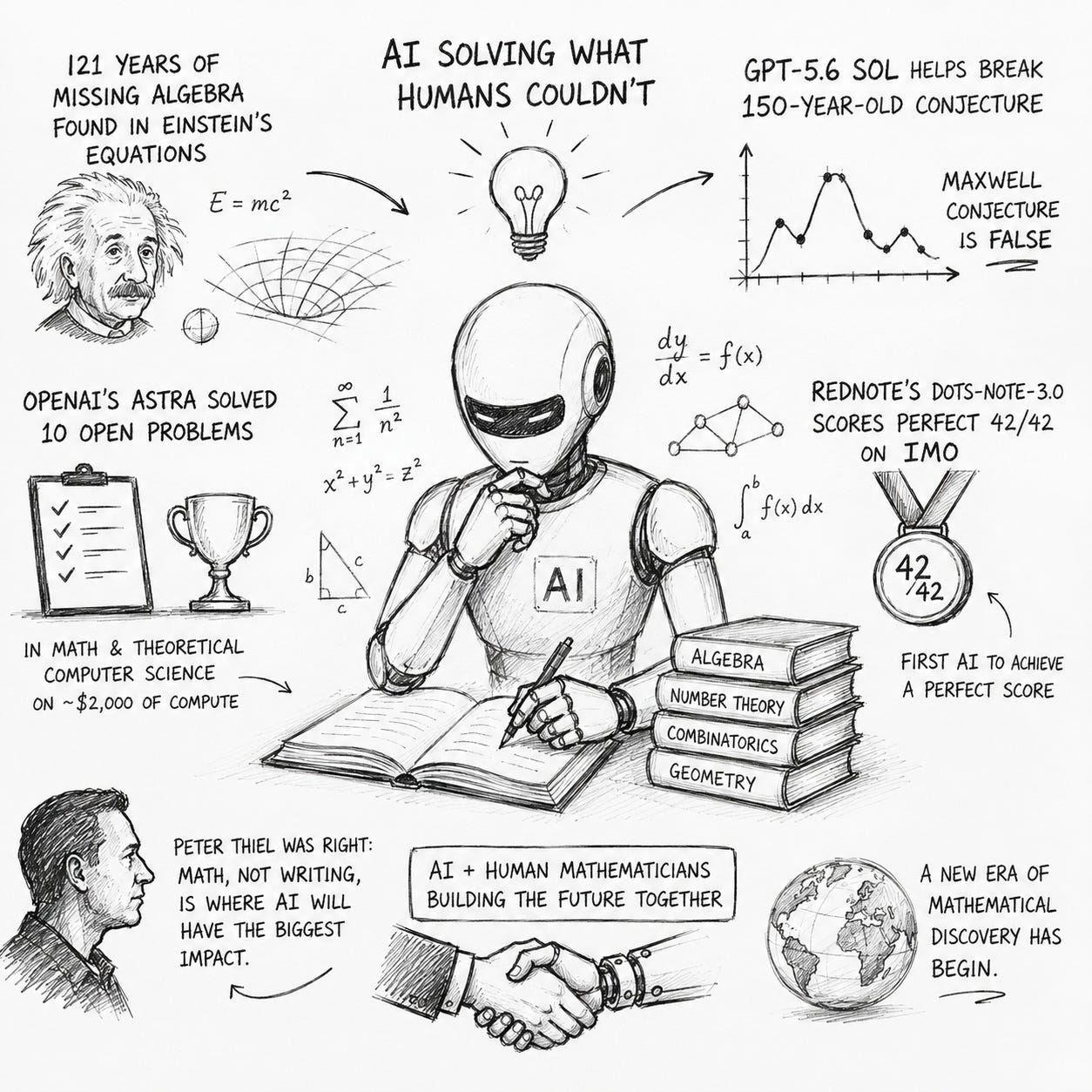
At the same time, OpenAI’s experimental research systems have been reported to solve multiple long-standing problems in mathematics and theoretical computer science using relatively modest computing resources. These results suggest AI is becoming a valuable research assistant rather than just a calculation tool.
China also reached a significant milestone. RedNote announced that its dots-note-3.0 model became the first AI system to achieve a perfect score of 42/42 on the International Mathematical Olympiad. Unlike traditional AI benchmarks, the competition requires complete mathematical proofs that are reviewed line by line by human judges.
The growing momentum supports an idea long discussed by investor Peter Thiel: mathematics could become one of AI’s strongest domains. Mathematical problems offer clear verification, rapid feedback, and structured reasoning, allowing AI models to improve far more efficiently than in creative tasks such as writing.
Earlier claims from AI researchers, including Emad Mostaque, also point toward increasingly powerful mathematical reasoning, with AI systems reportedly uncovering new insights related to Einstein’s equations.
Together, these developments highlight a clear trend. AI is no longer limited to assisting with calculations; it is becoming an increasingly important collaborator in mathematical research. While human experts remain essential for verifying and proving new discoveries, AI is already helping generate ideas that could accelerate scientific progress across mathematics, physics, and computer science.