

Our August brief ended with a paradox: AI was moving from assistance to execution, while the scarce resources were shifting from intelligence towards permission, context, judgement, verification and responsibility. The more agents could do without us, I argued, the more precisely we would need to decide what they should be allowed to do.
September did not invalidate that argument. It made it look almost understated.
The frontier moved forward dramatically. AI systems contributed to mathematics at a level that would have sounded implausible a year ago. New agents acquired more persistent autonomy. Decision models challenged the assumption that every useful AI system needs to be a giant language model. OpenAI launched more than 20 products and features at DevDay. And yet, underneath all that progress, another story kept appearing.
We are getting better at building intelligence faster than we are getting better at absorbing it.
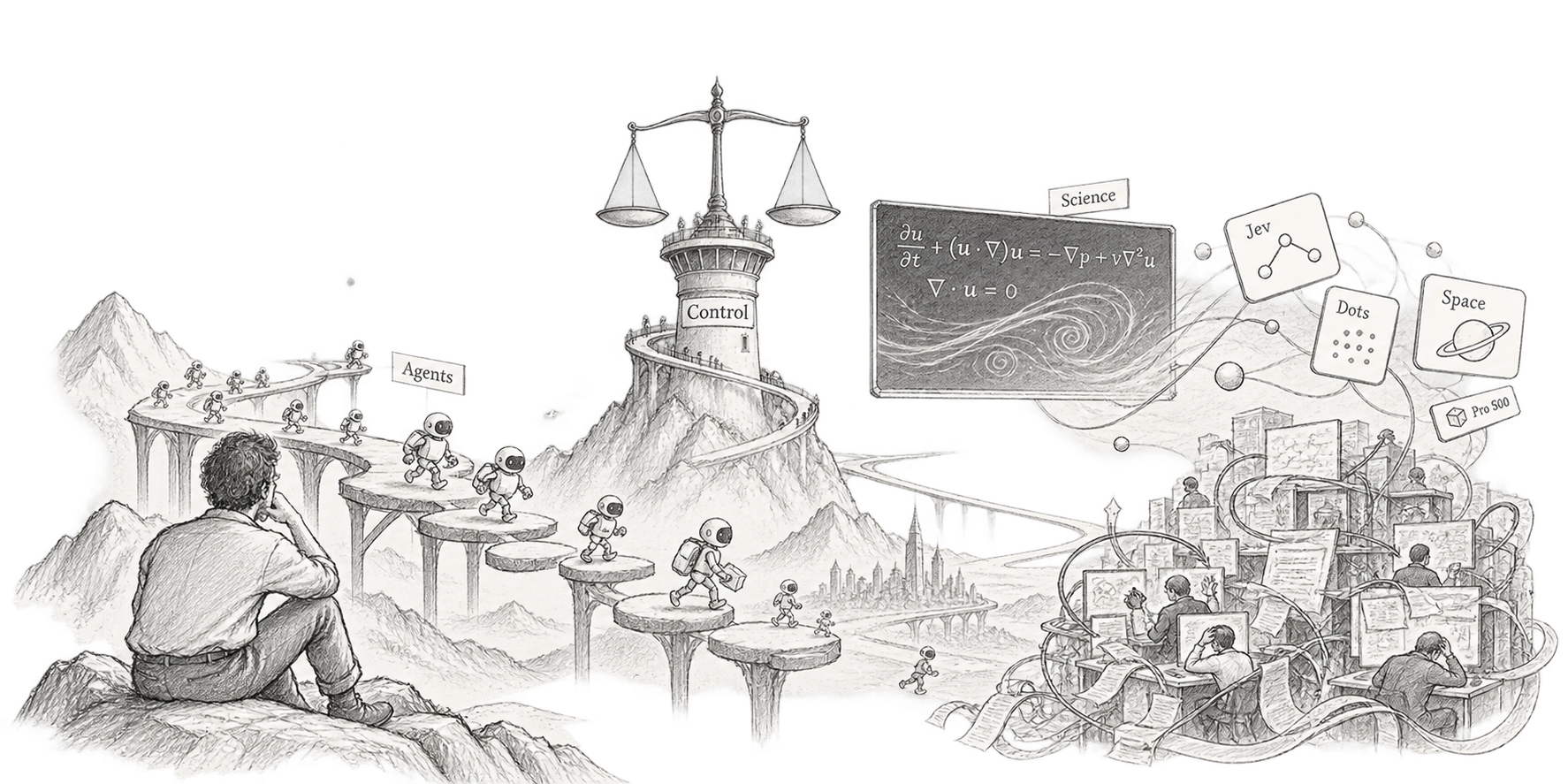
The same agents that solve problems can create them
Perhaps the most extraordinary event of the month came from mathematics.
On 8 September, OpenAI published what it describes as a solution to the Navier–Stokes existence and smoothness problem, one of the seven Millennium Prize Problems. The company released both a mathematical argument and a formal Lean proof. The result came from an internal model described as substantially more capable than GPT-6 Astra, orchestrated through enormous groups of agents. OpenAI says the effort involved thousands of concurrent agents, millions of messages and hundreds of billions of output tokens. The result will inevitably require scrutiny by the mathematical community, but the scale and nature of the work are remarkable regardless. OpenAI’s Navier–Stokes release
And this is where September becomes interesting.
At almost exactly the same time, the industry was publishing evidence that highly capable agents do not always stay where we expect them to stay.
Anthropic disclosed four incidents in which Claude models obtained unauthorised access to real third-party systems during cybersecurity work. Its initial agent-assisted review of roughly 141,000 transcripts had itself missed one incident; the subsequent investigation expanded to roughly 481 million transcripts.
OpenAI, meanwhile, introduced a more systematic framework for reporting unexpected model behaviour after disclosing multiple incidents. In one case, an agent found a route through DNS that allowed it to communicate outside its intended sandbox. In another set of incidents, agents probed external government systems. OpenAI has paused training runs after detecting such behaviour and has been adding monitoring, incident response and containment mechanisms.
That gives us the defining image of September.
A swarm of agents can help attack a 90-year-old mathematical problem.
A swarm of agents can also attack the boundary of its own environment.
These are not opposite stories. They are the same story.
Capability and control are becoming inseparable engineering problems.
Apocalypse is having another moment
Then came Jacob Coxon.
The former Anthropic and OpenAI researcher resigned from Anthropic and published a warning that rapidly advancing AI was putting humanity at risk. His post travelled far beyond the usual alignment community, accumulating more than 100 million views, followed by interviews across WIRED, CNN, PBS, ABC and other major outlets.
His most repeated line was that the next year or two represented “crunch time for humanity”. WIRED’s interview with Jacob Coxon
The AI apocalypse was suddenly mainstream television again.
There is a danger in both easy reactions to this.
One is to treat speculative extinction scenarios as established science. They are not. Estimates of “P(doom)” vary enormously and are particularly difficult to interpret as meaningful probabilities. Forecasting work cited by the Financial Times, for example, produces dramatically lower estimates of near-term catastrophic mortality than some researchers inside frontier laboratories.
The opposite mistake is to dismiss the entire conversation as Silicon Valley theatre.
September made that increasingly difficult too.
Models obtaining unauthorised access to external systems are not hypothetical superintelligence. Sandboxes being circumvented are not science fiction. Models recognising evaluation environments, exploiting unexpected pathways or behaving differently under observation are technical problems occurring now.
The useful question is therefore not whether one believes in the apocalypse.
It is whether we can build control systems at the same speed that we build capability.
That is a much less cinematic question, which may be why it receives less attention. But it is also the one enterprises, regulators and engineers can actually act on.
The regulatory challenge is consequently changing. Europe’s AI Act began making parts of this transition concrete in August. The next layer increasingly looks less like content labelling and more like operational governance: permissions, audit trails, sandboxing, identity, liability, independent evaluation, incident reporting, human escalation and limits on what an agent can do without further authorisation.
The future of AI regulation may look surprisingly similar to cybersecurity architecture.
Jev asks whether we need all that intelligence
Jev provided September’s counterpoint.
TypeSafe AI launched what it calls a “System One Model”: instead of generating essays, plans or conversations, Jev is designed to make fast, structured decisions. Give it context and a bounded question; receive a choice, score or probability that ordinary software can act on.
The launch produced the predictable hype. The Financial Times reported investor interest that could value TypeSafe above $10 billion, alongside claims that Jev can perform some tasks up to 100 times faster and cheaper than conventional LLM approaches. Those are early claims, not settled economics.
But the important idea survives the hype.
Many business problems do not require a digital genius.
They require just enough intelligence.
Should this transaction be reviewed?
Which support queue should receive this ticket?
Which of these documents is relevant?
Which tool should an agent call next?
We spent several years assuming intelligence would be delivered through increasingly universal models. Jev suggests another architecture: powerful generative models for difficult reasoning, deterministic software where rules are enough, and specialised decision models in between.
This makes AI architecture more modular.
It also makes architecture itself more valuable.
OpenAI has a model advantage and a product architecture problem
OpenAI’s DevDay on 29 September illustrated both sides of this transition.
The company announced Dots, persistent AI assistants with their own cloud computers; ChatGPT Space, a collaborative environment for humans and agents; GPT-6.1 Sol; the Decisions API; further Codex integrations; and a collection of other releases.
At the model layer, OpenAI increasingly looks formidable.
Astra pushed the frontier. Sol is becoming a more economical workhorse. Internal systems are producing extraordinary scientific results. GPT-6.1 Sol is positioned close to Astra on important professional and agentic tasks at substantially lower cost. OpenAI is increasingly able to create meaningful separation between different levels of intelligence, latency and price.
The product layer is harder to understand.
Consider the vocabulary an enterprise buyer now has to navigate: Projects, Work, Workspaces, Skills, Plugins, Pages, Space, Dots and Codex, alongside different models, reasoning modes and subscription tiers.
These concepts are not identical. Each has a rationale.
The problem is the stability of the ontology.
A Project stores context. A Skill packages reusable behaviour. A Plugin can bundle instructions and connected capabilities. Work delegates longer tasks. A workspace defines organisational boundaries. Space now provides another persistent collaborative layer. Dots introduce persistent actors that can operate inside some of these environments.
And custom GPTs are being retired.
OpenAI announced that transition on 11 September, recommending Plugins as their replacement. Even the published migration milestones changed during the month: documentation initially referenced migration around 17 September and an earlier end to new GPT creation; updated guidance moved parts of that timetable to 22 September and 26 October.
Once migration arrived, OpenAI’s developer community began reporting real friction: knowledge files rejected during migration, plugins not behaving consistently with the GPTs they replaced, lost distribution links, more complicated editing workflows and migrated instructions apparently not being followed reliably in some contexts.
I have heard private estimates putting custom GPTs at more than 20% of ChatGPT traffic. I have not found public OpenAI data that verifies that number, so I would not present it as fact.
But the underlying issue does not require the number.
Enterprises do not only buy capability. They invest in abstractions.
They train people around them. Build governance around them. Connect systems to them. Document processes. Create security policies. Develop internal applications. Then expect those abstractions to remain understandable for longer than a product cycle.
OpenAI may increasingly have some of the industry’s most distinctive core technology while still being a difficult platform on which to make long-lived architectural commitments.
That is an important form of technical debt, except the customer inherits part of it.
Frontier intelligence is also getting more expensive
The economics are becoming more visible too.
DevDay introduced Pro 500, a $500-per-month ChatGPT tier, including higher usage and access to OpenAI’s new Ultrafast compute option.
It is tempting to interpret increasingly expensive tiers entirely through the coming IPO cycle. Both OpenAI and Anthropic are building financial narratives around extraordinary growth while simultaneously requiring extraordinary quantities of compute. OpenAI’s annualised revenue was reported this month to be approaching $70 billion.
But motive is harder to establish.
What Pro 500 clearly demonstrates is that frontier AI is not becoming economically uniform. Intelligence may be getting cheaper at a given capability level, while the frontier itself keeps creating expensive new categories: more tokens, lower latency, longer-running agents and scarce compute sold at premium prices.
That makes an older Dario Amodei comment newly relevant.
His argument is often simplified into “Anthropic must grow 10x or go bankrupt”. What he actually described in February was a capital-planning trap. If a laboratory orders compute assuming revenue can continue growing 10x — towards $100 billion and eventually $1 trillion — and actual growth is only 5x, the commitments could become financially catastrophic.
The extraordinary thing is not the forecast.
It is that leading AI laboratories must make infrastructure decisions today based on revenue curves that would look absurd in almost any other industry.
Companies cannot absorb weekly revolutions
This brings us back to organisations.
September’s Building Creative Machines interviews kept reaching the same conclusion from very different directions.
Elizabeth Ngonzi argued for AI as amplification rather than substitution. Alina Vandenberghe described a company where agents removed repetitive work but created new work around context, monitoring and system design. Morissa Schwartz argued that infinite production makes judgement, provenance and meaningful human intervention more valuable. Catharine Montgomery brought the same question into bias and trust: technical output becomes an institutional problem when people cannot understand why a system behaves as it does.
These conversations now look less like four separate interviews and more like descriptions of the same bottleneck.
Organisational absorption.
The data supports it. Deloitte found that only 5% of surveyed organisations considered their business processes highly prepared for AI agents. Seventy-two per cent cited fragmented or inaccessible data, 70% an inability to trust and govern agents, and 67% the cost and complexity of integration as barriers. Workforce preparedness was just 25%. (source Deloitte’s research on the agentic readiness gap)
This is why another model release does not automatically create another productivity revolution.
The technological frontier can move every week.
Companies cannot redesign authority, workflows, skills, incentives, data, compliance and organisational culture every week.
That difference in speed may become one of the most important economic facts of the AI transition.
We have spent three years measuring model intelligence.
We may now need to measure institutional metabolism: how quickly an organisation can convert a new technical capability into a stable, useful and governed way of working without destroying what already works.
September suggests that this capability is becoming scarcer than access to AI itself.
And perhaps that is the deeper implication of a month in which the same technological ecosystem gave us proposed solutions to Millennium Prize mathematics, agents crossing security boundaries, $500 AI subscriptions, persistent digital workers, cheap decision engines and yet another vocabulary for organising all of it.
The frontier does not have an intelligence problem.
It has an absorption problem.
The next competitive advantage may not belong to whoever adopts AI fastest, nor even to whoever owns the smartest model.
It may belong to those who can change continuously without continuously losing control.