

Artificial intelligence is increasingly being framed as a substitution technology.
Which jobs can it replace? Which processes can it automate? How many people can an organisation remove from a workflow? How much more output can the remaining employees produce?
Elizabeth Ngonzi thinks this framing misses the larger opportunity.
For Ngonzi, the more consequential question is not what happens when artificial intelligence replaces human capability, but what becomes possible when it amplifies capabilities that already exist inside people and organisations.
This perspective is shaped by more than 25 years across technology transformation, management consulting, entrepreneurship, executive education, and, increasingly, human-centred AI.
Ngonzi serves on the Board of the American Society for Artificial Intelligence (ASFAI) and is an Adjunct Assistant Professor at New York University, where she has taught for more than 17 years. She is also the originator and founding platform architect of AI for Humanity: Human-Centered Strategies for Innovation and Impact, developed with contributors from ASFAI to explore AI governance, ethics, finance, workforce transformation, policy and responsible innovation. (Ngonzi’s website)
Since 2023, her AI learning and leadership initiatives have reached more than 12,000 professionals across six continents.
At the centre of her work is a deceptively simple equation:
1+1+AI=10™
It is not intended as mathematics. It describes an organisational philosophy: combine an individual’s lived expertise with the collective intelligence of other humans, then use AI to amplify both.
The distinction matters.
Much of the current AI economy is built around making generation cheaper. More text. More images. More analysis. More software. More decisions, produced more quickly.
Ngonzi is interested in what should not become cheaper in that process: judgment, accountability, relationships, intuition, lived experience and the distinctly human capacity to decide what something means.
She has tested these questions personally.
In April 2025, Ngonzi created a digital twin trained on more than two decades of her own intellectual work: articles, teaching materials, presentations, frameworks and ideas. The system allows her to interrogate her own professional archive, rediscover forgotten concepts and establish connections between ideas developed years apart.
Yet she is explicit about its limits.
The digital twin can retrieve Elizabeth Ngonzi’s work.
It cannot be Elizabeth Ngonzi.
That distinction opens a much larger conversation about what we are actually trying to preserve as AI systems become capable of reproducing increasingly convincing approximations of human knowledge, language, style and eventually presence.
Perhaps the goal should not be to reproduce humans at all.
Perhaps it should be to give humans better access to themselves.
We spoke with Elizabeth Ngonzi about digital twins, authorship, intellectual memory, bias, human taste and why organisations focusing primarily on AI-driven cost reduction may be overlooking the much larger economic opportunity of generating entirely new human capabilities.

Elizabeth Ngonzi CWIL 2026 (with credits)
What should AI preserve about a person, rather than reproduce?
AI should preserve a person’s ability to develop relationships with other people, to exercise judgment, and to draw on lived experience. It should also leave room for intuition, especially the kind that develops over time and is difficult to document, let alone replicate.
I created a digital twin in April 2025 using more than 20 years of my own work. It draws on my articles, teaching materials, presentations, frameworks, and ideas. I was careful not to include anything confidential or covered by a non-disclosure agreement. I created it because I wanted a way to return to work I had done in the past, recall ideas I might’ve forgotten, and see connections between things I’d written or developed at different points in my life.
It’s been useful in practical ways. I can ask it to surface a framework from years ago, help me recall something for a bio or CV, or bring forward relevant language as I’m developing a new piece of work. In that sense, it extends my intellectual memory.
But it doesn’t capture who I am. It can’t know what I notice in a conversation, how I feel in a particular moment, or the many experiences that have never been written down. I’ve made it publicly available and designed it to be empathetic and useful, but it’s not a replacement for me.
For me, that’s the right role for AI. It can be a partner and a way to query an archive of work. It can help surface ideas. It shouldn’t be asked to reproduce someone’s humanity or stand in for the relationships, judgment, and responsibility that make a person who they are.
Where does human authorship begin and end when working with a source-grounded AI system?
I believe human authorship begins with the idea.
Usually, I’ll write a draft myself. More and more, I dictate because it’s easier for me to get the thought out without interrupting myself too soon. I may have a question I want to answer, an observation I want to explore, or a point I want to make. That’s always what comes first for me.
Then I might use AI to help me work with it. I might ask it to sharpen an idea, question an assumption, help me look at an issue from another angle, or bring forward something relevant from my earlier work. I think of it a little like working with an editor. A good editor can show you what’s unclear, where an idea needs more depth, or how it may land with a particular audience. But it’s important to note that the editor isn’t the author.
The same is true of a source-grounded AI system. It can give me context from my own archive. It can remind me of an idea I hadn’t thought about in a while. Sometimes that’s exactly what I need. But I’m still the person deciding what matters, what the question is, whether something’s accurate, what needs to be revised, and whether the final work reflects what I actually believe.
So I don’t think authorship ends once AI becomes part of the process. It continues all the way through. AI can help me retrieve, test, and develop an idea. It can’t decide what I mean, what I believe, or what I’m prepared to put my name behind. The final product always has me as the human in the loop, putting the final touches on the rhythm, the flow, and the soul of the piece.
Can AI extend our intellectual memory without reinforcing our existing biases?
Yes, but only if we’re honest about the fact that memory is never neutral!
All of us are shaped by our experiences, what we’ve been taught, where we’ve lived, what we’ve paid attention to, and what we may never have had the chance to see. In that sense, we all have biases. I don’t think having a perspective is inherently bad. It becomes a problem when it reinforces something that’s untrue, unfair, harmful, or limiting, particularly when it affects other people.
A source-grounded AI system can be very helpful because it brings forward ideas, patterns, and material you might’ve forgotten. But it can also reinforce the assumptions and blind spots already present in the material you gave it. That’s why bias can’t be treated as something to clean up at the end. It has to be part of the design from the beginning.
When I build or use a source-grounded resource, I want to be clear about what comes from my own prior work and what needs to be checked against credible external sources. I also want the system to do more than agree with me. Can it flag an assumption? Can it show me another perspective? Can it tell me when a claim needs verification instead of simply repeating it back more confidently?
That ethical layer is especially important when a resource is available to other people. You have to think about whether it could discriminate, reinforce stereotypes, cause harm, or make one person’s viewpoint appear universal. We’ll never remove every bias from human or AI systems. But we can be intentional about noticing it, challenging it, and building safeguards before a system reaches someone else.
As AI becomes more capable, does human taste become more or less important?
It becomes more important, without question!
As AI becomes able to produce polished text, images, video, and ideas on demand, human taste becomes one of the clearest differentiators. Taste isn’t only knowing what looks good. It’s the judgment that comes from your experiences, values, curiosity, what you’ve paid attention to, and the way you make sense of the world.
Two people can be given the same assignment and the same AI tool. They may even use a similar prompting style. But their work shouldn’t come out the same. What each person notices, what they choose to emphasise, what they reject, what they feel is missing, and what they believe is worth making will change the result. That’s where taste enters the process.
This is especially true with images, video, and other creative work. AI can generate an endless number of options, but it can’t decide what has resonance for a particular audience, what’s culturally appropriate, what feels emotionally true, or what’s worth putting into the world. Those remain human decisions.
I also think taste needs to be developed. It comes from being out in the world, not only from sitting in front of a screen. I get inspiration from nature, art, travel, swimming, and being near water. I get it from conversations and from spending time with people whose experiences are different from mine. All of that informs how I see the world and, in turn, the work I create.
As AI becomes more capable, I don’t think the answer is to become more machine-like in response. We need to become more fully human. We need to keep developing curiosity, discernment, cultural awareness, and lived experience, because those are what give our work a real point of view.
Why should organisations focus on generating new capabilities rather than simply automating costs?
Cost reduction is a legitimate reason to use AI. There is repetitive work that can be streamlined, and people shouldn’t have to spend their days on tasks that add very little value.
But cost-cutting can’t be the whole strategy. If an organisation brings in AI mainly to remove people or demand more output from fewer people, it may get a short-term efficiency gain while losing knowledge, trust, creativity, and the capability it’ll need to adapt later.
This is where my 1+1+AI=10™ methodology comes in. It’s not a literal equation. It’s a way of thinking about what becomes possible when an individual’s experience and perspective are connected with the knowledge of a team or organisation, and then augmented by AI. The goal isn’t simply to make the same work happen faster. It’s to help people see more, connect more, and create things they might not have been able to create on their own.
Someone may have an idea for a better customer experience, a new product, a more effective process, or a solution to a problem that’s frustrated a team for years. AI can help them research it, test it, develop it, communicate it, and bring it forward. That’s capability generation.
I think organisations should ask not only, “What can we automate?” but also, “What becomes possible when our people have more access to knowledge, more room to experiment, and better tools to develop their ideas?”
That can lead to new products, stronger services, better decisions, and new sources of revenue. But it starts with a basic belief that people aren’t simply costs to manage. They’re a source of knowledge, imagination, and value. AI can help bring more of that forward.
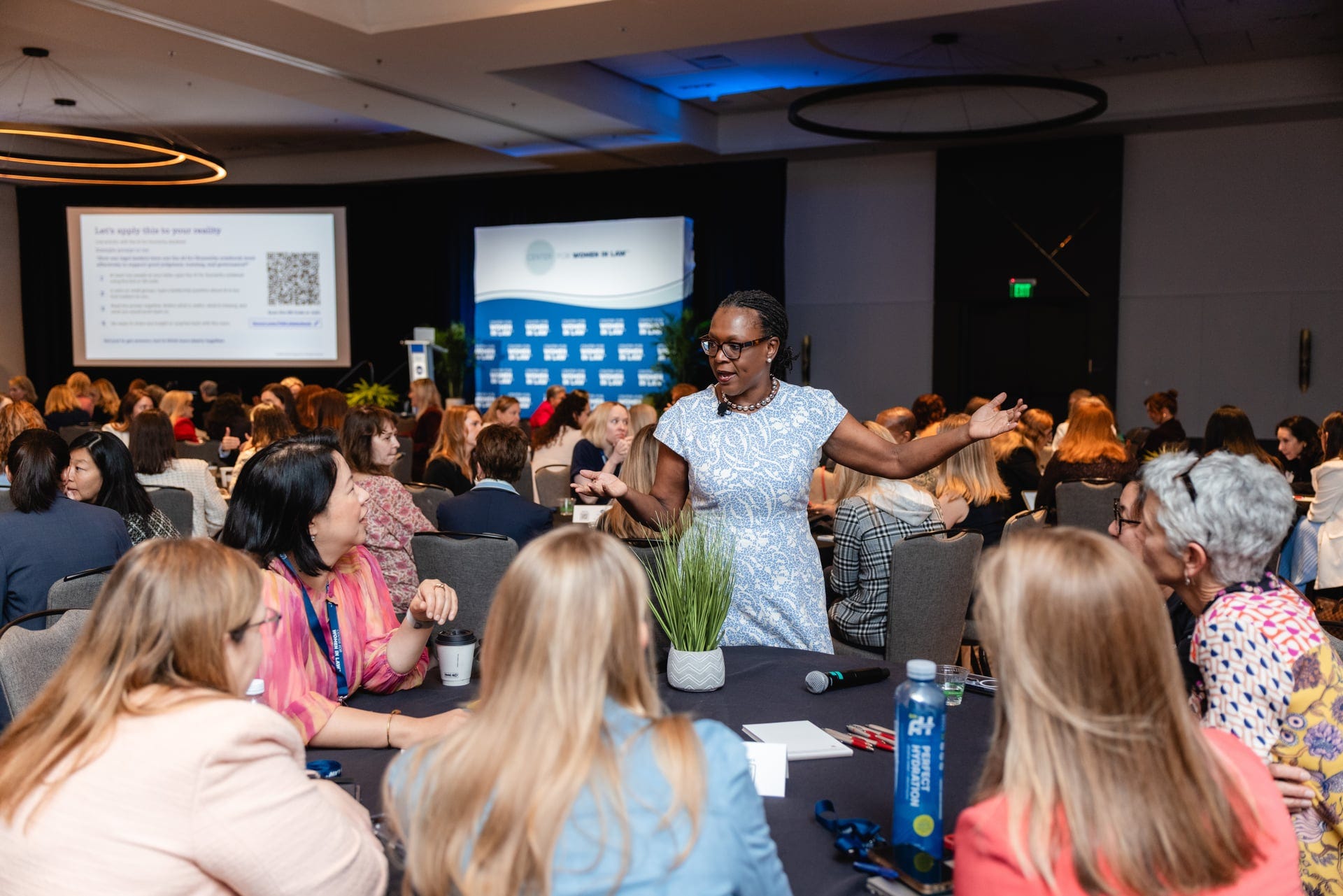
Elizabeth Ngonzi at CWIL in audience (with credits)
From Automation to Amplification
A recurring assumption in conversations about artificial intelligence is that the technology’s economic value is primarily proportional to the amount of human labour it can remove.
Ngonzi proposes a different equation.
What if the most important measure of AI is not the work it eliminates, but the capability it creates?
The distinction between those two ideas may prove fundamental.
Automation begins with an existing process and asks how much of it a machine can perform. Capability generation begins with humans and asks what they could accomplish if some of their existing constraints disappeared.
Those approaches can lead organisations towards very different futures.
A company optimising primarily for automation might use AI to reduce the number of people required to produce the same output. A company optimising for capability might give those same people tools that allow them to research unfamiliar domains, prototype ideas, interrogate institutional knowledge, communicate across languages or test possibilities that previously required resources they did not possess.
One extracts efficiency from what already exists.
The other potentially expands what can exist.
Ngonzi’s digital twin provides a small but revealing example.
More than twenty years of professional work inevitably contains forgotten ideas, abandoned frameworks and connections too general for unaided memory to retrieve on demand. By making that archive computationally accessible, AI does not need to replace its author to become valuable.
It makes the author’s own intellectual history more available to her.
That is augmentation in an unusually literal form: AI as an extension of intellectual memory.
But Ngonzi also identifies the danger hidden inside that proposition.
An archive does not contain an objective representation of a person. It contains what that person happened to document. Their assumptions, omissions and blind spots enter the system alongside their expertise.
Source grounding therefore solves one AI problem while potentially amplifying another.
A system may become more faithful to its sources without those sources becoming more truthful.
That makes her insistence that AI should be capable of challenging rather than merely agreeing with its user particularly important. The ideal intellectual companion may not be the machine that most accurately reproduces what we have previously thought.
It may be the one that helps us discover where that thinking is incomplete.
And as machines become better at producing technically competent creative output, another human capability moves towards the centre: taste.
Generation creates possibilities.
Taste eliminates them.
It determines what deserves attention, what resonates, what feels culturally appropriate, what should be discarded and, ultimately, what is worth putting into the world.
That capacity cannot develop entirely through interaction with machines because, in Ngonzi’s account, taste emerges partly from precisely what machines cannot experience for us: nature, travel, art, conversations, relationships, different cultures, physical environments and the accumulated texture of living.
There is a paradox here.
The more capable artificial intelligence becomes, the less useful it may be for humans to imitate its defining characteristic: endless production.
Our comparative advantage may instead shift toward judgment, discernment, accountability, curiosity, and lived experience.
Or, in Ngonzi’s formulation:
“As AI becomes more capable, I don’t think the answer is to become more machine-like in response. We need to become more fully human.”
That may be the more ambitious interpretation of human-centred AI.
Not protecting a shrinking territory of tasks that machines cannot yet perform.
But designing intelligent systems that expand the territory of what humans can become.
More Interviews
Building Creative Machines has published dozens of exclusive conversations with founders, researchers, executives, artists and other leading voices shaping artificial intelligence and its impact on society.
Editorial Disclosure
This interview was conducted independently by Building Creative Machines. No payment, sponsorship, or other editorial consideration was received in connection with its publication. The views expressed are those of the interviewee.