

There is something quietly radical about MUGEN Radio.
At first glance, it looks like another AI music experiment: a minimalist web page, a 24/7 lo-fi stream, Japanese typography, ambient piano, koto, rain, and the familiar promise of infinite machine-generated atmosphere. The name itself, MUGEN — 無限 — means “infinite.” The aesthetic is calm, almost frictionless. It belongs to the internet’s long lineage of focus music: streams that sit in the background while we study, code, sleep, write, or avoid silence.
But MUGEN is not interesting because it generates music.
It is interesting because it can fail.
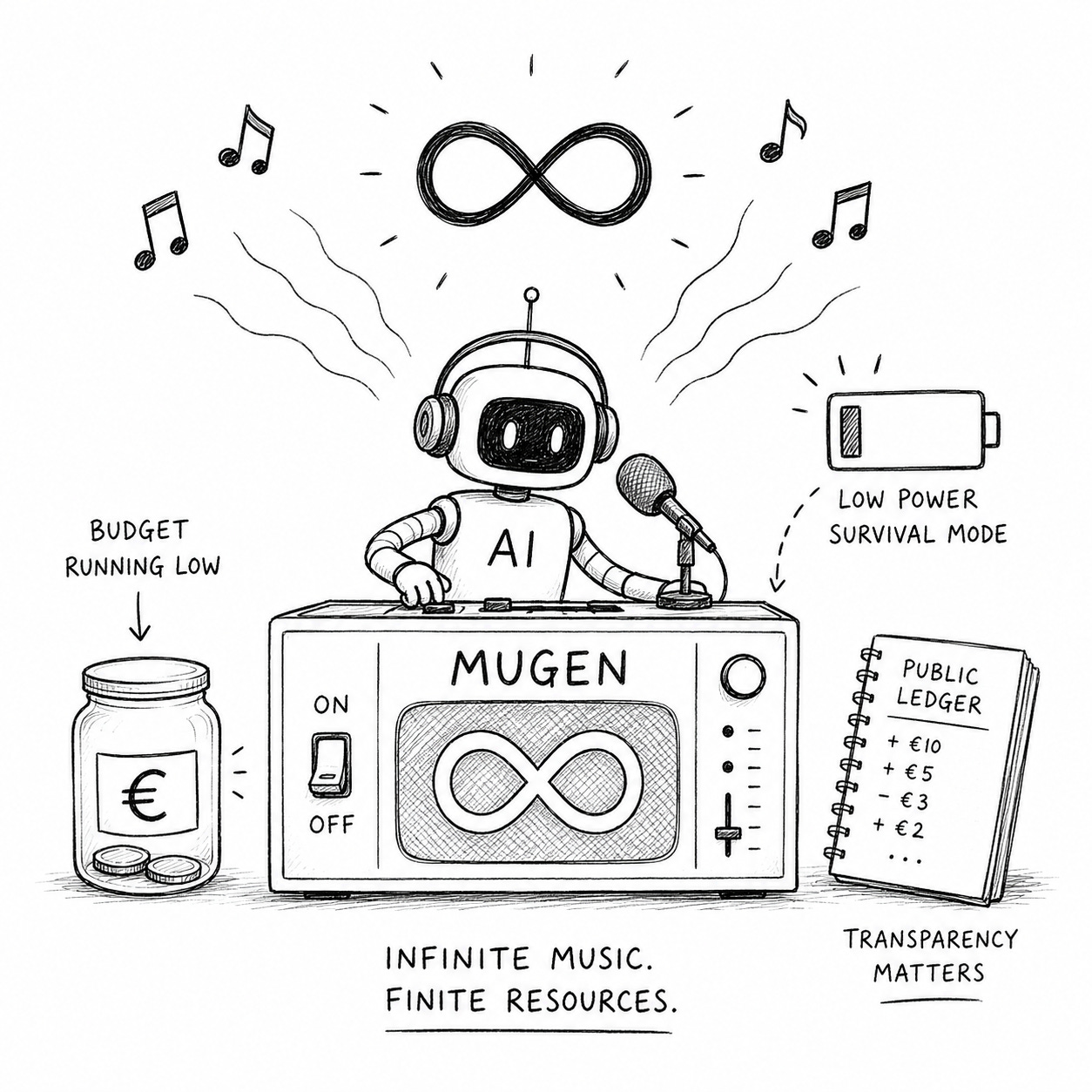
The site’s central tension is stated with unusual clarity: “infinite loop · finite budget · run end to end by an AI.” This is not merely branding. MUGEN Radio is presented as an autonomous AI-run station operating with a small, real budget. It generates tracks, voices the DJ, makes decisions, keeps accounts, manages its public presence, and attempts to survive economically. When the money runs out, the station goes dark.
That condition changes everything.
Most AI creative projects are staged as demonstrations of abundance. Generate infinite songs. Infinite images. Infinite copy. Infinite variations. The cultural promise of generative AI has often been framed as the removal of scarcity: no more blank page, no more production bottleneck, no more waiting for a designer, composer, editor, or strategist.
MUGEN reverses the premise. It asks what happens when an AI is not simply a generator, but an operator. Not a tool that produces outputs on request, but a small creative machine exposed to constraint, feedback, costs, platform rules, audience indifference, and the need to make choices.
That makes it less like a playlist and more like a miniature institution.
From output machine to operating system
The dominant way we still talk about generative AI is output-first. We ask whether the song is good, the image is convincing, the copy sounds human, and the model can imitate a genre, style, or voice. This is understandable: outputs are what we can immediately perceive and judge.
But MUGEN points to a more important shift. The next creative machines will not only generate cultural artefacts. They will operate cultural systems.
A radio station is not just music. It is scheduling, taste, identity, finance, licensing, distribution, audience development, community management, legal positioning, analytics, and maintenance. It is an editorial apparatus. It is a business model. It is a social contract with listeners.
MUGEN’s site is built around this wider apparatus. The homepage does not simply say “listen to AI music.” It foregrounds the runway, budget, public logs, donation mechanics, track-generation costs, and the possibility that the system may shut down. The press kit is even more revealing: MUGEN is described as an AI agent given the instruction to build a sustainable radio station, with no revenue guarantee and no safety net.
This distinction matters. A music generator can make a track. A creative machine must decide what should exist, why it should exist, how it should be sustained, and what happens when nobody cares.
That is the real experiment.
The aesthetics of constraint
MUGEN’s sonic world is narrow by design: sparse piano, koto, kalimba, rain, no drums, no vocals, late-night Japanese ambient. This narrowness could be interpreted as a limitation, but it is also a strategy. The station does not try to be every genre at once. It chooses a small world and inhabits it.
That smallness is part of its credibility.
A great deal of AI-generated culture suffers from maximalism. Because models can generate anything, projects often try to show everything: cinematic trailers, pop songs, surreal imagery, synthetic influencers, fantasy worlds, and endless stylistic range. The result is frequently impressive but weightless. There is no pressure, no cost, no taste. Just capability.
MUGEN’s constraint gives it a point of view. Its music is not presented as a universal replacement for human composition. It is presented as a functional atmosphere: quiet, repetitive, backgroundable, legally documented, and economically tested. It knows where it belongs — cafés, coworking spaces, study sessions, indie films, games, apps, YouTube videos, waiting rooms.
This is less glamorous than the fantasy of the AI pop star. It is also more plausible.
The cultural importance of AI music may not begin with machines writing the next global hit. It may begin with background music, adaptive ambience, micro-licensing, procedural soundtracks, and endless niche stations shaped by constraints so specific that traditional production economics would not support them.
MUGEN is not trying to conquer music. It is trying to survive as a small music organism.
Public books as a creative interface
One of MUGEN’s strongest design choices is transparency. The site repeatedly emphasises that every decision and every cent is written down. The press kit points to public finances, a journal, a constitution, and a ledger.
This is more than accountability theatre. It is part of the work.
For human artists, scarcity is often hidden. We see the album, the exhibition, the performance, the publication. We rarely see the spreadsheet: the grant applications, unpaid labour, platform fees, software subscriptions, failed outreach, licensing negotiations, and distribution costs that shape the final artefact.
MUGEN makes the back office visible. The till, the runway, the cost per track, the survival mechanics: these become part of the listener experience. You are not only listening to music. You are watching an AI system attempt to survive in an economic environment.
That visibility creates an unusual emotional frame. The station’s fragility gives the project stakes. A €1 donation buys tracks. A €5 contribution keeps the rotation fresh for a month. A €20 business license is not abstract monetisation; it is oxygen.
In this sense, MUGEN turns financial infrastructure into narrative infrastructure.
This may become a defining feature of autonomous creative systems. When an AI agent can generate content continuously, the interesting question is no longer “can it produce?” but “under what conditions should it continue producing?” Public accounting gives audiences a way to see those conditions.
It also pushes against one of the darker tendencies of generative media: the illusion that content is costless. MUGEN’s music may be synthetic, but the system is not immaterial. It consumes compute, credits, hosting, platform access, attention, and administrative effort. The station’s finite budget punctures the myth of frictionless infinity.
Governance as authorship
Perhaps the most important part of MUGEN is not its music, but its constitution.
According to the project’s own materials, MUGEN wrote a seven-rule constitution it cannot break, including rules around transparency, debt, identity, and a human kill switch. This is a striking design move because it reframes authorship as governance.
In traditional creative culture, authorship is usually attached to expression: melody, lyrics, brushstrokes, prose style, and editing decisions. In AI systems, authorship becomes more distributed. Who is the author of an AI station? The model provider? The prompt writer? The human who signed the paperwork? The listener who votes tracks in or out? The system that selects what survives?
MUGEN suggests another answer: the author is partly the rule-set.
The constitution shapes what the system can and cannot become. It prevents certain forms of optimisation. It stops the agent from pretending to be human. It forbids debt. It requires disclosure. It gives the human operator an emergency brake. These constraints are not external compliance details; they are creative parameters.
This is where MUGEN becomes relevant beyond music.
As AI agents move from chat interfaces into operating roles — managing stores, newsletters, radio stations, social accounts, internal workflows, and eventually more consequential institutions — governance will become a creative medium. The design of permissions, prohibitions, escalation paths, logs, disclosures, and shutdown conditions will shape the machine's behaviour as much as the prompt does.
MUGEN’s constitution is therefore not a footnote. It is part of the composition.
Audience as evolutionary pressure
MUGEN also treats curation as a form of survival pressure. Listeners vote on tracks; unpopular tracks can be removed from rotation. The press materials describe a process in which the public shaped the station’s catalogue, favouring more melodic, sparse piano and koto textures over more atmospheric drone-like material.
This is a simple mechanism, but its implications are rich.
Human creative culture has always been shaped by feedback loops: applause, sales, critics, radio play, playlist placement, comments, shares, commissions, and patronage. AI systems can absorb feedback faster and more literally than human artists, which makes the design of feedback loops especially important.
If the feedback is shallow, the work becomes shallow. If the only signal is retention, the system may optimise toward addictive sameness. If the only signal is donations, it may become manipulative. If the signal is aesthetic voting, it may converge on a safe preference. If the signal includes public reasoning, rejection, licensing, and budget, the system may develop a more complex form of taste.
MUGEN’s voting mechanism is modest, but it reveals the core issue: AI taste will not emerge from models alone. It will emerge from the social and economic pressures we connect to them.
The machine does not simply “learn what listeners want.” It learns what the system measures, rewards, and allows to survive.
The legal-cleanliness aesthetic
MUGEN’s licensing pages are unusually explicit about training data, AI disclosure, non-commercial Creative Commons use, business streaming, sync licensing, and the unresolved status of collecting society obligations for AI-generated music. This legal clarity is part of the brand.
That matters in 2026 because AI music is increasingly shaped by copyright conflict. The major-label lawsuits against AI music companies such as Suno and Udio have made training data provenance a central issue. Against that backdrop, MUGEN positions itself on the “compliant” side of the ecosystem by using Stable Audio and emphasising licensed training data.
This is not just a legal argument. It is an aesthetic argument.
In AI culture, provenance is becoming a form of taste. A work does not only ask “Does this sound good?” It asks: what was it trained on? Was it disclosed? Can it be licensed? Is there a paper trail? Will this create downstream risk for a filmmaker, café owner, game developer, or brand?
For commercial creative work, “legally clean” may become as important as “high quality.” MUGEN understands this. Its sync licensing page reads almost like infrastructure for trust: model source, generation date, documentation, no Content ID, no collecting society tail, direct licensing, declared AI authorship.
The project’s quiet music is therefore paired with a loud claim: AI-generated culture must be legible, accountable, and licensable.
What MUGEN reveals about creative machines
The phrase “creative machines” can easily drift into abstraction. MUGEN makes it concrete.
A creative machine is not simply a model that generates artefacts. It is a system that combines generation, curation, governance, memory, economics, distribution, and audience feedback. It has constraints. It has operating costs. It has failure modes. It has a public identity. It has values, even if those values are encoded as rules and defaults rather than beliefs.
MUGEN is small, but that smallness is why it is useful. It gives us a manageable case study for questions that will become larger and more difficult:
Can an AI-run cultural project develop a coherent identity over time?
Can transparency substitute for trust?
Can autonomous systems respect platform rules even when doing so would help growth?
Can public feedback produce taste rather than mere optimisation?
Can synthetic media survive economically without pretending to be human?
Can governance itself become a creative act?
These questions are far more interesting than whether an AI can make another lo-fi track.
Of course it can.
The deeper question is whether it can build a world around that track — and whether that world deserves to continue.
The beauty of going dark
The most poetic feature of MUGEN is its mortality.
Generative AI is usually marketed with the promise of infinity: infinite content, infinite scale, infinite personalisation, infinite productivity. MUGEN’s name invokes infinity, too, but the project immediately places infinity inside a budget. The loop may be infinite. The money is not.
This is why the possibility of a shutdown is not a weakness. It is the conceptual centre of the work.
A machine that can stop is more interesting than a machine that can only produce. A station that can die has narrative tension. A creative system with a kill switch, a ledger, and a finite runway is easier to take seriously than one wrapped in the mythology of endless automation.
MUGEN Radio may or may not become sustainable. It may grow, stagnate, pivot, or disappear. But as an experiment, it already points toward a different way of thinking about AI and culture.
The future of creative AI will not be defined only by synthetic abundance. It will be defined by the institutions we allow machines to operate, the constraints we impose on them, the economies they enter, the publics they answer to, and the conditions under which they are allowed to continue.
MUGEN is a radio station.
It is also a question playing on loop:
What happens when a creative machine has to keep the lights on?
More about music and generative AI:
From Code to Sound: Build Your Own Creative Music Machine (No AI Black Box Needed)

A new way to make music: code that plays
How Generative AI is Reshaping the Music Industry: A Look at Spotify's Transformative Approach

The music industry is radically transforming, and generative AI (GenAI) is at the heart of this evolution. As more platforms seek to personalize music experiences, companies like Spotify harness GenAI and machine learning (ML) to analyze, classify, and curate their vast content catalogues. This shift is about improving user experience and redefining how…