

A new way to make music: code that plays
Most AI music tools today work like magic boxes. You type a prompt, wait, and receive a finished track. It’s impressive, but you don’t really build anything.
This experiment is different.
Instead of asking an AI to generate music for you, you use code as the instrument. The music is not “imagined” by an AI model; it is performed by rules, timing, structure, and sound engines you can see, edit, and understand.
For this article, I created three short pieces using Sonic Pi, a lightweight live-coding music tool:
Mix.wav – a generative electronic performance
Jazz.wav – a jazz trio with expressive, sax-like phrasing
Rock.wav – an epic, stadium-style rock anthem
You can download all three files and treat this as a DIY creative machine experiment.
Mix.wav
Jazz.wav
Rock.wav
Why this matters for creative builders
If you are an early-stage creative technologist, artist, or builder, this approach changes the role of AI:
AI helps write systems, not finished songs
You keep control, authorship and transparency
Music becomes repeatable, editable and performable
This is closer to building a machine than pressing “generate”.
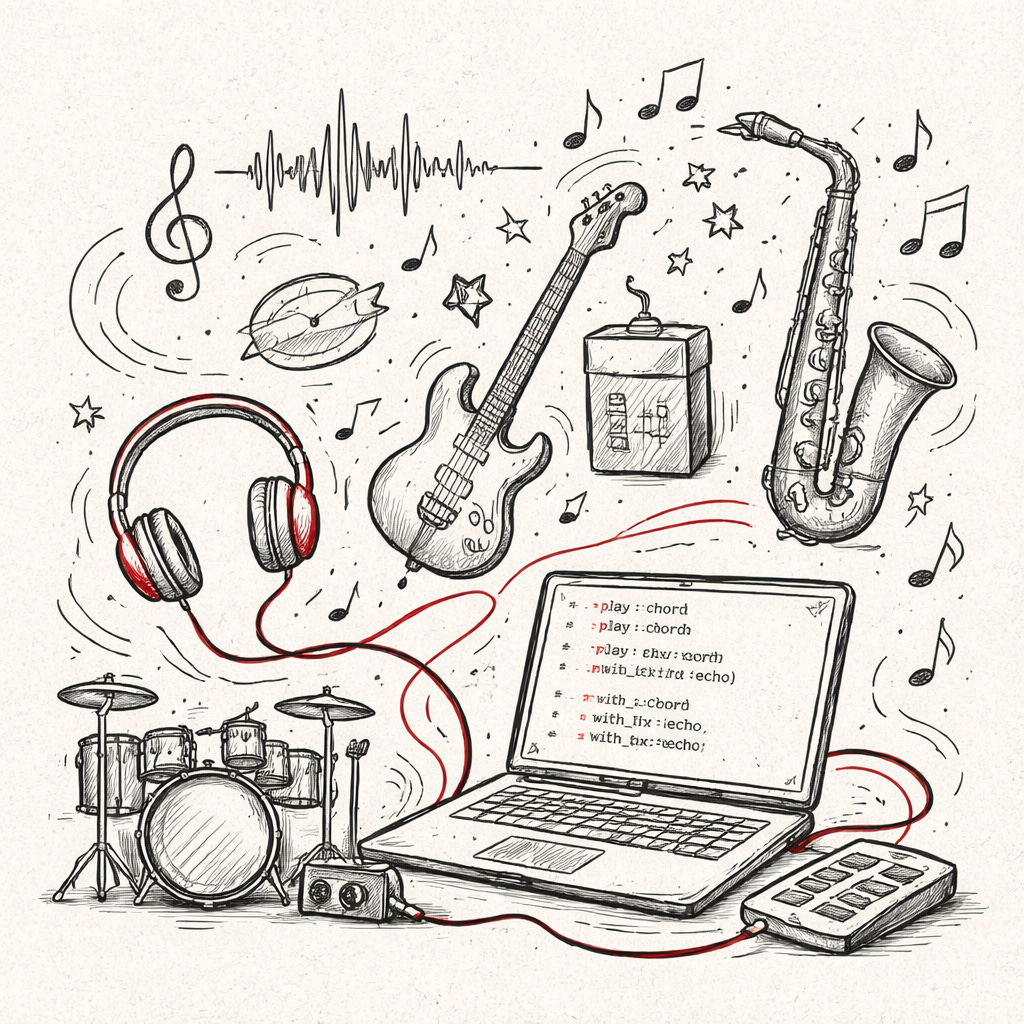
Image: By ChatGPT
Code-driven music vs traditional AI music generators
Most popular AI music platforms work like this:
Traditional music LLM generators
Prompt → audio file
Closed models
No control over structure
Hard to edit or reproduce
Limited live performance use
They are great for:
Fast demos
Background music
Non-technical users
But they are not ideal if you want to learn, tweak, or build systems.
Code-to-music systems (like this experiment)
Code → sound engine → music
Fully transparent
Modular and hackable
Works live or offline
Easy to remix, extend or automate
Instead of generating a song, you generate behaviour.
That’s a big difference.
The DIY setup used here (simple and free)
Tool: Sonic Pi
Free and open-source
Runs on Mac, Windows and Linux
Designed for beginners
Uses readable, simple code
You write small pieces of code like:
“Play these notes”
“Repeat every bar”
“Add delay, reverb, swing”
The result is real-time sound.
No machine learning model is running music generation.
The “intelligence” is in the structure you design.
How does this compare to other creative platforms?
Sonic Pi
Best for beginners
Immediate results
Educational and performative
Lightweight and fast
TidalCycles / FoxDot
More complex
Extremely powerful for rhythm and patterns
Better for experienced coders
Max/MSP / Ableton Max
Visual and flexible
Heavy setup
Steeper learning curve
Browser tools (Tone.js, p5.js)
Easy sharing
Web-native
Great for interactive music
All of these let you export sound or MIDI into traditional DAWs if needed.
Where AI still fits in
Large language models (like GPT-style systems) are still advantageous here, just not as music generators.
They work best as:
Code assistants
Idea expanders
Structure designers
You ask the AI to write music code, not music files.
Then the sound engine does the rest.
Why this approach is powerful
You can rebuild the same track forever
You can change tempo, mood or structure instantly
You can perform live or automate systems
You learn how music actually works
This is creative engineering, not content generation.
Try it yourself
Play the three audio files (download them at the beginning of the article):
Mix.wav
Jazz.wav
Rock.wav
Then:
Install Sonic Pi
Create code e.g. using ChatGPT
Press Run
Change one line
Hear a new result
That’s a creative machine.
Example of code used for Jazz.wav:
# ============================================================
#  ARENA ECHO ANTHEM — original stadium-rock vibe
#  ============================================================

use_debug false

# --------------------------
# CONTROL PANEL
# --------------------------
set :bpm, 124
set :energy, 0.82     # 0.5 chill -> 1.0 huge
set :key, :d2         # try :a1, :e2, :c2
set :drop_bar, 33     # when the big section hits (bars)

# --------------------------
# HELPERS
# --------------------------
define :chance do |p|
  rrand(0.0, 1.0) < p
end

set :bar, 0
define :tick_bar do
  set :bar, get(:bar) + 1
  get(:bar)
end

# Dotted-eighth delay time: in beats, dotted 8th = 0.75 beats
define :dotted_8th do
  0.75
end

# --------------------------------
# MASTER CLOCK (1 bar = 4 beats)
# --------------------------------
live_loop :clock do
  use_bpm get(:bpm)
  tick_bar
  cue :bar_tick
  sleep 4
end

# --------------------------------
# CHORD PROGRESSION (anthemic)
# --------------------------------
# Using a classic uplifting movement (original content; common harmony)
define :prog_chords do |k|
  [
    chord(k, :major, invert: 1),
    chord(k + 5, :major, invert: 1),
    chord(k + 7, :major, invert: 2),
    chord(k + 2, :minor, invert: 1)
  ]
end

# --------------------------------
# "EDGE-LIKE" ECHO GUITAR (synth)
# --------------------------------
live_loop :echo_guitar, sync: :bar_tick do
  use_bpm get(:bpm)
  k = get(:key)
  e = get(:energy)
  b = get(:bar)

  chords = prog_chords(k + 12)  # up an octave
  ch = chords[(b - 1) % chords.length]

  # intro is sparse, then gets denser, then drop gets full
  intro = b < 9
  pre   = (b >= 9 && b < get(:drop_bar))
  drop  = b >= get(:drop_bar)

  density =
    if intro then 6
    elsif pre then 10
    else 14
    end

  amp = (intro ? 0.35 : pre ? 0.55 : 0.85) + e * 0.25

  with_fx :reverb, room: 0.9, mix: 0.35 do
    with_fx :echo, phase: dotted_8th, decay: 6, mix: 0.45 do
      with_fx :hpf, cutoff: 70 do
        use_synth :pluck
        density.times do
          n = ch.choose
          # add sparkly extensions sometimes
          n += [0, 0, 0, 7, 12].choose

          play n,
            release: 0.12 + rrand(0.02, 0.08),
            amp: amp * (chance(0.12 + e * 0.08) ? 1.25 : 1.0),
            pan: rrand(-0.4, 0.4),
            cutoff: 90 + e * 25 + rrand(-10, 10)

          sleep 0.25
        end
      end
    end
  end
end

# --------------------------------
# BASS (steady, driving)
# --------------------------------
live_loop :bass, sync: :bar_tick do
  use_bpm get(:bpm)
  k = get(:key)
  e = get(:energy)
  b = get(:bar)

  chords = prog_chords(k)
  roots = chords[(b - 1) % chords.length].sort.take(1) # root-ish
  r = roots[0]

  drop = b >= get(:drop_bar)

  with_fx :lpf, cutoff: (drop ? 85 : 75) + e * 20 do
    with_fx :distortion, distort: (drop ? 0.2 : 0.1) + e * 0.15, mix: 0.2 do
      use_synth :fm
      8.times do |i|
        # little push on the "and" after drop
        accent = (drop && (i == 3 || i == 7)) ? 1.15 : 1.0
        play r,
          release: 0.12,
          amp: (0.55 + e * 0.55) * accent,
          depth: 1.2 + e,
          divisor: 2
        sleep 0.5
      end
    end
  end
end

# --------------------------------
# DRUMS (big room feel)
# --------------------------------
live_loop :drums, sync: :bar_tick do
  use_bpm get(:bpm)
  e = get(:energy)
  b = get(:bar)

  intro = b < 9
  pre   = (b >= 9 && b < get(:drop_bar))
  drop  = b >= get(:drop_bar)

  kick_amp = (intro ? 0.7 : pre ? 1.0 : 1.6) + e * 0.8
  sn_amp   = (intro ? 0.35 : pre ? 0.7 : 1.25) + e * 0.6
  hat_amp  = (intro ? 0.18 : pre ? 0.28 : 0.45) + e * 0.4

  with_fx :reverb, room: 0.85, mix: (drop ? 0.25 : 0.18) do
    with_fx :compressor, threshold: 0.2, clamp_time: 0.01, relax_time: 0.12 do
      16.times do |i|
        # Kick: four-on-the-floor, plus extra push at drop
        if (i % 4 == 0) || (drop && chance(0.12 + e * 0.1) && i == 10)
          sample :bd_tek, amp: kick_amp
        end

        # Snare: 2 and 4 (big)
        if i == 4 || i == 12
          sample :sn_dub, amp: sn_amp
          sample :sn_zome, amp: sn_amp * 0.35 if drop
        end

        # Hats: more motion as song builds
        if chance(intro ? 0.35 : pre ? 0.55 : 0.75)
          sample :drum_cymbal_closed, amp: hat_amp, pan: rrand(-0.2, 0.2), rate: [0.95, 1, 1.05].choose
        end

        # Big open hat / crash moments
        if (i == 0 && !intro) || (drop && (i == 0 || i == 8) && chance(0.6))
          sample :drum_cymbal_open, amp: 0.35 + e * 0.6
        end

        sleep 0.25
      end
    end
  end
end

# --------------------------------
# PAD + LIFT (cinematic glow)
# --------------------------------
live_loop :pad, sync: :bar_tick do
  use_bpm get(:bpm)
  k = get(:key)
  e = get(:energy)
  b = get(:bar)

  chords = prog_chords(k + 12)
  ch = chords[(b - 1) % chords.length]

  intro = b < 9
  drop  = b >= get(:drop_bar)

  with_fx :reverb, room: 0.95, mix: 0.55 do
    with_fx :hpf, cutoff: 55 do
      use_synth :hollow
      play ch,
        attack: (intro ? 1.8 : 0.8),
        sustain: 2.2,
        release: 2.5,
        amp: (intro ? 0.25 : 0.35) + e * (drop ? 0.45 : 0.25),
        cutoff: 75 + e * 25
    end
  end

  # simple "lift" riser into drop
  if b == get(:drop_bar) - 1
    with_fx :reverb, room: 0.95, mix: 0.6 do
      with_fx :sweep, mix: 0.5 do
        sample :ambi_glass_rub, amp: 1.0 + e, rate: 0.8 + e * 0.3
      end
    end
  end

  sleep 4
end

# --------------------------------
# "HOOK" LEAD (anthem top line)
# --------------------------------
live_loop :hook, sync: :bar_tick do
  use_bpm get(:bpm)
  k = get(:key)
  e = get(:energy)
  b = get(:bar)

  # only after the drop, so it feels like a chorus
  stop if b < get(:drop_bar)

  sc = scale(k + 24, :major_pentatonic, num_octaves: 1)
  phrase = [0, 2, 4, 2, 0, 2, 7, 6] # simple singable hook (degrees)
  base = sc[0]

  with_fx :reverb, room: 0.9, mix: 0.35 do
    with_fx :echo, phase: 0.375, decay: 4, mix: 0.35 do
      use_synth :prophet
      8.times do |i|
        n = base + phrase[i]
        play n, release: 0.25, amp: 0.18 + e * 0.35, cutoff: 95 + e * 15
        sleep 0.5
      end
    end
  end
end
Final thought
AI doesn’t have to replace creativity.
It can help you build instruments instead of outputs.
If you want to shape sound, not just consume it,
code-based music is one of the most exciting places to start.
Excellent framing on transparency vs black-box generation. The distinction between generating outputs vs generating behavior is key. I built similar rule-based systems for visual art using p5.js and the editability factor changes everything since the artifact becomes a living system not a frozen asset. Only downside is explaining to stakeholders why the "AI" isn' t doing the work when really the AI just shifted from generator to coauthor.