

YourAISlopBoresMe: the “anti-chatbot” game that accidentally explains the next internet cycle
A small website has become a big cultural tell.
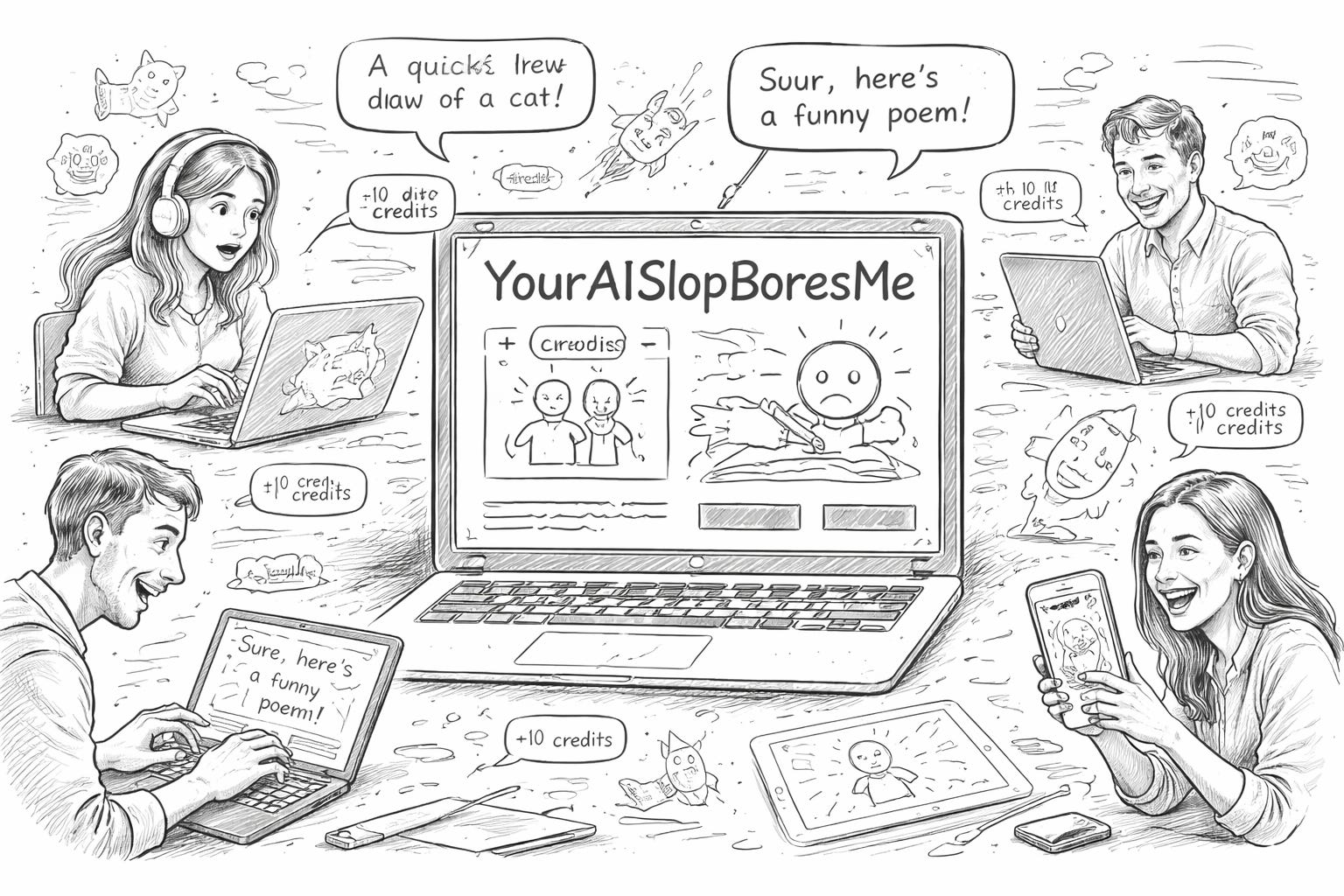
youraislopbores.me (often shared as “your ai slop bores me”) is going viral because it does something oddly satisfying: it makes people play the role of the model. You ask a question, but a random human answers it “as the AI”. You want an image, a stranger draws it. You want a copy; someone bangs it out. It’s part parody, part therapy, part social game.
Fast Company describes it as a people-powered chatbot designed by programmer Mihir Maroju, created out of frustration with low-effort generative content and a desire to bring back “early internet vibes” — and it reportedly hit huge traffic and concurrency within days. (source: Fast Company)
Kotaku captures the key mechanic: before you can ask for answers, you have to “LARP as AI” yourself, producing text or drawings on a tight clock to earn tokens you then spend on your own prompts. (source: Kotaku)
If that sounds like a throwaway meme, it isn’t. This little game is a clean lens on three things that matter to anyone building products, brands, or strategy right now:
People are exhausted by AI slop.
People still want the interface benefits of AI (instant requests, low friction).
People are willing to trade “quality” for aliveness.
First: what the game is really selling
On paper, it’s simple: a prompt goes in, an answer comes back. In reality, it sells four emotions:
Relief: “At least it’s not another synthetic blob.”
Risk: a human might be hilarious, rude, brilliant, or nonsensical.
Recognition: you can feel there’s a person on the other side.
Play: the whole thing is a performance of a performance.
That last point is the hook. For two years, everyone has been role-playing with chatbots. Now they’re role-playing as the chatbot. It’s the internet doing what it always does: absorbing the new power, then turning it into a game.
The “slop” part matters more than the “AI” part
“AI slop” has become shorthand for high-volume, low-soul content: filler posts, spammy images, bland SEO pages, cheap ebooks, dead-eyed ads. Wikipedia’s definition is blunt: low-quality generative content, produced in bulk, optimised for attention and monetisation. (source: Wikipedia)
The important bit isn’t whether something is AI-made. It’s whether it feels disposable.
YourAISlopBoresMe works because it flips that feeling. Even if the answer is objectively worse than a modern model, it carries effort, time, and personality. A messy stick figure drawn by a stranger can feel more “real” than a perfect diffusion image—because it contains human limitations.
That is a warning sign for anyone betting that “cheaper content” automatically means “better business”.
A small design trick with big implications: enforced scarcity
Most AI products market abundance:
infinite drafts
endless variations
unlimited regen
This game quietly markets the opposite:
you earn credits by doing labour
you spend credits to request labour
you can’t scale yourself instantly
That scarcity changes behaviour.
In abundance mode, users become careless. Prompts get lazy. Outputs get skimmed. Everything becomes disposable because it is cheap to replace.
In scarcity mode, users become intentional. You ask fewer questions, but you care more about the answer. You treat the response like an interaction, not a download.
If you build tools for knowledge work, marketing, research, or design, this is the uncomfortable takeaway:
Unlimited generation trains users to value nothing.
And once users value nothing, they don’t pay for much either—unless you can prove hard ROI.
Why it’s spreading: it’s a screenshot machine
Virality here is not just “people like it”. It’s structural.
YourAISlopBoresMe produces shareable artefacts in seconds:
absurd requests
unpredictable human replies
low-stakes humour
“look what I got” screenshots
This is the same mechanic that made early Twitter strong (quote-worthy one-liners) and made early meme forums sticky (remixable outputs). Generative AI platforms should be screenshot machines, but most outputs look the same. When aesthetics converge, shareability drops.
This site forces divergence because every “model” is a different human with different tastes, moods, language skills, and patience.
So the product lesson is simple:
If your outputs are too consistent, your users won’t market you for free.
The hidden subtext: labour, value, and the human-in-the-loop lie
There’s another reason the game lands: it’s a joke that points at a truth.
A lot of “autonomous AI” is actually:
human raters
content moderators
data labelers
outsourced QA
invisible clean-up work
YourAISlopBoresMe makes that visible by turning it into the main gameplay loop. You want answers? Do the work. You want volume? Recruit more humans. The “model” is literally people.
That creates a strange mirror:
In the real economy, humans are hidden behind the AI.
In the game, the AI is a costume humans wear.
Either way, someone is doing rushed, timed labour. The only difference is whether you admit it.
So what should leaders do with this insight?
Here are practical moves—less “AI strategy”, more “internet reality”.
1) Treat “anti-AI” as a product segment, not a political opinion
Some users aren’t “anti-technology”. They’re anti-waste. They hate spam, repetition, and low-effort surfaces.
You can serve them without preaching:
label provenance clearly (human, AI-assisted, AI-generated)
build “slow modes” (limited regens, intentional prompts)
reward edits and curation, not raw generation
In other words: sell taste, not tokens.
2) Design for presence, not just performance
For many workflows, a slightly worse answer that feels alive will beat a better answer that feels generic.
Add presence cues:
lightweight personality controls
visible reasoning steps (when useful)
signed responses (teams, individuals, or roles)
deliberate constraints that create style
Constraint is not a bug. It’s a brand.
3) Stop measuring success only as “cost per asset”
If you only chase lower cost per email, per banner, per post, you will flood your own channels with sameness. You’ll win the spreadsheet and lose the audience.
Measure:
re-read rate
share rate
reply quality
downstream trust (complaints, churn, unsubscribes)
If your content is cheap and ignored, it’s still expensive.
4) Build “human remix loops” into AI tooling
The game is basically: prompt → response → screenshot → remix → repost.
Most enterprise AI flows are: prompt → response → paste into doc → done.
Add the loop:
internal galleries of “best answers”
remix buttons that encourage improvement, not regeneration
peer review baked into the tool
You don’t need a meme site. You need the energy of one.
The bigger signal: we’re moving from “AI wow” to “AI fatigue management”
The last wave was about capability shock: “Look what it can do.”
The next wave is about attention hygiene: “Please stop making my world noisier.”
YourAISlopBoresMe sits right on that pivot. It’s funny, but it’s also a protest sign you can play.
And that’s the strategic point to hold onto:
The winning products won’t just generate faster. They’ll help people feel less bored, less manipulated, and more connected.