

An email from OpenAI arrived in my inbox with a date: 1 April 2027. Access to GPT-5.4 nano, GPT-5.3-Codex and GPT-5.1 would end. The message described this as part of a continuous upgrade process and pointed towards replacement models.
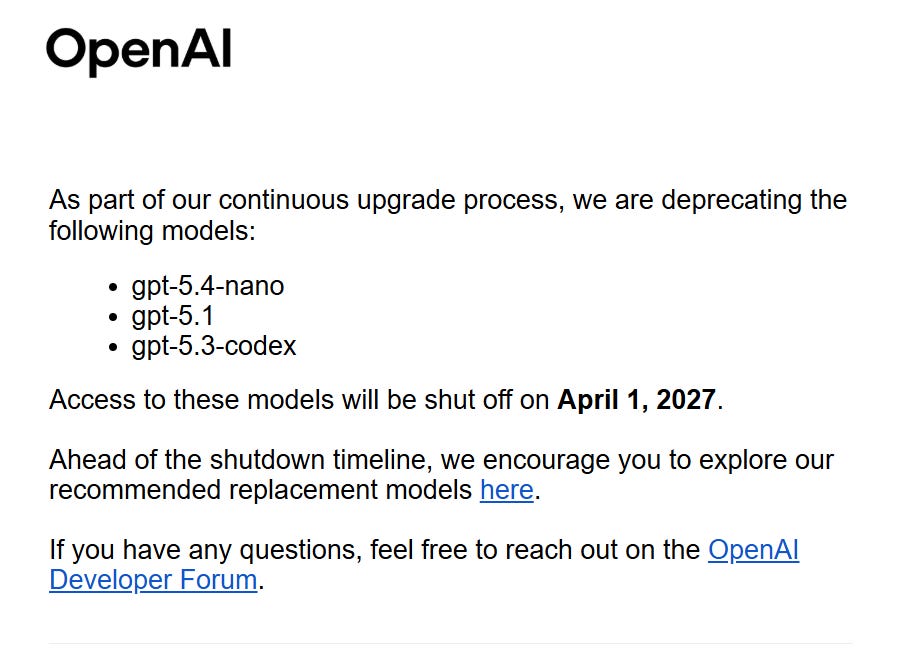
Email from 1st october 2026
For the supplier, this is product maintenance. For a company that has built a working system around one of those models, it creates another project, another validation exercise and another deadline it did not choose.
The uncomfortable question is how to build dependable operations on a component whose retirement may already be approaching by the time you finish implementing it.
The published deprecation notice confirms the deadline. Measured from their API releases, GPT-5.1, GPT-5.3-Codex and GPT-5.4 nano will have been available for approximately 16.6, 13.2 and 12.5 months, respectively. Those figures describe scheduled availability. They say nothing about how much settled, productive operation a customer gets.
The historical comparison needs care. Some older versions have substantially longer lives: GPT-4 0613 is scheduled to reach roughly 40 months, and the original GPT-4o snapshot about 29. Yet two early GPT-3.5 Turbo versions lasted around 15 and 18 months. There is no neat, uninterrupted decline. These are selected versions with known retirement dates, not evidence that every generation or provider follows the same pattern.
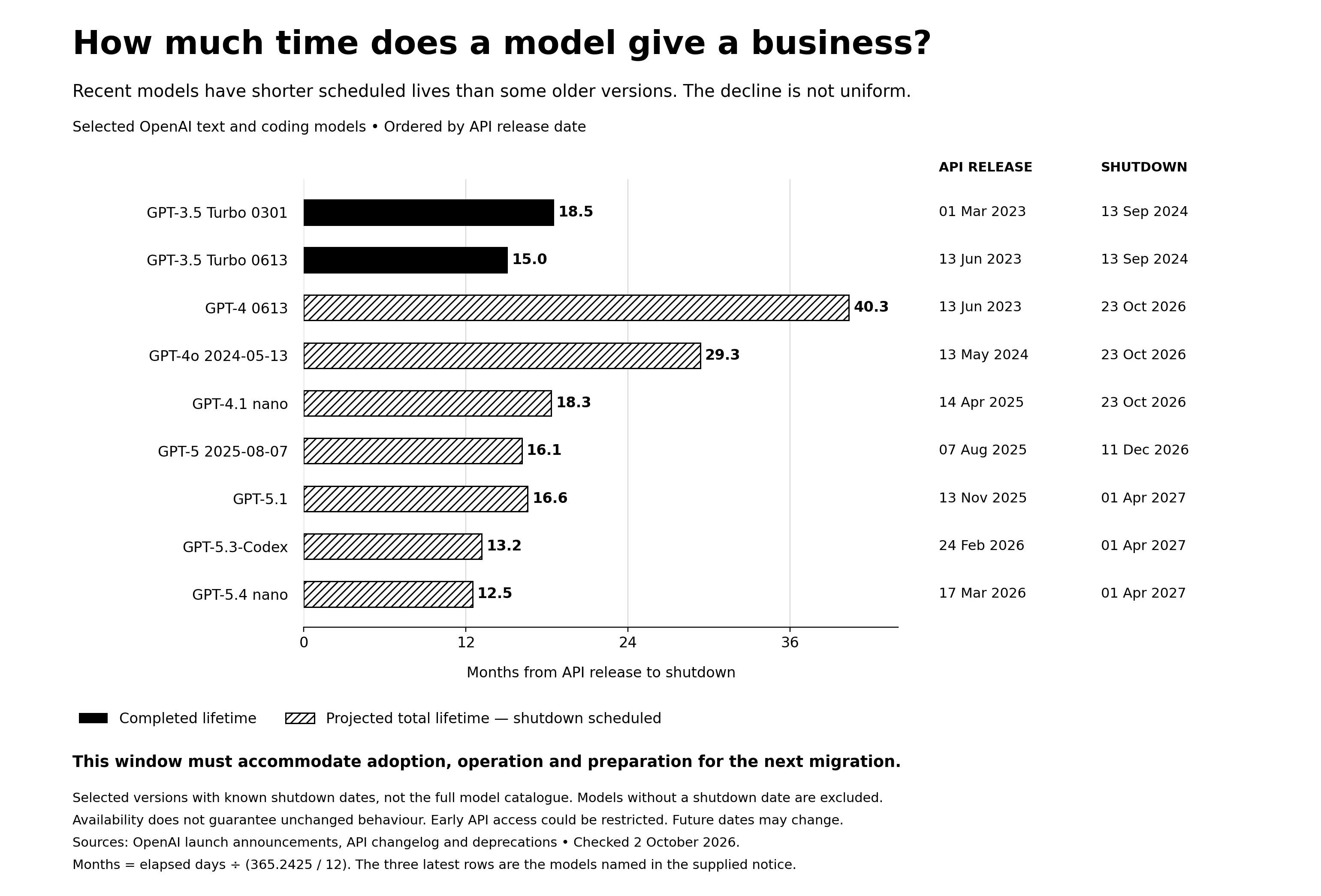
The comparison does show that a business adopting these recent models cannot assume the longer operating horizon offered by some predecessors. Release dates come from OpenAI’s announcements and API changelog; retirement dates are actual or scheduled, as marked in the chart.
A model’s commercial lifetime has to accommodate several kinds of work. First, the company tests it, adapts its prompts, connects its data and tools, and establishes what counts as acceptable performance. Then it deploys the system and lets it earn its place. Before access ends, it must test and implement the successor.
These activities can overlap. The current system may keep producing value while the team evaluates its replacement. But the same calendar must contain both efforts, and the same team may have to deliver them.
Consider a hypothetical model available for 13 months. A business adopts it three months after release and spends another three reaching production. Seven months remain before shutdown. If it reserves the final three for validating and deploying the successor, it gets four months of operation before the next migration project begins. It may keep operating during that transition, but it is already paying to replace what it has just built.
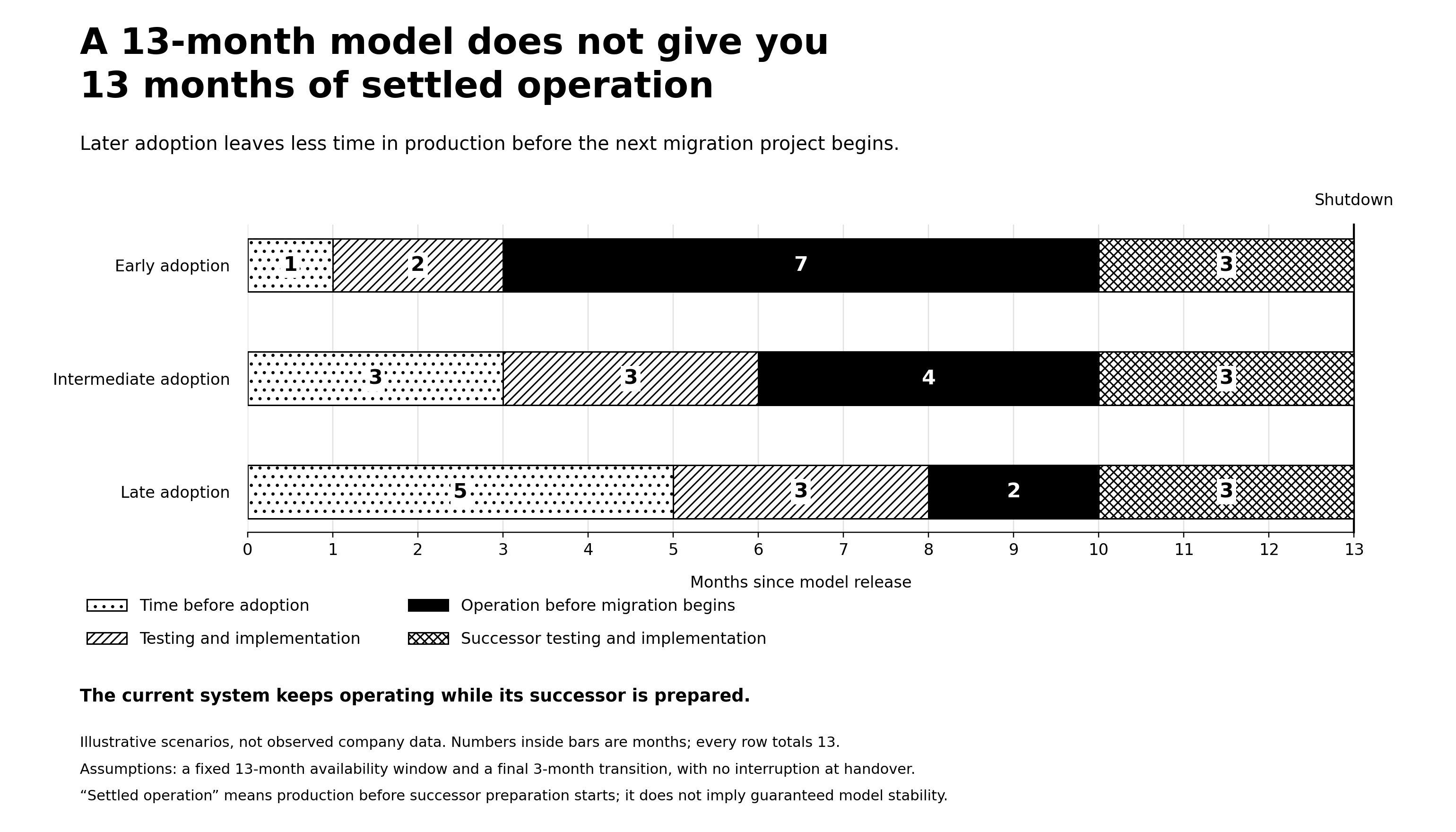
This is why launch-to-shutdown duration overstates the practical window. Companies buy into a running clock. Procurement, integration and testing consume part of it before the system produces anything useful.
Changing a model name can be technically straightforward. Establishing that the resulting system still behaves acceptably is a different task.
Keep the same prompt, documents and tools, and a replacement may interpret an exception differently, escalate fewer cases, become more willing to infer missing information or take a different sequence of actions. A response can satisfy the required format while expressing the wrong judgement. A better average benchmark score cannot establish equivalence for a particular workflow.
OpenAI itself acknowledged this problem in 2023: improvements across most evaluation metrics could coexist with worse performance on particular tasks. It offered pinned versions to give developers greater stability. Pinning helps only while that version remains available.
Imagine a customer-service system that drafts refund decisions for approval. The replacement model writes clearer explanations and handles more languages, but interprets ambiguous complaints more generously. Nothing crashes. Every field arrives correctly. Nevertheless, more refunds are recommended, review workloads change and the economics move. This is an illustrative scenario, but it captures the mechanism: an apparently successful migration can change the business process.
A reasonably stable generative system is possible. Stability means keeping outcomes within defined tolerances, rather than expecting identical wording every time.
The company needs evidence that belongs to the application: representative cases, known failures, acceptable decisions and limits on cost, delay and human intervention. OpenAI’s own evaluation guidance recommends task-specific tests and evaluation after changes. The successor has to earn acceptance against those requirements.
Rules that must hold should also be enforced outside the model wherever practical. A model can recommend a refund; application code can check the authorised amount and require approval. That reduces how much business policy depends on a changing interpretation of a prompt.
Running old and new versions against the same cases helps expose differences before migration. A staged rollout leaves room to intervene. Yet rollback has a deadline too: once the old service disappears, returning to it is no longer an option. The fallback must then be another validated route, reduced functionality or human handling.
All of this costs money. Lower inference prices can coexist with higher total operating costs if repeated migrations consume engineering and domain expertise. Providers have legitimate reasons to retire models, including efficiency and the burden of maintaining older systems. Customers have equally legitimate reasons to want their investment to last.
That tension belongs in procurement. Minimum support periods, meaningful overlap between versions and credible migration assistance should carry weight alongside price and capability. Self-hosting a model whose weights are available can give an organisation more control over retirement, but it shifts infrastructure and maintenance responsibilities. There is no cost-free escape.
The email’s most consequential message was therefore a change to the investment horizon. A business needs enough time to validate a model, deploy it, benefit from it and qualify its successor. When those activities occupy most of the available lifetime, permanent transition becomes part of the operating model and part of the business case.
A supplier can announce an upgrade. The customer still has to prove that its system works again.