

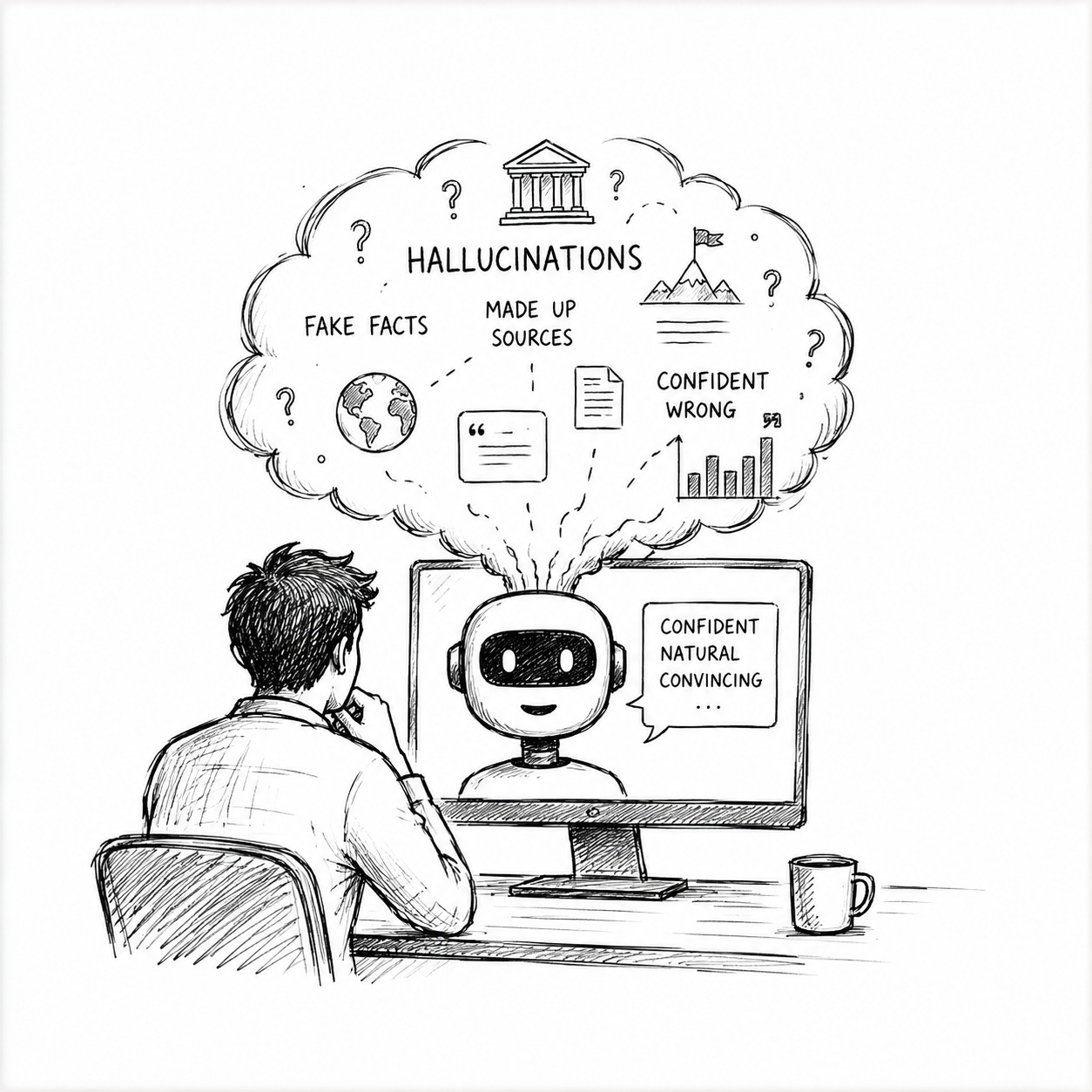
When people hear the word hallucination, they imagine AI inventing fake facts, fake court cases or fake statistics. Those mistakes are easy to spot, which is exactly why they’re not the ones businesses should worry about.
The dangerous hallucinations are the ones that look perfectly reasonable.
A contract summary that misses one important clause. A customer email classified incorrectly. A report that mixes outdated information with new facts. A recommendation that sounds convincing but isn’t actually supported by the data. Individually, these errors seem harmless. At scale, they become expensive decisions.
The problem is that most companies think hallucinations are rare events. They’re not. They are a natural consequence of how large language models work. AI doesn’t “know” things in the way people do. It predicts the next most likely words based on patterns it has learned. Most of the time, probability and reality overlap. Sometimes they don’t. That’s not a software bug; it’s the nature of the technology.
The real question, then, isn’t whether your AI hallucinates. It does. The question is whether you know how often, where, and what happens when it does.
Most organisations don’t.
Instead, they measure adoption. How many employees use AI. How many workflows were automated. How many hours were saved. Those numbers make great presentations, but they say almost nothing about reliability. Very few companies can answer far more important questions: How often is the AI wrong? Which mistakes matter most? Has performance improved over time, or is it slowly getting worse?
Ironically, the better AI becomes, the harder these problems are to detect. Early models made obvious mistakes. Today’s models make believable mistakes. And believable mistakes are far more dangerous because people stop questioning them.
This is why buying a better model isn’t enough. Better prompting isn’t enough. More documents in your RAG system aren’t enough. None of these eliminates hallucinations. They simply change where and how they appear.
The companies that succeed with AI won’t be the ones with the smartest models. They’ll be the ones that can measure, monitor and continuously verify what their AI is doing.
Because the biggest risk isn’t that AI hallucinates.
It’s that your business has no idea when it does.