

People ask this question as if there’s one clean date. There isn’t.
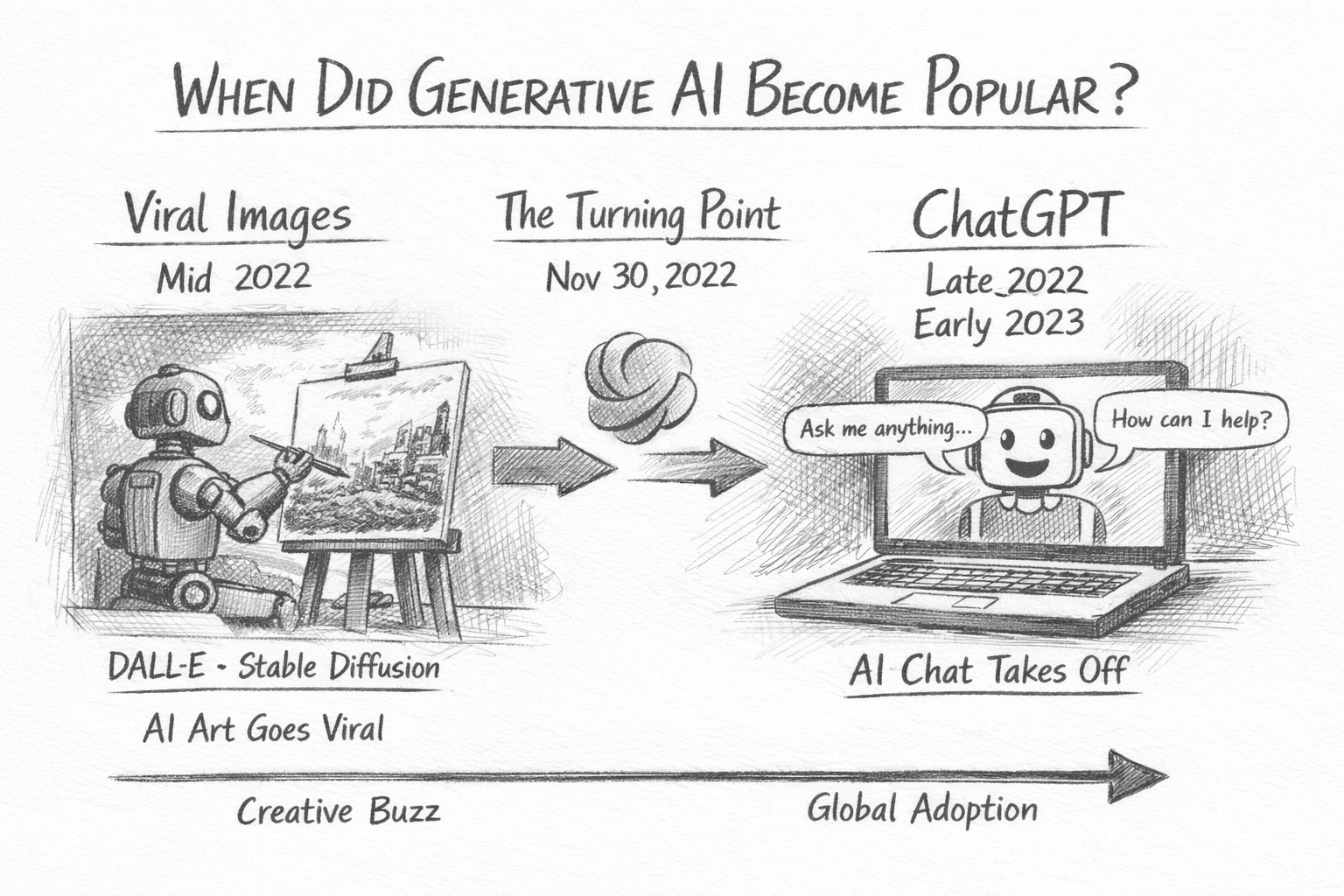
Generative AI became “popular” in two different ways:
Popular as a cultural object (memes, images, social feeds, creators).
Popular as a mainstream utility (workflows, classrooms, boardrooms, customer service).
Those two waves arrived months apart, and that gap matters because it explains why some companies felt blindsided while others felt “we saw this coming”.
The simplest answer
Mid-2022: generative AI becomes widely visible through text-to-image tools (the “wow” phase).
Late-2022 to early-2023: generative AI becomes widely used through ChatGPT (the “habit” phase).
ChatGPT’s public release on 30 November 2022 is the cleanest single marker for mass-market attention. (OpenAI’s announcement is here: https://openai.com/index/chatgpt/ (OpenAI))
But if you want the real answer — the one you can use in strategy, investment memos, or product roadmaps — you need a better definition of popular.
Popular with whom?
Popularity is not a single thing. It’s a sequence of audiences.
1) Researchers and engineers (before it was “popular”)
By 2021, generative AI was already serious technology in labs. The capability curve was rising fast, but it wasn’t yet socially contagious. The outputs weren’t easy to share, and the tools weren’t simple enough for non-technical people to use daily.
This is the part many executives miss: the tech can be “ready” long before the market is “ready”.
What changed wasn’t just model quality. It was a distribution.
2) Creators and online communities (the 2022 “shareable” wave)
In 2022, generative AI became publicly legible. People didn’t need to understand machine learning to feel the impact — they could see it.
Two things helped:
The output was instantly shareable (images work better than demos).
The feedback loop was fun (prompt → surprise → post → reactions → more prompts).
A key moment here was the public release of Stable Diffusion on 22 August 2022, which accelerated experimentation by making it broadly accessible and developer-friendly. (Stability AI’s release note: https://stability.ai/news/stable-diffusion-public-release (Stability AI))
This is when generative AI became “popular” in the way TikTok makes things popular: fast, visual, remixable.
If you remember the internet filling with synthetic portraits, fake film stills, “in the style of…” art, and brand parodies — that was this phase.
3) Everyone else (the 2023 “utility” wave)
The second wave was bigger: generative AI became a general-purpose tool. Not a novelty. Not a creator toy. A daily assistant.
ChatGPT’s release made two breakthroughs at once:
The interface was natural language (no learning curve).
The value appeared in minutes (summarise, rewrite, draft, plan, explain).
That combination turns curiosity into habit — and habit is what drives mass adoption.
By January 2023, analysts estimated ChatGPT had reached 100 million monthly active users, making it one of the fastest-growing consumer apps on record. (Reuters coverage: https://www.reuters.com/technology/chatgpt-sets-record-fastest-growing-user-base-analyst-note-2023-02-01/ (Reuters))
That’s the point where “generative AI” stopped being a category and started being a line item.
The better question: what caused popularity?
If you’re trying to predict the next popularity moment (for agents, multimodal, video, voice, robotics), focus less on model releases and more on what made 2022–2023 explode.
Here are the practical ingredients.
1) A zero-friction “first win”
The first win has to be immediate.
For image models: type a sentence, get a picture.
For ChatGPT: ask a question, get a decent answer.
No procurement. No integration. No training course. No “we’ll see value in Q4”.
This matters because adoption isn’t rational. It’s behavioural. People don’t adopt tools. They adopt moments of relief (“this saves me time”) or moments of delight (“this is magic”).
2) Outputs that travel
Popularity requires distribution channels.
In 2022, AI-generated images circulated on social feeds. In late 2022, ChatGPT travelled through screenshots and “try this prompt” threads. Each output acted like a mini advert created by users.
If your generative product doesn’t produce shareable proof, you’ll grow slower than the tech suggests you should.
3) A story people can repeat
Stable Diffusion and ChatGPT had simple stories:
“It makes art from words.”
“It talks like a person.”
That’s not marketing fluff. It’s adoption physics. If the story can’t be repeated accurately in one sentence, it doesn’t spread.
4) A “replacement” narrative
Generative AI got popular when it was perceived as replacing something real:
stock images
basic copywriting
summarisation
first drafts
email replies
study notes
customer support scripts
Whether it truly replaced those things at a high quality is almost secondary. Perceived substitution is enough to trigger attention and experimentation — and experimentation drives real capability discovery.
So what date should you use?
If you need a single date for a slide, memo, or conversation, use one of these depending on what you mean by “popular”:
“Popular with the general public as a daily tool” → 30 Nov 2022 (ChatGPT launch). (https://openai.com/index/chatgpt/ (OpenAI))
“Popular in internet culture and creator communities” → Aug 2022 (Stable Diffusion public release). (https://stability.ai/news/stable-diffusion-public-release (Stability AI))
“Proven mass adoption at historic scale” → Jan 2023 (100M MAU estimate reported early Feb 2023). (https://www.reuters.com/technology/chatgpt-sets-record-fastest-growing-user-base-analyst-note-2023-02-01/ (Reuters))
Personally, if your goal is understanding market behaviour, the best framing is:
Generative AI became culturally popular in 2022 — and operationally popular in early 2023.
That distinction is useful because it tells you what to look for next: the moment a capability stops being impressive and starts being normal.
The insight executives keep missing
Generative AI became popular when it crossed three thresholds at the same time:
Good enough to feel competent, even with mistakes
Cheap enough to be tried without permission
Easy enough to become habitual
When those three align, adoption doesn’t rise gradually — it flips.
That’s why the next big jump likely won’t come from a slightly better model. It will come from a slightly better product loop: agents that actually finish tasks, voice that actually works in noisy environments, video that’s actually controllable, and enterprise deployments that don’t feel like ERP projects.