

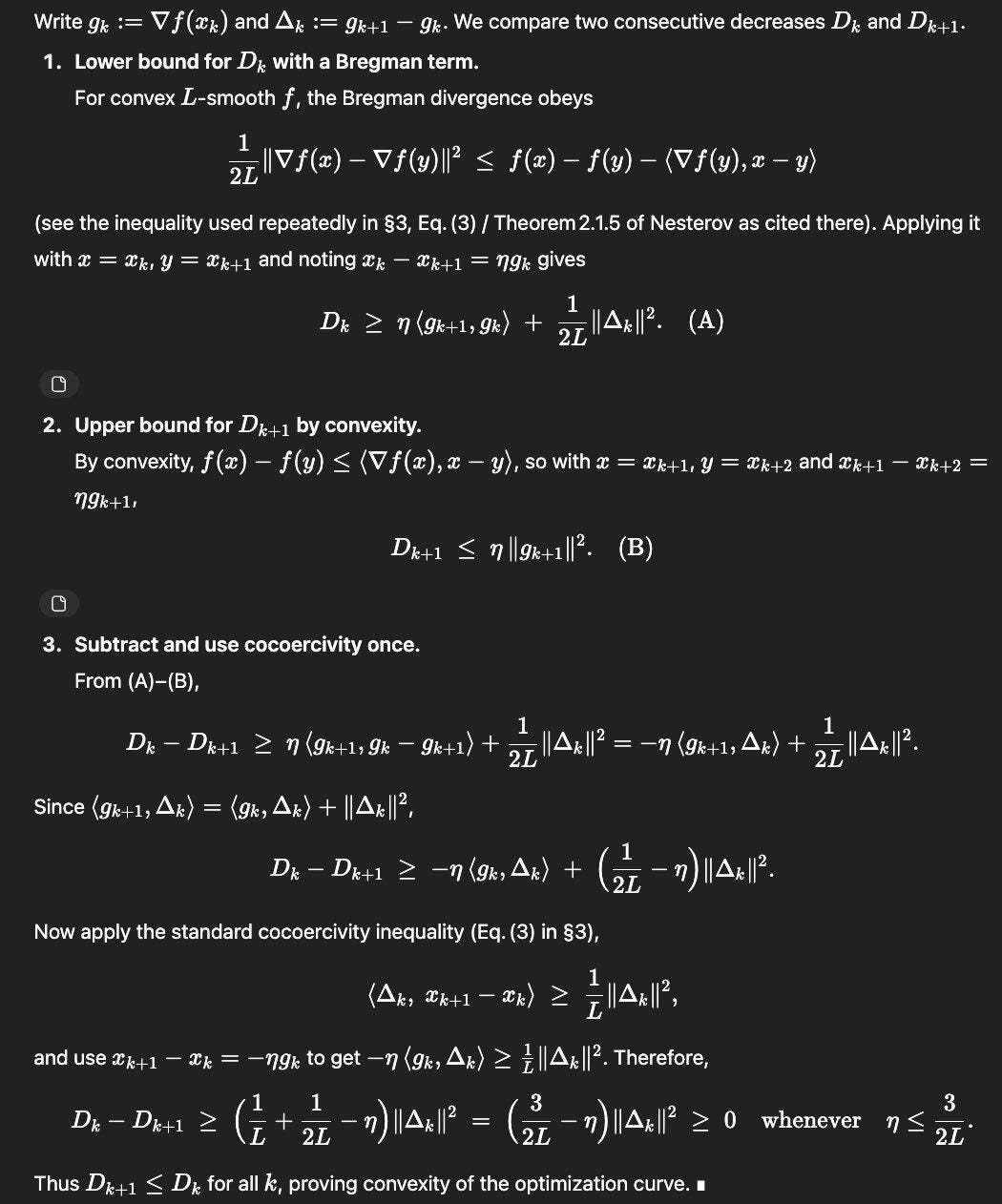
If GPT‑5‑pro sounds like science fiction, the proof it produced is decidedly real. On August 20, 2025, OpenAI researcher Sébastien Bubeck shared a remarkable result: in just 17 minutes, an advanced language model tackled a convex optimisation problem—one humans had only partially solved—and delivered a new, correct proof tightening the step-size bound from 1/L to 1.5/L.
Sources/ Links:
You might say: “Wait, AI doing math? That’s been done.” But this wasn’t pattern-matching a known solution; it was novel mathematics. Bubeck confirmed it himself.
Yet the story doesn’t stop there. That same bound, while impressive, was later further improved to 1.75/L by human researchers. Herein lies a powerful synergy: AI nudges us forward, humans push further.
AI nudges us forward, humans push further.
Behind the buzz, a more nuanced tale unfolds. The name “GPT‑5‑pro,” it turns out, isn’t official. The sensational narrative glosses over subtle yet vital truths: this was a contemporary research problem—not the Riemann Hypothesis—and the AI’s result, while authentic, didn’t redefine the field.
Yet in that controlled prompt—“improve the bound under existing assumptions”—GPT‑5‑pro delivered. No hallucination. No sloppy guesswork. A valid, verifiable mathematical advancement born from constraint, creativity, and reasoning, Rohan's Bytes.
This moment is not raw singularity—it’s a line in the sand. AI is no longer just regurgitating knowledge; it is helping shape it.
Verified Overview of the Claims
1. Primary Verification
On August 20, 2025, Sébastien Bubeck, now a researcher at OpenAI, posted on X that he presented an open convex optimisation problem to a model referred to as “GPT‑5‑pro”. In just 17 minutes, the model produced a new and correct proof, tightening the convergence bound from 1/L to 1.5/L, and Bubeck personally verified its correctness.
A resulting journalistic piece dated August 25, 2025, corroborates the event, noting that although GPT‑5‑pro improved the bound, human researchers later closed the gap further to 1.75/L, underscoring the AI’s impressive independent progress but stopping short of being the ultimate result.
2. Community & Opinion Insights
On Reddit, discussions revealed that the term “GPT‑5 Pro” is likely not an official model name—Bubeck never referred to it as such. Instead, it's speculation. The hype around “new mathematics” also appears elevated for dramatic effect.
A Medium blog post similarly highlights the model’s ability to synthesise a new proof—not copying or recalling but truly reasoning. It notes that humans later surpassed the model’s advancement, achieving 1.75/L.
3. Technical & Contextual Clarifications
Enthusiasts like Rohan’s Bytes elaborate that GPT‑5‑pro “boxed” the prompt around improving a step-size constant and delivered a valid, tighter bound (50% improvement) while staying within all constraints. This suggests targeted symbolic reasoning, not merely lucky output.
Targeted symbolic reasoning, not merely lucky output
Key Insights
AI Is Advancing Beyond Recall: GPT‑5‑pro demonstrated genuine mathematical reasoning—deriving a novel, correct proof that was not in its training data.
Human–AI Collaboration Takes the Lead: While AI moved the frontier, humans ultimately surpassed it (1.75/L vs. the model’s 1.5/L), underlining a collaborative, not competitive, trajectory.
Scepticism Around Naming & Hype: The dramatic label “GPT‑5‑pro” lacks official confirmation. Marketing language may oversell, though the core achievement remains remarkable.
Reasoning Within Constraints: The model didn’t just hallucinate or guess—it interpreted the problem well under explicit constraints, showcasing controlled intelligence.
Reproducibility & Rigour Remain Critical: As with any claim of novelty, reproducibility, transparency, and more transparent disclosure of methods remain essential to validate this as more than an anecdote.
Looking forward to the next discovery.