

Ricardo Chaves’s Traduzir a Inteligência Artificial (Translating Artificial Intelligence) was published yesterday, 20 October 2026, by Oficina do Livro. Its subtitle promises to explain what AI is, how it works and how it creates value in practice. Across 408 pages, Ricardo shows why these questions belong together.
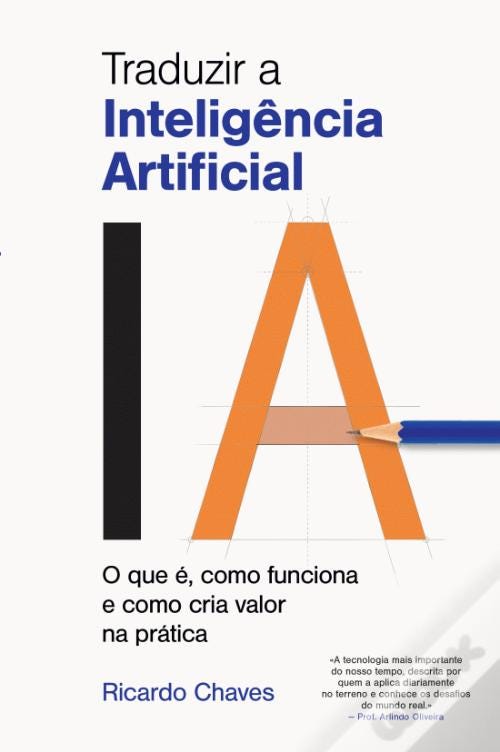
On the cover, Professor Arlindo Oliveira, who has devoted much of his career to the study of computing and artificial intelligence, describes it in words that go to the heart of the book:
“The most important technology of our time, described by someone who applies it daily on the ground and knows the challenges of the real world.”
— Professor Arlindo Oliveira (translated from the Portuguese)
Commentary on AI’s possibilities is abundant. Far fewer accounts connect scientific understanding with the difficulty of making it work inside an organisation.
I read an advance manuscript in August, and I intend to read it again. Ricardo is also a close friend. We have worked together for years, and when I interviewed him for Building Creative Machines in March 2025, it felt like a continuation of a decade-long conversation. Friendship explains my eagerness to read the book. Its substance explains why I want to return to it.
The patience to begin at the beginning
The book opens where many boardroom conversations now find themselves: between urgency, optimism and anxiety. AI has shaped daily life for years, often invisibly, yet generative tools have left many organisations using the technology without a clear method for directing it. Ricardo examines that gap, including shadow AI and the cost of failing to adapt.
He widens the lens to AI as a general-purpose technology, able to spread across sectors and activities. Breadth alone, however, creates little value. Scale demands processes, investment and people who can connect technical possibilities to business priorities. The book gives that role a name: the business translator.
It is an apt choice. Translation demands fluency in two worlds: enough knowledge of models to recognise their limits, and enough understanding of an organisation to know which problems deserve solving.
Rather than race towards the latest chatbot, Ricardo steps back into the history of intelligence: from biology and Aristotle’s logic to Leibniz, Turing, the birth of AI and the early perceptron. These are not decorative names. They reveal a discipline built through breakthroughs, false starts and rediscoveries.
That patience gives the technical chapters their force. From expert systems and hand-written rules, we reach machine learning: algorithms that learn patterns from data. Ricardo explains what a model aims to do, how it represents information, and how optimisation improves it. He gives equal attention to error, bias, variance and overfitting: learning yesterday’s examples so closely that the model fails tomorrow’s reality.
These foundations outlast particular products. A leader need not perform gradient descent by hand, but understanding what a model optimises, and where it may fail, changes the questions worth asking.

Credits: Wook
Where intelligence meets a decision
The book gives proper space to predictive AI, which predates the excitement surrounding ChatGPT. Decision trees, bagging, boosting and association algorithms become part of an evolving account of how machines identify patterns and make predictions.
Consider the book’s example of proactive customer-churn management. Predicting which customers might leave is a technical achievement. Deciding whom to contact, which intervention might help and how to measure its effect is a business achievement. A probability, however accurate, is not a strategy.
As Ricardo told me in 2025, “The bigger the impact, the harder the adoption funnel.” An AI system must survive messy data, established habits and organisational incentives. Above all, a decision is useful only when someone can act on it.
Ricardo then follows deep learning through neural networks, backpropagation, computer vision, sequence models and the hardware that made larger systems possible. By the time he reaches transformers and the attention mechanism behind modern language models, the reader has the context to understand them.
ChatGPT enters as the result of a much longer journey, not its starting point. Hallucinations, foundation models, reasoning systems and hybrid approaches are examined in the light of what preceded them. AlphaFold reminds us that AI’s most consequential applications may have little to do with conversation.
The movement towards agents, systems that use tools and carry out sequences of actions with some autonomy, raises the stakes. Allowing software to act requires a different level of reliability, oversight and judgement than producing a convincing answer.
The enduring part
Ricardo has spent more than a decade leading AI transformation, now leads Banco BPI’s AI Centre of Excellence and teaches executives. His perspective is shaped by both the underlying science and the real-world resistance.
What I admired in the August manuscript was its almost old-fashioned respect for explanation: establish where ideas came from, show how the machinery works, examine its errors, and only then ask what can be improved. It is a demanding sequence, but a generous one. It gives readers the means to think for themselves.
The names of leading models will change. Interfaces will come and go. Yet the distinction between prediction and decision, the problem of generalisation, the discipline of measurement and the difficulty of organisational change will remain.
For now, Traduzir a Inteligência Artificial is available only in Portuguese. I hope it reaches readers in other languages. The need to understand both the mathematics of a model and the consequences of putting it to work is universal.
I read this book before it had its finished cover. I will read it again now that it does. Some books tell us what to think about the latest technology. The better ones leave us better equipped to think when the technology changes. Ricardo has written one of those.