

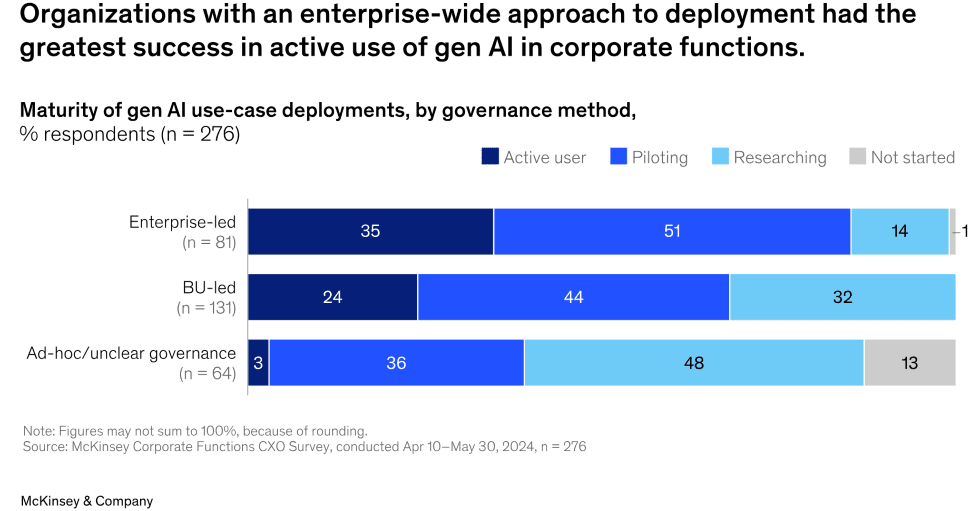
According to McKinsey’s recent report, companies find centralized, enterprise-wide governance is critical to achieving tangible results with Gen AI, as shown in the figure. While many organizations are in the early stages, those with structured approaches see tremendous success.
Enterprise-led Deployment: The Key to Successful AI Integration
McKinsey’s study highlights a critical insight: organizations that adopt an enterprise-wide approach to Gen AI deployment lead in the active use and scaling of Gen AI initiatives. Specifically, 35% of enterprise-led governance adopters actively use Gen AI, with 51% in the pilot stage. This compares favourably with business-unit-led (BU-led) and ad-hoc governance approaches, showing lower active use levels and more fragmented adoption stages.
The advantage of an enterprise-wide approach lies in consistency and alignment. By centralizing Gen AI efforts, these organizations can better prioritize high-impact use cases, manage security and ethical concerns, and ensure that AI capabilities integrate seamlessly into existing workflows. In contrast, organizations relying on BU-led or ad-hoc governance face challenges in scaling and standardizing Gen AI applications.
The Current Landscape and Potential of Gen AI in Business Functions
Currently, most organizations are leveraging Gen AI for efficiency-driven tasks such as automating workflows, data processing, and simple customer interactions. Finance departments, for instance, are using Gen AI to automate repetitive tasks and streamline report generation. In HR, AI-driven tools assist talent acquisition by screening resumes and scheduling interviews. Customer service applications focus on improving response times through AI-powered chatbots and virtual assistants.
However, McKinsey’s report indicates that while these efficiency-driven applications are valuable, they represent only the beginning of Gen AI’s potential. Leaders anticipate future applications beyond automation, aiming for strategic benefits like enhanced decision-making, real-time revenue forecasting, and even optimizing cash flow. The journey from automation to effectiveness is where Gen AI will offer the most transformative value.
Challenges and Barriers to Gen AI Adoption
Despite its potential, several barriers hinder Gen AI adoption. Concerns around data security, model accuracy, and ethical usage continue to weigh heavily on executives’ minds. Additionally, many organizations struggle to identify high-value use cases or to scale pilots into full deployments due to fragmented governance.
Centralized governance emerges as a solution to these issues. By ensuring a uniform approach to AI deployment, enterprise-led governance can address security concerns, streamline infrastructure investments, and provide a clear roadmap for Gen AI initiatives. McKinsey’s data reflects that organizations with enterprise-wide governance are ahead in active usage, suggesting that this approach mitigates risks and accelerates adoption.
Business Implications: Why Enterprises Should Consider a Centralized Approach
For C-level executives, the insights from McKinsey’s report underscore the value of centralized oversight in maximizing Gen AI’s impact. As companies look to move beyond pilot projects, enterprise-led governance models provide a structure for scaling AI across business units without compromising on data security, regulatory compliance, or alignment with business objectives.
A centralized approach also enables businesses to maximize returns on their AI investments. Rather than duplicating efforts across departments, enterprise-led models can identify and prioritize the highest-impact applications, ensuring efficient resource allocation and faster realization of AI-driven outcomes.
Future Opportunities: The Shift Toward Strategic Gen AI Applications
The future of Gen AI in corporate functions will likely shift towards strategic applications focused on effectiveness rather than pure efficiency. Potential applications include advanced analytics in finance, such as real-time forecasting, scenario analysis, and predictive insights. In customer service, Gen AI could enhance personalization at scale, delivering tailored responses based on user profiles and historical interactions. HR functions could benefit from AI-driven people analytics, aiding workforce planning and talent development.
McKinsey’s findings suggest that companies should prepare for this shift by building a robust AI governance framework now. By doing so, they will be well-positioned to capitalize on Gen AI’s evolving capabilities as the technology matures.
Conclusion
As Gen AI matures, businesses must look beyond pilot projects and fragmented deployments. McKinsey’s report makes a compelling case for enterprise-led governance as the optimal approach for driving successful Gen AI integration. The rewards for organizations willing to invest in centralized oversight include improved efficiency, enhanced decision-making, and a more decisive competitive edge in the digital age.
For executives, the message is clear: if you want to unlock the full potential of Gen AI, consider adopting a structured, enterprise-wide approach to deployment. This strategic move not only addresses current challenges but also prepares the organization for a future where AI-driven insights and automation are integral to every business function.