

The rise of generative AI has led to a seismic shift in how businesses are created, scaled, and operated. For the first time in history, the prospect of a single person—armed with the right generative AI tools—creating a unicorn company is not just a hypothetical but a looming reality. While unicorn status, defined by a company valuation of over $1 billion, traditionally requires significant investment and large teams, generative AI is breaking these barriers. This article analyses the implications of this trend, exploring how one-person AI-powered ventures could redefine the startup ecosystem, the skill sets necessary for this shift, and the potential impact on traditional business structures.
The Solo Unicorn Dream: Is It Possible?
Generative AI’s progress has turned solo entrepreneurship into a viable route to significant financial success. Previously, unicorns were born out of extensive funding rounds, strategic team-building, and relentless competition. But today, a solo founder with mastery over generative AI tools can operate with a lean structure, using AI as an "infinite workforce" to ideate, design, develop, market, and even manage customer support. This lean approach can compete with companies with multiple teams and millions in funding.
For instance, Jasper, an AI writing tool, started as a small operation before attracting heavy investment. The early success of this model suggests that a single founder, leveraging AI with the right product-market fit, could be capable of building similarly valuable platforms.
In today's climate, a $1 million+ solo AI-based business is even more feasible and achievable within months or even weeks. An entrepreneur with a powerful generative model can produce products—be the content, software, designs, or consulting services—that generate substantial income with minimal overhead. From newsletters to e-commerce automation, many of these micro-businesses could grow beyond $1 million annually without requiring traditional team structures.
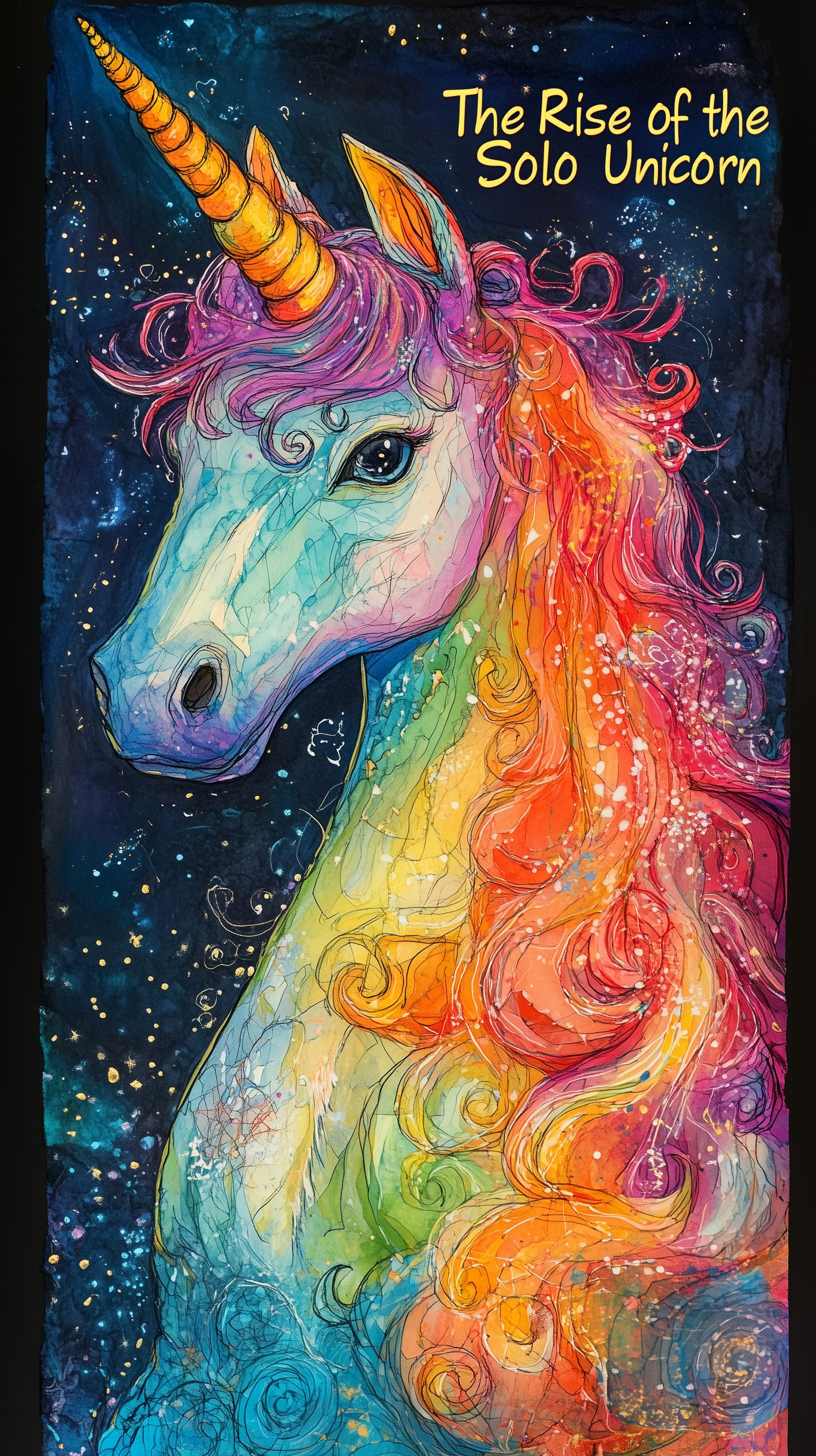
Source: Image created with Midjourney by Gonçalo Perdigão, Building Creative Machines
Skills Needed: From Creative Mastery to Data Literacy
Building a successful solo AI-driven venture requires more than a surface-level understanding of AI tools; it requires deep knowledge in several domains:
Mastery of Generative AI Tools
Proficiency in tools like ChatGPT, Midjourney, or custom-built generative models is essential. Knowing how to leverage these tools across various domains—from text generation and image creation to software development and product ideation—enables an individual to bypass traditional roles and labour.Product and Market Acumen
Beyond AI, a deep understanding of market needs and user behaviour remains crucial. Knowing what products will resonate, attract engagement, and sustain a customer base is critical to achieving scale.Data Literacy and Model Optimization
Successful generative AI users need a baseline understanding of how models operate and how they can be tuned or customized. The founder must be able to read and leverage performance data to optimize outputs and meet specific goals.Marketing and Customer Engagement
It is essential to be able to use AI tools for effective digital marketing and brand building. Solo entrepreneurs must know how to craft compelling, targeted messaging that maximizes customer acquisition without traditional sales teams.
A Paradigm Shift in Startups and Businesses
Generative AI is reshaping the nature of startups, transitioning from team-based to tool-based operations. For decades, startups have been driven by large teams, extensive networks, and substantial funding rounds. However, AI has introduced a “skill leverage” paradigm, where one skilled individual can harness the power of algorithms to drive functions that once required an entire team.
This shift impacts three main aspects of startups and businesses:
Operational Efficiency
Traditional startups require departments for everything from marketing to customer support. Generative AI can automate these functions, reducing cost and complexity. Startups leveraging AI as a team replacement can achieve operational efficiency at a fraction of the usual price.Scalability
Generative AI allows startups to scale at unprecedented speeds. A single entrepreneur can generate, distribute, and personalize products for massive audiences in a way that previously required significant staff.Investment Dynamics
With operational costs minimized, many solo startups may not need venture capital to reach profitability, allowing for self-funded, rapid growth. For instance, an AI-driven content platform could launch without external funding, eliminating equity dilution and giving solo founders complete control.
Use Cases: From Creatives to Tech
A range of industries and individuals are already demonstrating the potential of solo AI-based ventures:
Content and Media
Many writers and creators have leveraged generative AI tools to produce content at scale. Authors use tools like ChatGPT to co-write novels, while content marketers deploy AI to generate personalized articles, manage social media, and even edit videos autonomously. This can create $1M+ businesses in content-driven industries.E-Commerce and Design
Designers using AI tools such as Midjourney can create digital art and digital assets sold online. With the right marketing approach, these one-person e-commerce stores can achieve seven-figure sales with minimal inventory and labour.Software Development and Consulting
A single developer with access to powerful code-generating AI can build and deploy apps or even offer consulting services that previously required a whole engineering team. This could enable one-person SaaS businesses to thrive without needing a large technical staff.
Implications for the Startup Ecosystem
The possibility of solo unicorns and $1M+ microbusinesses powered by generative AI has far-reaching implications.
A Rise in Solo Founders
More individuals may enter the startup ecosystem without needing co-founders or entire teams. This trend can democratize entrepreneurship, making it accessible to more individuals with technical skills but limited networks or capital.Devaluation of Traditional Roles
Specific traditional roles like project management, marketing, and software engineering may become less central in early startup phases. Founders who are also AI experts can take on these roles through tool-based automation, reducing the need for large team structures.Talent Market Shifts
As individuals are empowered to pursue solo ventures, large corporations may struggle to attract top generative AI talent. Instead, this talent may prefer to capitalize on their skills independently, creating successful businesses.Investor Adaptation
Venture capitalists may need to adjust their investment strategies to accommodate solo founders or lean startups. This could result in new funding models tailored to AI-driven solo enterprises, such as micro-investments or revenue-sharing agreements.
The Future of One-Person Startups: Potential and Challenges
The rise of one-person AI-powered startups will likely continue, fueled by advances in AI capabilities and increased access to sophisticated tools. Yet challenges remain:
Skill Access
While generative AI tools are widely available, mastery of these tools still requires a specific skill set. Future educational pathways, especially those combining creativity and AI, will be essential for preparing the next wave of solo entrepreneurs.Market Saturation
With more people entering the market, specific sectors may become oversaturated with similar AI-driven products. Solo founders must differentiate through quality, innovation, and customer experience.Dependence on Tech Companies
AI entrepreneurs depend heavily on AI platforms such as OpenAI, Google, or Meta. This dependency could become a vulnerability, mainly if these companies impose higher costs or restrictive policies.
Conclusion: A New Era of Entrepreneurship
Generative AI is ushering in a new era where the power of a large workforce can be distilled into a single founder's expertise. This allows individuals to launch and scale businesses with limited resources, redefining what it means to be a "unicorn" or a successful business owner in the digital age.
The future of generative AI startups may belong to the one-person business, leveraging the creativity and productivity boost AI offers to create million-dollar enterprises and, perhaps, the world’s first solo unicorn company. For creative technologists and visionary entrepreneurs, mastering AI is no longer just a competitive advantage—it may soon be the ticket to building transformative, scalable companies singlehandedly.