

A machine that makes us reconsider ourselves
A computer finishes a sentence. A laboratory predicts a protein structure. An artist works with a robotic arm. The same initials, AI, now cover all three. Yet the questions behind these activities are different. What does it mean to understand a sentence? How can a model help discover something about nature? Where does authorship sit when a machine participates in making an image?
To follow the history of artificial intelligence is to watch those questions move. Sometimes a new method made an old ambition practical. Sometimes a successful demonstration exposed the inadequacy of the question itself. A machine could perform a task impressively while leaving our explanation of intelligence unresolved.
Building Creative Machines brings these histories together in People Shaping AI. The films linked throughout this essay introduce researchers, builders and artists whose work helps explain how we arrived here. This is a selective history, not a roll call of sole inventors. Behind every named contribution are collaborators, institutions, datasets and people whose labour made an experiment possible. The point of following individuals is to make those ideas easier to examine, not to turn a collective endeavour into a succession of heroes.
Before intelligence had a programme
In 1950, Alan Turing opened Computing Machinery and Intelligence with a question about whether machines could think. He then replaced that disputed wording with an imitation game. The move was productive because it made a philosophical argument partly experimental: what would a machine have to do, and what would count as evidence? His discussion also considered learning machines. The familiar test is only one part of a much larger intellectual proposal. [1]
A different bridge had already appeared in 1943. Warren McCulloch and Walter Pitts described a logical model of nervous activity in which simplified units could be combined to perform logical operations. It was an abstraction, not a faithful miniature of the brain, and it did not provide the training methods used by modern networks. Its importance lay in making a connection between biological inspiration and formal computation precise enough to investigate. [2]
The 1955 Dartmouth proposal, written by John McCarthy, Marvin Minsky, Nathaniel Rochester and Claude Shannon, gave artificial intelligence a name and a research agenda for the following summer. It encompassed language, abstraction, neural networks and creativity. These interests were present together at the beginning; the field did not simply start with rules and discover learning decades later. [3]
Minsky would continue to ask how intelligence might emerge from the interaction of many simpler processes. McCarthy developed tools and ideas for symbolic computation, including Lisp. The enduring tension was already visible: should we explain intelligence by describing what a system knows, how it reasons, or how its many parts work together?
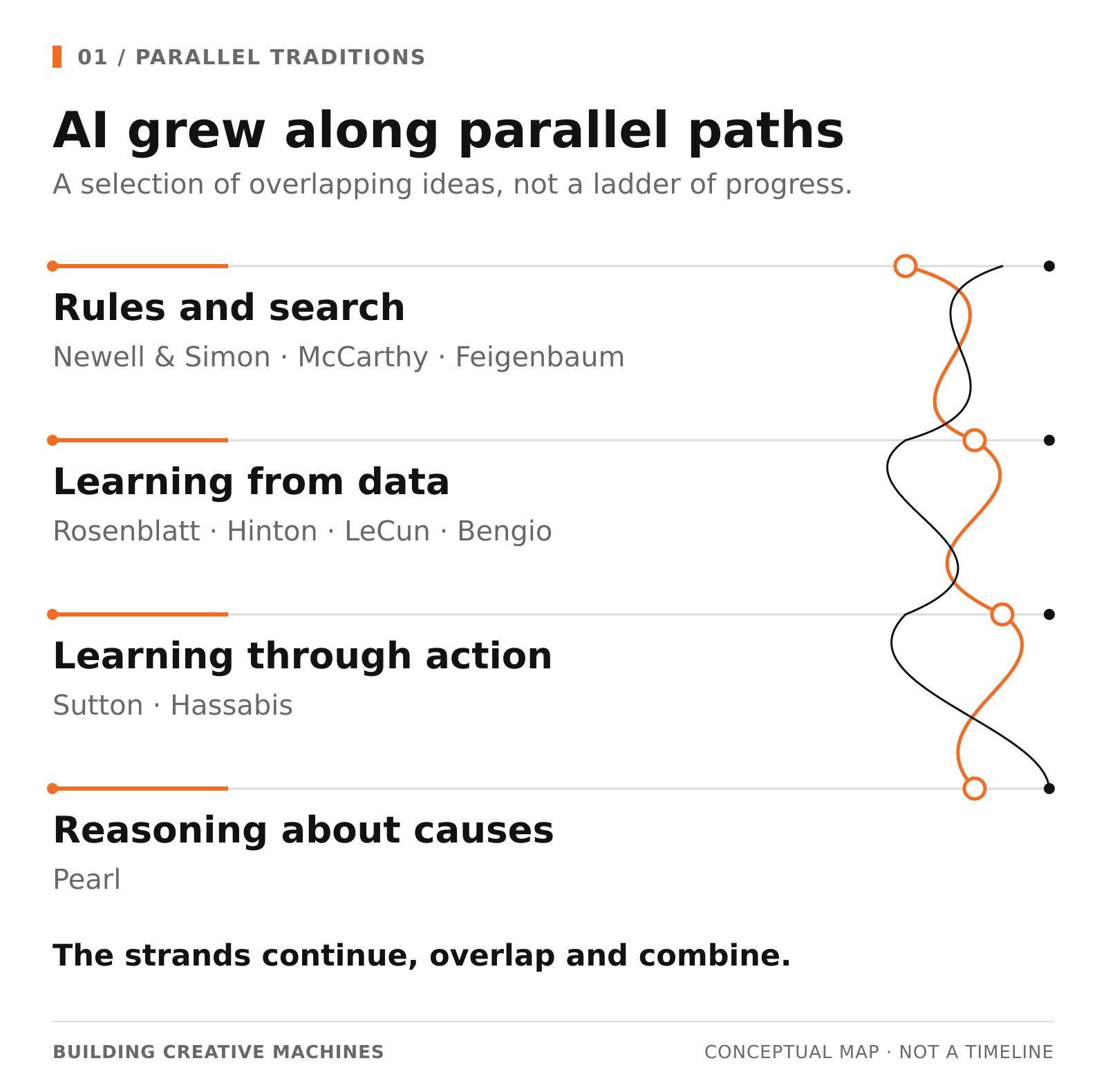
AI developed through overlapping traditions rather than a single succession of ideas. Selected contributors are shown; this conceptual map is not an exhaustive chronology.
Reasoning with a limited mind
With Allen Newell, Herbert Simon and J. C. Shaw, symbolic reasoning became something a programme could attempt. Logic Theorist searched for proofs; the General Problem Solver explored ways of moving from a present situation towards a goal. The challenge was not merely to store a rule. It was to decide which possibility to examine next when the space of possibilities became enormous.
Simon supplied a useful correction to the fantasy of unlimited calculation. People and organisations act with restricted time, knowledge and computational capacity. His account of bounded rationality and satisficing asks how decisions are made under those constraints. That remains a practical question for an executive choosing whether an AI system should search longer, ask a person, or stop with an adequate answer. The contemporary application is ours; it does not require assuming that a language model thinks like Simon’s human decision-maker. [4]
Edward Feigenbaum and the DENDRAL collaborators, including Joshua Lederberg and Bruce Buchanan, took a different route through complexity: make specialist knowledge explicit. A programme could become useful in a carefully defined scientific domain because it incorporated knowledge of that domain. The expert-systems era demonstrated the value of expertise while exposing the work required to represent, maintain and apply it.
Language brought its own complications. Raj Reddy and his collaborators explored speech understanding through systems such as Hearsay, in which different sources of knowledge contributed partial interpretations. Karen Spärck Jones showed why an uncommon term can be more informative for finding a document than a word that appears almost everywhere. Her inverse document frequency work became a foundation of information retrieval. Understanding a spoken instruction and finding a relevant page are different problems, but both show that intelligence depends on organising evidence, not simply accumulating it. [5]
Learning a boundary rather than writing a rule
Frank Rosenblatt made learning from examples central to the perceptron. Instead of specifying every classification rule by hand, a system could adjust weights in response to experience. Kunihiko Fukushima later proposed the neocognitron, a hierarchical network designed to recognise patterns despite shifts in position. These were distinct architectures, but together they help explain why the history of neural networks begins long before their recent public prominence.
The gaps between promising ideas and useful systems mattered. Better learning procedures, suitable data, computing resources and tractable tasks did not arrive at once. Nor did every abandoned approach return vindicated. What changed was the collection of conditions under which particular ideas could be tested and made to work.
Geoffrey Hinton, with David Rumelhart and Ronald Williams, helped establish the importance of learning internal representations through backpropagation. The technique had earlier antecedents; the 1986 paper was a landmark rather than a solitary creation story. Yann LeCun and collaborators brought trainable convolutional networks into applications such as handwritten character recognition. Reusing a feature detector across an image made a particular assumption about visual structure computationally useful. [6]
Another influential tradition asked how to draw a boundary that would generalise beyond the examples already seen. Corinna Cortes and Vladimir Vapnik’s support-vector networks made that question concrete through margins and a principled treatment of imperfect separation. Statistical learning was not a waiting room for deep learning. It offered a different set of tools and ways to reason about evidence. [7]
Masashi Sugiyama extends this concern into situations in which the data encountered in practice differ from those used for learning. A model’s apparent competence depends on where its examples came from. This is a quiet but consequential theme running through the field: learning a pattern and knowing where that pattern will remain useful are separate achievements. [18]
The world enters through data
An architecture needs a world to learn from, or at least a representation of one. Fei-Fei Li and the ImageNet team helped create a large, organised visual dataset and an infrastructure for comparison. The 2009 paper credited six authors, led in author order by Jia Deng. Annotation and classification were central parts of the work, not incidental preparation for the real science. [8]
The 2012 ImageNet result associated with Alex Krizhevsky, Ilya Sutskever and Hinton made the interaction of architecture, training, data and computation especially visible. It is tempting to tell that moment as a machine suddenly learning to see. A more useful account asks what it was being asked to recognise, how success was measured and which conditions supported the result. On the 2012 competition test set, the reported top-five error was 15.3%, compared with 26.2% for the second-best entry. That is a comparison on a defined classification task, not a measurement of general intelligence. [8]
Sara Hooker brings the consequences of computational and design choices into this discussion: whose problems can be pursued, who can participate and what is lost when scale becomes the default answer. Pelonomi Moiloa makes the language question geographically concrete through work on African-language technology. The world represented in an AI system depends on decisions about which languages and communities receive sustained attention. [18, 19]
Infrastructure also shapes what others can build. Thomas Wolf has helped make models and tools accessible through the open-source ecosystem around Hugging Face. Chip Huyen concentrates on the engineering realities of moving machine learning into use. A promising model becomes a functioning service only through decisions about data, evaluation, deployment, monitoring and change. These contributions belong in the history because they influence which research results become usable capabilities. [19] [22]
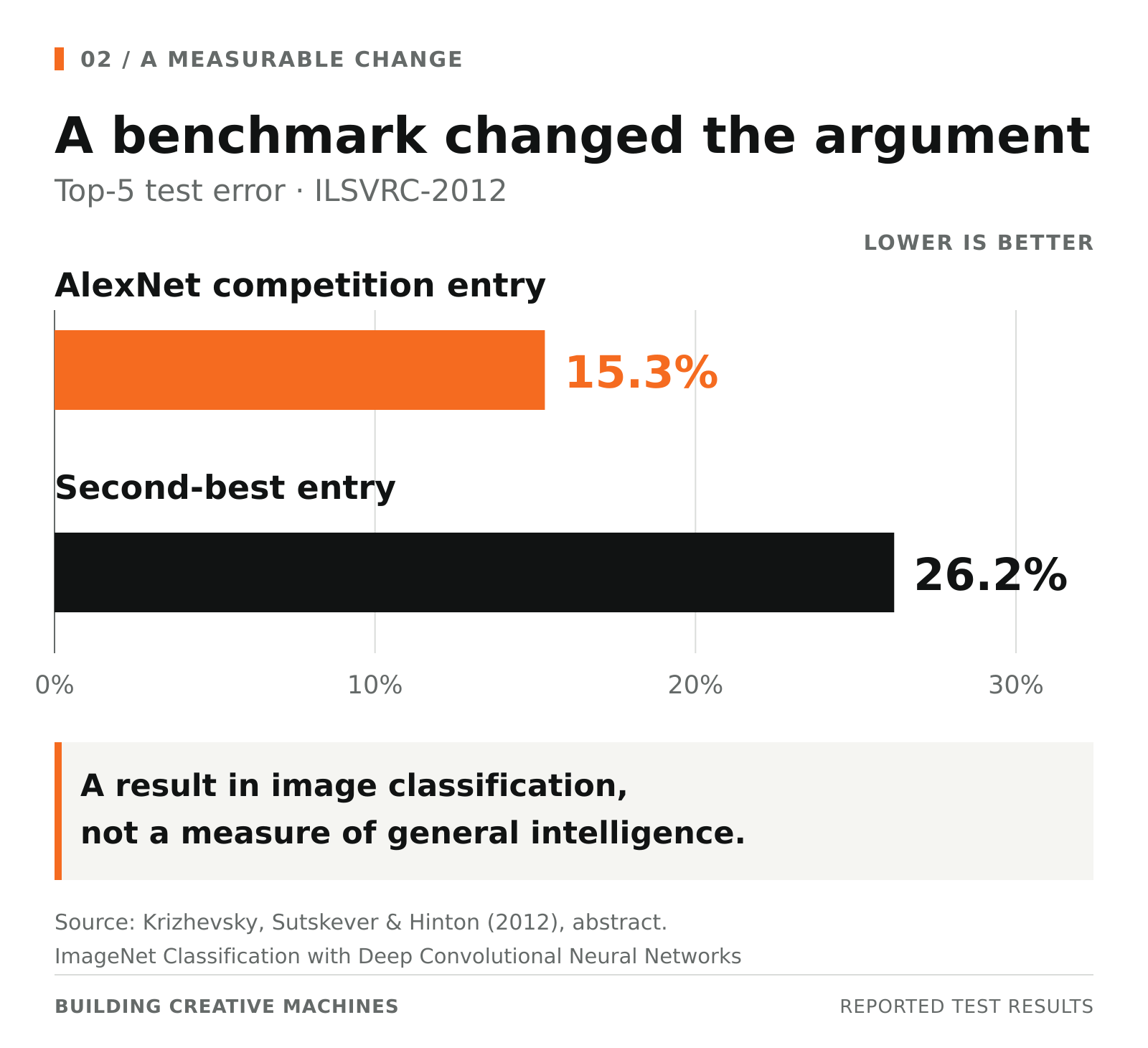
ILSVRC-2012 top-5 test error: 15.3% for the AlexNet competition entry versus 26.2% for the second-best entry. Lower is better. Source: Krizhevsky, Sutskever and Hinton (2012), abstract. [8]
Remembering, attending and generating
A sequence poses a particular problem: what should a system preserve from earlier moments? Sepp Hochreiter and Jürgen Schmidhuber’s long short-term memory architecture addressed the difficulty of learning dependencies over extended sequences. It offered a way to carry information forward while learning what to retain. [9]
Yoshua Bengio, with Réjean Ducharme, Pascal Vincent and Christian Jauvin, explored a neural probabilistic language model in which words acquired learned representations. This helped make generalisation across related contexts part of language modelling rather than treating each observed phrase as an isolated event. [10]
Dzmitry Bahdanau, Kyunghyun Cho and Bengio then showed an influential way for a translation model to attend to relevant parts of an input as it produced an output. Niki Parmar was one of the eight equal-contribution authors of Attention Is All You Need, the paper that introduced the Transformer, and subsequently led the Image Transformer paper. Memory, attention and self-attention are connected chapters, but they are not interchangeable mechanisms or a single person’s invention. [11]
Generating an image opened other routes. Ian Goodfellow and his co-authors proposed generative adversarial networks, training a generator in relation to a discriminator. Jascha Sohl-Dickstein, Eric Weiss, Niru Maheswaranathan and Surya Ganguli investigated a different approach: learn to reverse a gradual process of corruption towards noise. Later work was essential to the diffusion systems now used for image generation. The important historical point is that creative-looking outputs can emerge from very different mathematical objectives. [12]
Those outputs do not settle the question of understanding. Yejin Choi investigates language and common-sense reasoning, drawing attention to what systems need beyond fluent expression. Melanie Mitchell studies intelligence and abstraction while questioning easy comparisons between task performance and human understanding. François Chollet places generalisation to unfamiliar problems at the centre of his account of intelligence. Their questions help prevent the history from ending whenever a demonstration becomes impressive. [20, 24]
From a prediction to an action
Richard Sutton, working alongside Andrew Barto and a wider research community, helped establish foundations of reinforcement learning. Here the system’s choices affect what it encounters next, and the consequences may arrive later. Learning what to do differs from learning to label an example. The design of a reward becomes part of the problem rather than a neutral description of success.
Judea Pearl opens a further distinction. A pattern observed in data does not, by itself, tell us what will happen if we intervene. His work on Bayesian networks and causal reasoning provides ways to represent uncertainty and assumptions about how the world produces observations. For a business deciding whether an action will improve an outcome, that distinction is more than philosophical. [13]
Physical interaction makes these questions difficult to ignore. Anca Dragan studies robots that must act around people and infer what those people intend or value. Maja Matarić, with collaborators including David Feil-Seifer, helped define socially assistive robotics, where support is delivered through social interaction. Rosalind Picard established affective computing as a research programme around machines and signals related to emotion. Recognising a cue, interpreting a person’s state and deciding how to respond remain distinct steps. [14] [23]
The creative relationship can be deliberately less instrumental. In Sougwen Chung‘s work, drawing with machines becomes a way to explore gesture, collaboration and authorship. This is not evidence that a robot experiences creativity as a person does. It is a change in the conditions under which a person makes art, and therefore a legitimate part of the story of creative machines. [22]
Scientific applications supply another test of usefulness. Anima Anandkumar works at the intersection of machine learning and scientific problems, including methods that learn relationships between functions. Demis Hassabis, John Jumper and the AlphaFold team showed the impact that accurate protein-structure prediction could have. The achievement deserves precise language: predicting structure is not the same as resolving every problem of protein behaviour or biology. [15] [20]
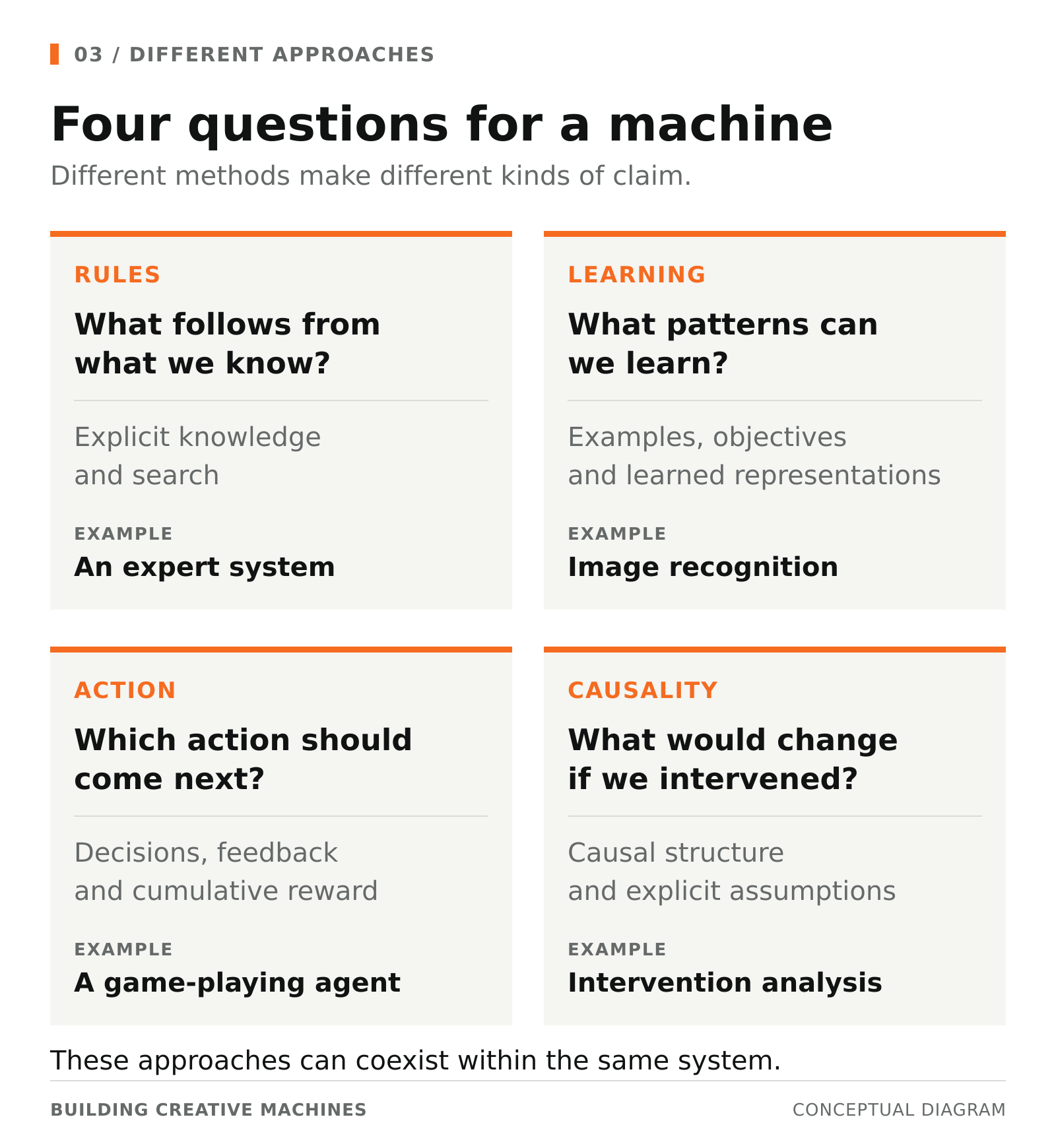
Different approaches answer different kinds of question. They can coexist within the same system; the examples are illustrative.
Who gets to call it progress
A result acquires meaning through the way it is tested. Percy Liang‘s work on the evaluation of foundation models helps make that visible: a single score cannot express every capability, limitation or consequence of a system. Evaluation is a design choice about what deserves to count. [21]
Joy Buolamwini and Timnit Gebru demonstrated this sharply in Gender Shades. Their 2018 study of three commercial gender-classification systems reported substantial differences between demographic groups that an aggregate result could obscure. These were results for particular systems and a particular task at a particular time, not a timeless description of every face-processing system. The enduring lesson is methodological: ask whose errors disappear inside the average. [16]
Cynthia Dwork and her collaborators developed differential privacy, giving a mathematical form to limits on what an analysis can reveal about an individual. Privacy becomes a property to specify and examine, not simply a reassuring label placed on a dataset. Ricardo Baeza-Yates brings responsible AI and the consequences of information systems into the conversation. Shakir Mohamed and collaborators have argued for examining AI through the histories and power relations that shape its development. These perspectives change the questions asked before a system is built, as well as the judgement made afterwards. [17] [24]
The history cannot therefore be reduced to an upward curve of performance. A capability may improve while a community remains poorly represented. A benchmark may become harder while a consequential use remains insufficiently evaluated. A tool may make something easier to produce while making its ownership or interpretation harder to resolve.
There is no final chapter in which these tensions disappear. Turing’s question still sits beside a supplier decision, a translated sentence, a robot’s movement and an artist’s mark. The machines have changed dramatically. Our responsibility to say what we are asking them to do has not become less demanding.
People Shaping AI is an invitation to follow those questions through the people who made them tangible. Watch a film, return to the argument and take another route through the collection. The history becomes more revealing when the names stop looking like milestones on a single road and begin to show the different kinds of intelligence we have tried to build.
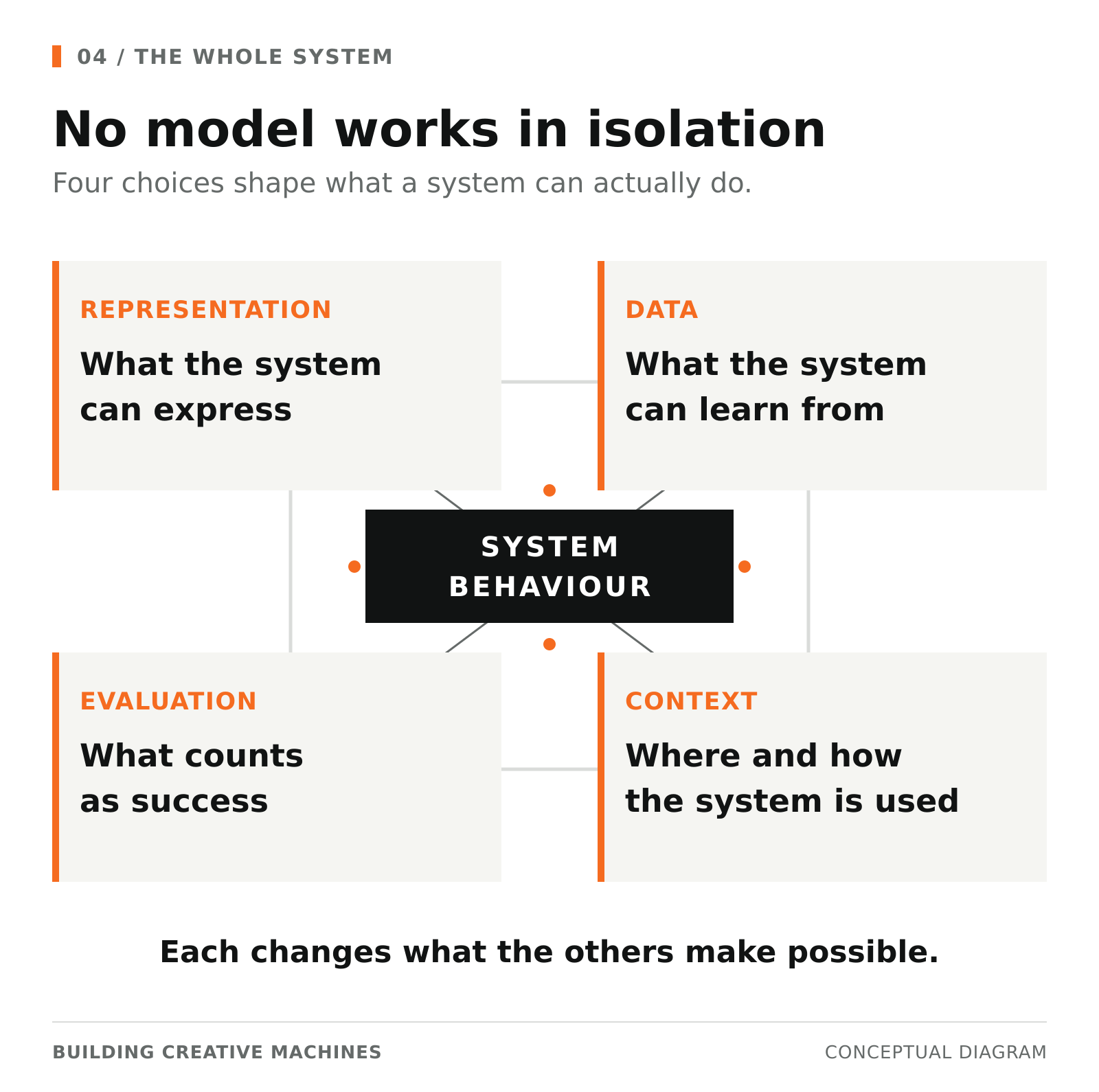
Representation, data, evaluation and context jointly shape system behaviour. Connections are conceptual, not quantitative.
Watch People Shaping AI on YouTube
Follow us on Youtube and LinkedIn.
Sources and further reading
1. Alan Turing, Computing Machinery and Intelligence, Mind, 1950. Source
2. Warren McCulloch and Walter Pitts, A Logical Calculus of the Ideas Immanent in Nervous Activity, 1943. Source
3. McCarthy, Minsky, Rochester and Shannon, A Proposal for the Dartmouth Summer Research Project on Artificial Intelligence, 1955. Source
4. Herbert Simon, Rational Decision-Making in Business Organizations, Nobel lecture, 1978. Source
5. Karen Spärck Jones, A Statistical Interpretation of Term Specificity and Its Application in Retrieval, 1972. Source
6. Rumelhart, Hinton and Williams, Learning Representations by Back-Propagating Errors, Nature, 1986. Source
7. Corinna Cortes and Vladimir Vapnik, Support-Vector Networks, 1995. Source
8. Deng and colleagues, ImageNet, CVPR, 2009; Krizhevsky, Sutskever and Hinton, ImageNet Classification with Deep Convolutional Neural Networks, 2012. Source 1 Source 2
9. Sepp Hochreiter and Jürgen Schmidhuber, Long Short-Term Memory, 1997. Source
10. Bengio, Ducharme, Vincent and Jauvin, A Neural Probabilistic Language Model, 2003. Source
11. Bahdanau, Cho and Bengio, Neural Machine Translation by Jointly Learning to Align and Translate, 2014; Vaswani and colleagues, Attention Is All You Need, 2017. Source 1 Source 2
12. Goodfellow and colleagues, Generative Adversarial Nets, 2014; Sohl-Dickstein and colleagues, Deep Unsupervised Learning Using Nonequilibrium Thermodynamics, 2015. Source 1 Source 2
13. Judea Pearl, An Introduction to Causal Inference, 2010. Source
14. Feil-Seifer and Matarić, Defining Socially Assistive Robotics, 2005; Rosalind Picard, Affective Computing, MIT technical report, 1995. Source 1 Source 2
15. Nobel Prize in Chemistry 2024 announcement, crediting Hassabis and Jumper for protein-structure prediction and Baker for computational protein design. Source
16. Joy Buolamwini and Timnit Gebru, Gender Shades, 2018. Source
17. Dwork, McSherry, Nissim and Smith, Calibrating Noise to Sensitivity in Private Data Analysis, 2006; Mohamed, Png and Isaac, Decolonial AI, 2020. Source 1 Source 2
18. Sara Hooker, The Hardware Lottery; Sugiyama and colleagues, Covariate Shift Adaptation by Importance Weighted Cross Validation, 2007. Source 1 Source 2
19. Lelapa AI documentation; Wolf and colleagues, Transformers software library, 2020. Source 1 Source 2
20. Sap and colleagues, ATOMIC, 2019; Li and colleagues, Fourier Neural Operator for Parametric Partial Differential Equations, 2020. Source 1 Source 2
21. Liang and colleagues, Holistic Evaluation of Language Models, Stanford CRFM, 2022. Source
22. Chip Huyen, Machine Learning Systems Design; Sougwen Chung, Memory and Drawing Operations. Source 1 Source 2
23. Hadfield-Menell, Russell, Abbeel and Dragan, Cooperative Inverse Reinforcement Learning, 2016. Source
24. Ricardo Baeza-Yates, Bias on the Web, 2018; François Chollet, On the Measure of Intelligence, 2019. Source 1 Source 2