

A Workforce in Flux
For decades, career advice followed a predictable script: focus on cognitive skills, seek desk jobs, and prepare for a future where manual labor is automated. But today, a profound shift is underway. AI isn’t just automating repetitive physical tasks—it’s fundamentally redefining cognitive work, from coding to decision-making. As a result, the nature of productivity, skill valuation, and career security is being rewritten.
This transformation isn’t just incremental; it’s exponential. Knowledge that took days to process can now be completed in minutes. Once requiring teams and hefty budgets, complex analysis can be handled at a fraction of the cost. The question isn’t whether you’ll be affected but how you’ll adapt.
What’s Changing? The AI Revolution in Work
The AI revolution is driving what some call "The Great Inversion of Work." The assumptions that defined professional pathways in the 20th century no longer hold. Consider these key shifts:
AI is Redefining All Work:
AI is no longer confined to routine tasks. It’s coding, diagnosing, and strategizing alongside us—or sometimes better than us. Cognitive functions that took weeks can now be completed in moments with AI augmentation.Physical Work is Being Revalued:
As AI automates many knowledge-based jobs, specific high-skill physical roles are regaining prominence. Precision-driven engineering, artisanal craftsmanship, or roles requiring a unique blend of human creativity and hands-on expertise are less easily replaced.Adaptability is the New Skillset:
Job titles are becoming less relevant as adaptability takes centre stage. The ability to learn, pivot, and integrate AI tools into workflows will separate the indispensable from the obsolete.
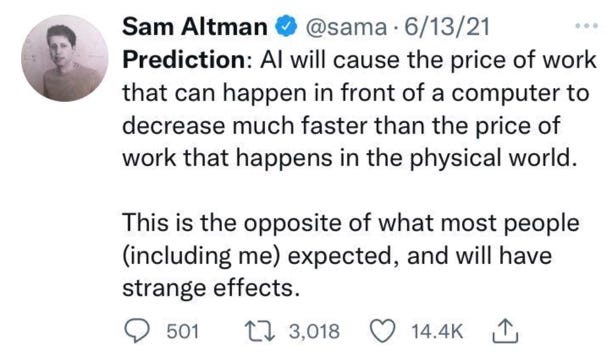
Image: Sam Altman on X 13/6/21
Why This Matters for Business Leaders
For organizations, the AI-driven workforce presents both opportunities and existential risks. Productivity baselines have shifted—what was once cutting-edge is now table stakes. Companies that fail to adopt AI-driven processes risk falling behind competitors who can produce faster, cheaper, and more innovative solutions.
The commoditization of mid-level roles poses challenges for talent strategy. Knowledge workers who rely on predictable tasks face downward pressure on wages and relevance. On the flip side, businesses that invest in reskilling employees and fostering a culture of adaptability are more likely to thrive.
The imperative for CEOs and C-suite leaders is clear: AI is not a “tool for the IT team.” It’s a strategic enabler affecting every department, from finance and HR to marketing and operations.
Industries Feeling the Impact
Tech and Software Development:
Coding has undergone a seismic shift. AI-assisted development tools like GitHub Copilot or ChatGPT can now expedite what once required large teams and long hours. The result? Faster product cycles and reduced development costs—but pressure on junior developers to evolve or risk replacement.Manufacturing and Logistics:
High-skill physical roles, such as robotics technicians or advanced machinists, are increasingly valued. While automation dominates repetitive tasks, replacing roles requiring adaptability and technical insight are more challenging.Healthcare and Life Sciences:
AI-powered diagnostics are revolutionizing medicine, enabling faster and more accurate results. However, the human element—care, empathy, and complex decision-making—remains irreplaceable, placing a premium on healthcare workers who can integrate AI into their practices.Creative Industries:
Content creation, design, and marketing are experiencing an AI-fueled boom. Tools that generate images, copy, or videos are becoming mainstream, forcing creatives to focus on conceptualization and strategic insights to remain competitive.
The Future of Work: What You Should Be Doing Now
Staying still is no longer an option. Whether you’re an executive, a factory worker, or a knowledge worker, here’s how to future-proof your career:
Invest in Lifelong Learning: AI tools are evolving rapidly. Staying updated with the latest advancements is no longer a luxury—it’s a necessity.
Embrace Hybrid Workflows: Instead of fearing AI, learn to collaborate. Integrating AI tools into your daily work will set you apart.
Focus on Uniquely Human Skills: Creativity, emotional intelligence, and problem-solving are harder for machines to replicate. Developing these capabilities will make you indispensable.
Foster Adaptability: The workforce of tomorrow values flexibility over rigid specialization. A career built on learning and evolving is the safest bet in an unpredictable economy.
Staying Ahead of the Curve
As Sam Altman predicted, the price of work that can be done in front of a computer is falling dramatically. But this doesn’t signal the end of opportunity but a reorganization. High-value roles will belong to those who adapt, embrace AI, and continuously push boundaries.
So, the real question isn’t “Will AI replace me?” “How can I leverage AI to make myself irreplaceable?”
For businesses and professionals alike, the time to act is now. The Great Inversion of Work is here—those who embrace it will shape the future; those who resist it may find themselves left behind.