

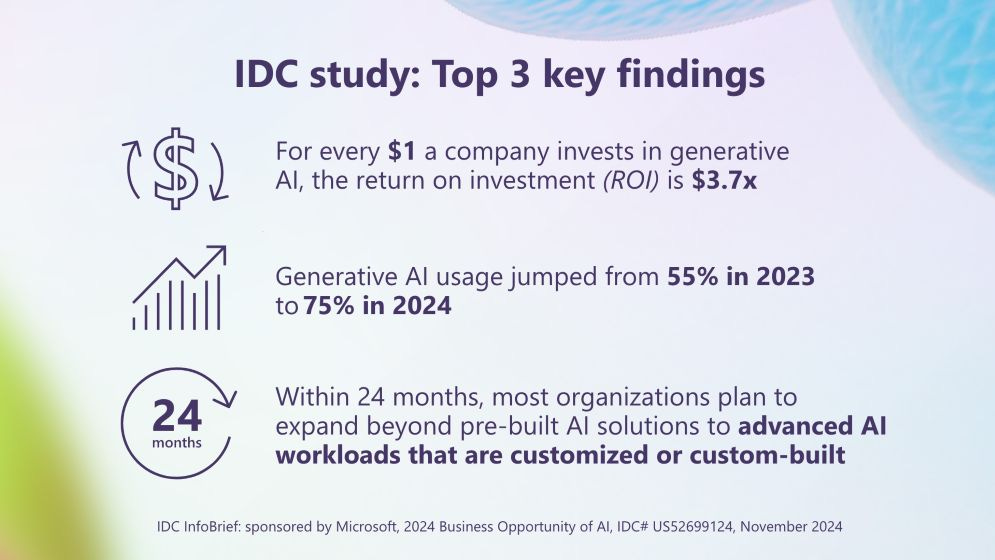
In 2024, generative AI will no longer be a futuristic buzzword—it will be a transformative force reshaping industries. According to IDC's latest report, “The Business Opportunity of AI,” the adoption of generative AI surged from 55% in 2023 to 75% in 2024, signalling a global shift toward AI-first strategies. This boom reflects curiosity and a fundamental shift in how organizations operate, innovate, and compete.
Let’s explore what’s driving this AI revolution and why businesses that embrace it are reaping the rewards.
Generative AI: From Disruption to Differentiation
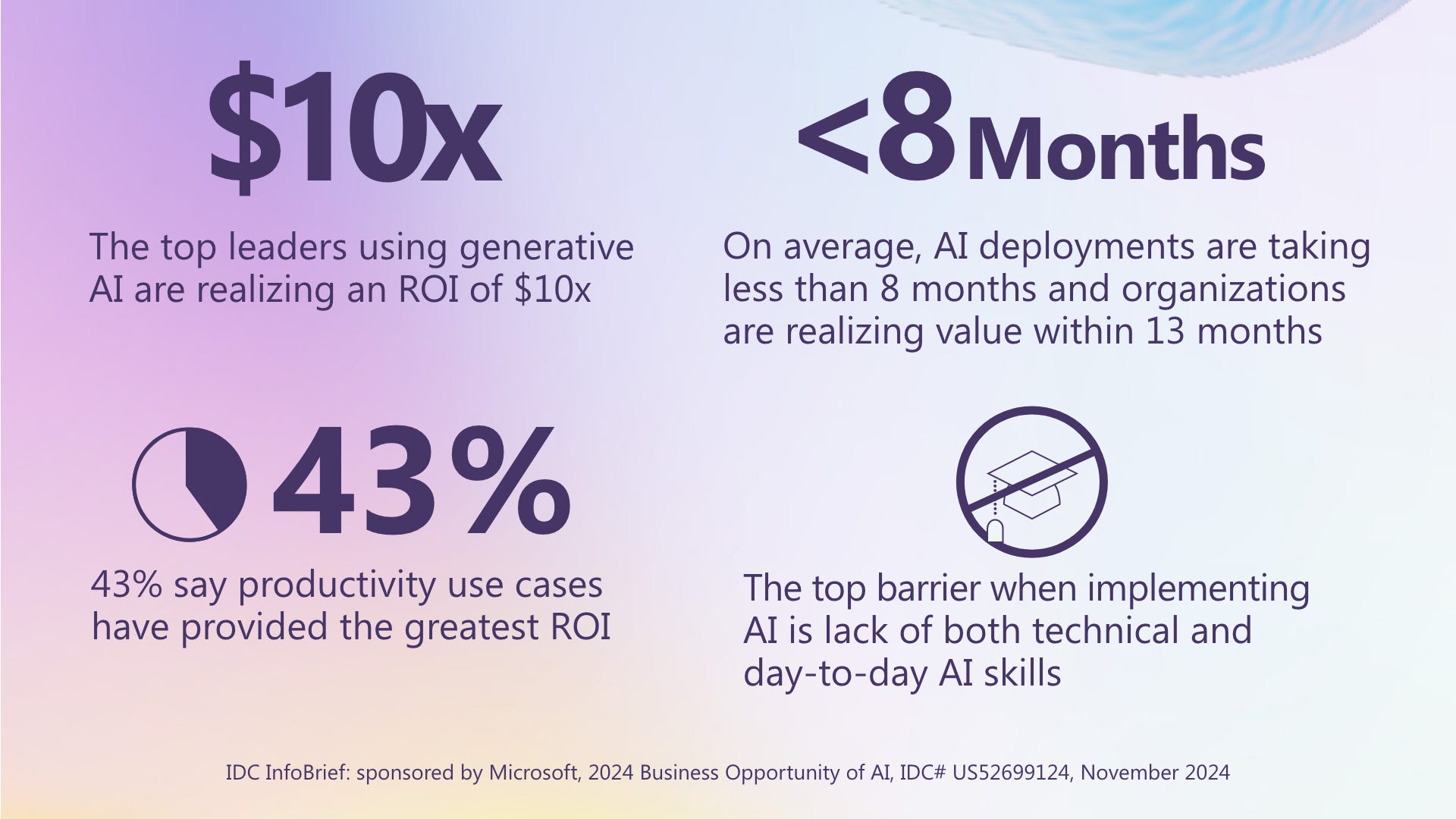
Generative AI has evolved beyond chatbots and simple content-generation tools. Businesses now leverage AI to streamline operations, enhance productivity, and unlock new revenue streams. IDC highlights that companies investing in AI are seeing an average ROI of 3.7x, with top performers achieving an astonishing 10.3x ROI.
This transformation isn’t happening in isolation. Across sectors like healthcare, manufacturing, retail, and education, AI tools are revolutionizing workflows:
Healthcare: Chi Mei Medical Center reduced medical reporting time from an hour to 15 minutes, enabling doctors to focus more on patient care.
Retail: Coles uses AI to predict inventory flow for 850 stores, generating 1.6 billion predictions daily with remarkable accuracy.
Manufacturing: Siemens developed the Industrial Copilot, addressing skill shortages while boosting efficiency for over 50 customers.
These stories demonstrate a clear trend: generative AI is no longer a luxury—it’s a competitive imperative.
Source: IDC and Microsoft Report, November 2024
Why Generative AI Matters to Business Leaders
1. Enhanced Productivity
Productivity remains the top priority, with 92% of AI users leveraging it. Tools like Microsoft Copilot are helping employees save hours each week on routine tasks, from summarizing meetings to drafting presentations. For companies like Dentsu, these time savings translate into faster delivery of creative concepts and higher client satisfaction.
2. Tailored Solutions
Organizations are moving toward customized AI solutions that address specific industry needs. IDC predicts that within 24 months, most companies will expand their AI efforts from off-the-shelf tools to bespoke solutions. Siemens’ Industrial Copilot is a prime example tailored to the complexities of industrial automation.
3. Strategic ROI
Generative AI drives the highest ROI in financial services, followed by media, telecommunications, and retail. This indicates that AI’s value extends beyond operational efficiencies to strategic benefits like enhanced customer engagement and revenue growth.
4. Accelerated Implementation
IDC's study notes that AI projects take less than 8 months to deploy, with value realized within 13 months. The accelerated timeline means businesses can stay agile in rapidly evolving markets.
5. Tackling Talent Gaps
While adoption is soaring, talent remains a critical barrier. 30% of organizations cite a lack of AI-specific skills as a challenge. To bridge this gap, businesses invest in training programs, such as Microsoft’s initiative to upskill 14 million people globally.
Use Cases: AI in Action Across Industries
Generative AI isn’t just reshaping individual companies—it’s transforming entire sectors:
Financial Services: AI is automating fraud detection, personalized banking, and algorithmic trading, leading the way in ROI.
Retail: Predictive AI tools are optimizing inventory and personalizing customer experiences at scale.
Healthcare: Tools like DAX Copilot save physicians over 5 minutes per patient visit, providing more comprehensive care.
Education: Universities like the University of South Florida use AI to enhance learning and administrative efficiency while preparing students for AI-driven careers.
The Bigger Picture: Economic and Social Impact
According to IDC, generative AI is poised to deliver a $19.9 trillion cumulative economic impact by 2030, contributing to 3.5% of global GDP. This growth isn’t just about profits; it’s about redefining the future of work and innovation. As autonomous AI agents become more prevalent, businesses shift from reactive AI applications to proactive, multi-step workflows that deliver even greater efficiency.
However, this transformation also challenges responsible AI use, ethical considerations, and navigating regulatory landscapes. Companies must prioritize transparency and accountability as they scale AI initiatives.
Source: IDC and Microsoft Report, November 2024
The Takeaway: A Call to Action for Leaders
The generative AI boom presents a historic opportunity. Organizations that embrace AI today are positioning themselves as leaders in their industries, while those who delay risk being left behind. The key is not just adoption but strategic implementation—leveraging AI to solve real business problems, enhance customer experiences, and drive innovation.
For decision-makers, now is the time to act. Build a roadmap, invest in the right talent, and explore how generative AI can propel your organization forward. The future isn’t just automated—it’s intelligently designed.