

From INSEAD to MIT: Encountering a New Kind of Venture Lab
Over the past two months, Sundai has been a fixture in the INSEAD A.I. Venture Lab, meeting weekly to showcase and refine their approach. What emerged was not just another student project but a disciplined culture of rapid building that stood apart from typical accelerator cohorts. Where most venture programmes encourage startups to refine pitches, Sundai insisted on building and shipping new A.I. products weekly. This relentless cadence revealed both the originality of their methods and the scale of their ambition.
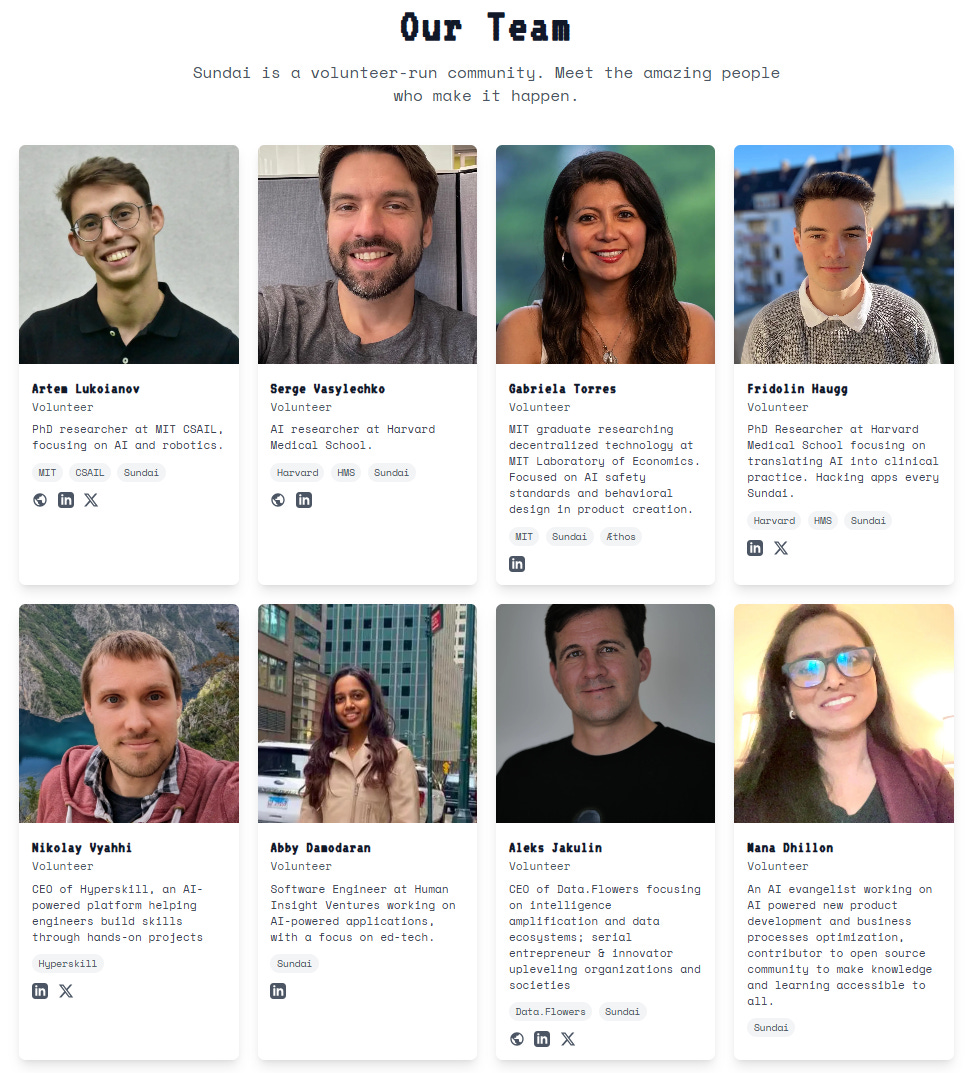
Image: Part of the team. Credits to Sundai website
The Hacker Mindset Goes Institutional
At a time when trillion-dollar companies are locked in an arms race over foundation models, one of the most intriguing movements in AI is unfolding not in corporate R&D labs but in a hacker collective. Sundai, founded by students and researchers around MIT and Harvard, is reviving a culture that has defined technological leaps for decades: the hacker ethos.
Every Sunday, members of Sundai gather to build an entirely new A.I. product from scratch and deploy it before the end of the day. They call it “pushing the envelope of what is possible to do with A.I. in a day.” Over the past year, the group has completed more than 80 consecutive “Sunday hacks,” transforming weekends into an ongoing laboratory of rapid invention.
The principles are starkly simple: build, ship, and shortcut. Build something real, deploy it beyond localhost, and use ingenious shortcuts to collapse development timelines. This is not about perfect engineering, but about speed, creativity, and public demonstrations. The result is an experimental pipeline that produces both unexpected consumer tools and proofs-of-concept, hinting at tomorrow’s startups.
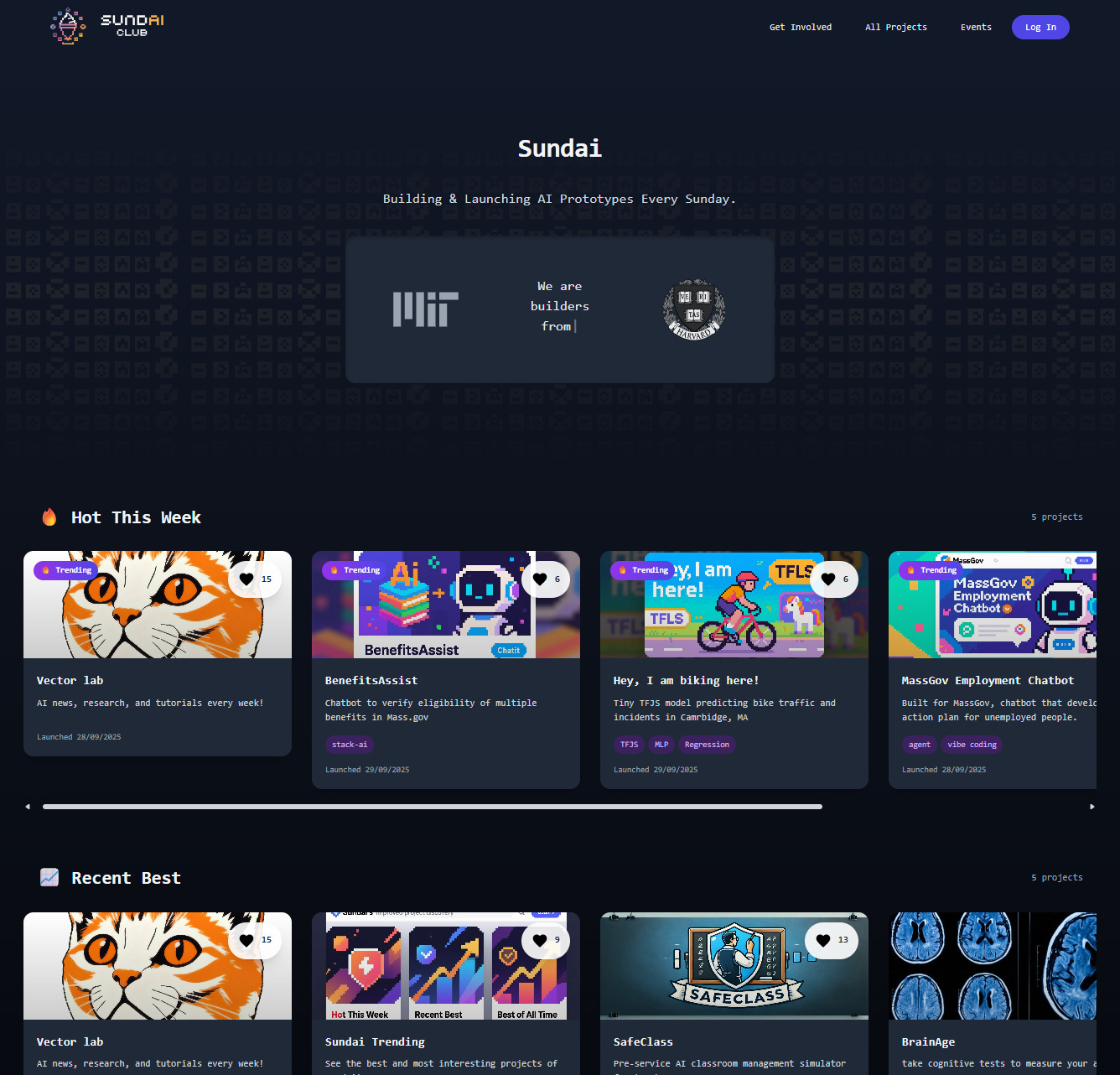
Image: List of Sundai Club prototypes. Credits to Sundai Club
From MIT Railroads to Machine Intelligence
The group’s ethos is rooted in the original meaning of “hacker,” a term coined at MIT in the 1950s when students of the Tech Model Railroad Club rewired circuits to improve performance. Hacking meant ingenuity and elegance, not cybercrime. Sundai has resurrected that definition in the age of machine learning.
In their constitution, Sundai distinguishes between hackers and engineers. Engineers optimise for robustness and order; hackers prioritise speed and recombination. The distinction is more than cultural—it maps directly onto the A.I. landscape, where the advantage increasingly goes to those who can orchestrate and recombine models, APIs and frameworks faster than incumbents can formalise strategy.
Engineers optimise for robustness and order; hackers prioritise speed and recombination
A Counterweight to Corporate Consolidation
The timing is notable. As Big Tech consolidates A.I. infrastructure—from GPUs to proprietary models—the space for experimentation is narrowing. Many startups are de facto extensions of OpenAI, Anthropic, or Google platforms. In this environment, Sundai represents a counter-model: decentralised, fast, and radically open.
By publishing demos and code on a weekly basis, the collective contributes to what can be seen as a “public R&D commons.” This rhythm of experimentation also offers valuable lessons for venture capital. While investors increasingly lament the scarcity of original consumer-facing AI products, Sundai’s cadence shows that novelty emerges less from brute force computing and more from the speed of iteration.
From Weekend Hacks to Venture Pipelines
The implications extend into the venture ecosystem. Sundai is less a hobbyist gathering than an incubator in motion. The club is already seeding ideas with measurable traction—projects that gain users, generate revenue or amass GitHub stars. This positions Sundai as a living prototype of what a next-generation startup studio might look like: one where the unit of experimentation is not a pitch deck but a working product.
This aligns with trends in accelerators and venture labs that prioritise “build-first” cohorts. However, Sundai’s velocity—shipping weekly instead of quarterly—compresses the cycles even further. For investors, this creates a valuable filtering mechanism: a steady stream of pre-validated ideas, already pressure-tested in real time.
Teaching the Next Generation to Think in Shortcuts
The long-term ambition extends beyond venture outcomes. Sundai positions itself as a training ground for the world’s best hackers. By teaching a mindset of speed, recombination and pragmatism, the club is cultivating talent in ways formal programmes cannot. In an A.I. economy where the difference between leaders and laggards often lies in how quickly teams can adapt existing tools, this skillset is strategic.
Sundai’s “shortcuts” philosophy is particularly telling. A shortcut is not a compromise but an elegant hack: a reconfiguration that allows builders to reach functionality in hours rather than months. In practice, this means leveraging pre-trained models, chaining APIs, or repurposing consumer-grade tools to prototype enterprise-grade workflows. For policymakers and educators, it raises an important point: innovation may increasingly come not from foundational breakthroughs but from those who know how to reassemble the pieces faster than anyone else.

Image: Sundai official logo. So cool.
Why Sundai Matters Now
The emergence of Sundai should be read not as a curiosity but as a barometer. It signals a shift in how the next wave of A.I. founders are being trained—not in corporate labs or classrooms, but in hacker communities where failure is fast, lessons compound weekly and product cycles are measured in hours.
In a world where capital is concentrating around fewer players and the barrier to model training is rising, the advantage may belong to collectives like Sundai. They embody a different power dynamic: distributed talent, rapid iteration, and open knowledge. If history is any guide—from the early days of the personal computer to the birth of the web—this is where the next generation of iconic companies may quietly be seeded.
Sundai is less a club than a prototype of the future innovation model. For investors, it is a pipeline. For policymakers, a reminder that grassroots hacking drives progress. And for the broader A.I. economy, it is proof that speed, not scale, may be the ultimate competitive edge.