

If you’ve been following AI news, you’ve likely seen a new name pop up across India: Sarvam AI. It’s a Bengaluru-based startup building “India-first” AI systems designed for Indian languages, accents, documents, and everyday business workflows, not just English-first internet use cases. (sarvam.ai)
The buzz accelerated in early February 2026 after multiple reports claimed Sarvam’s models performed strongly on India-specific tasks—sometimes even beating well-known global systems like Gemini AI and ChatGPT on certain local benchmarks (especially around Indic documents and speech). (source: The Times of India)
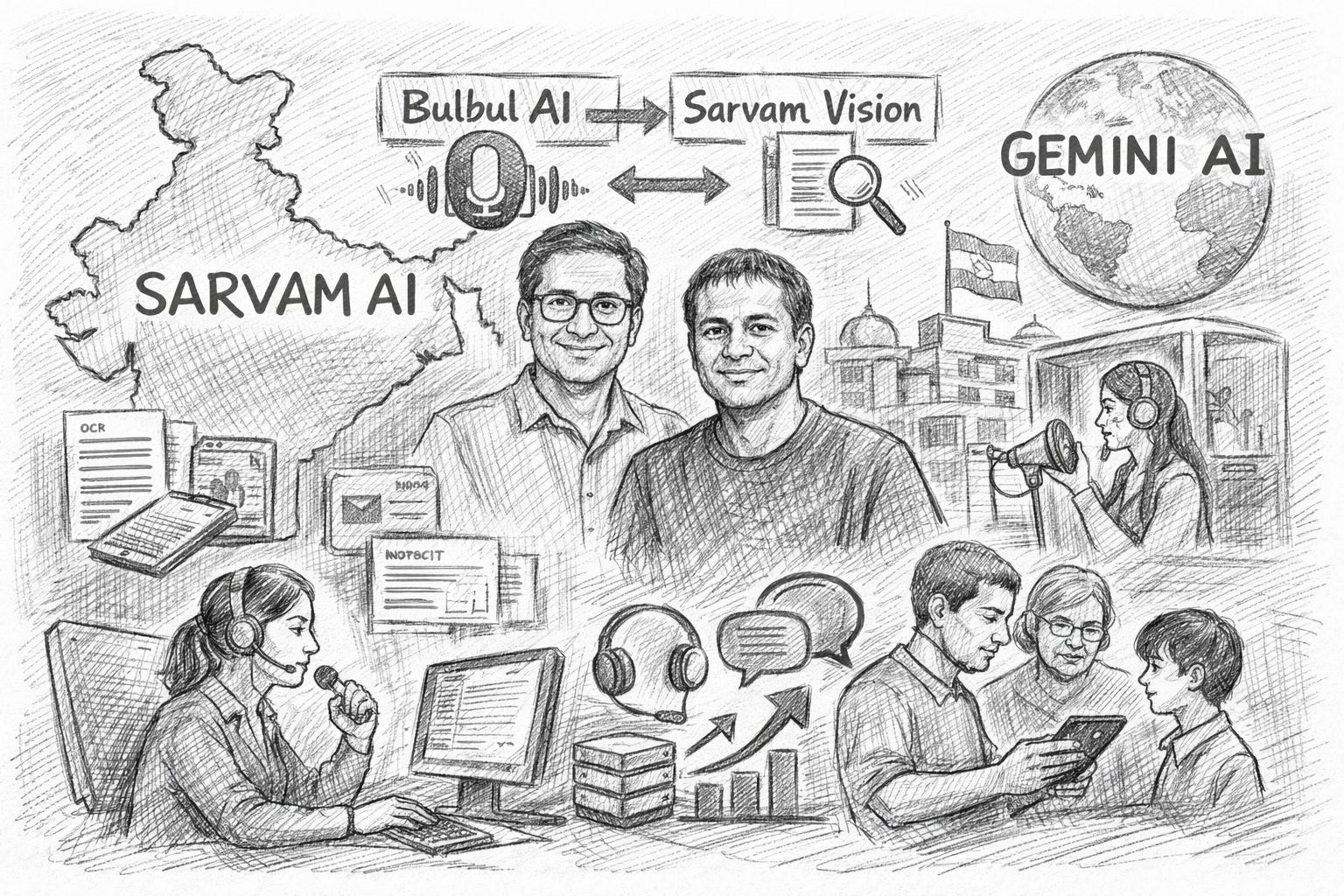
What is Sarvam AI?
In simple terms: Sarvam AI is an Indian AI company building models and tools optimised for India—including speech, text, and document understanding across multiple Indian languages.
Instead of trying to be “best in the world at everything,” Sarvam is trying to be best in the world at India-specific AI:
Indian languages (including code-mixing like Hinglish)
Indian accents and speaking styles
Indian documents (forms, IDs, invoices, handwritten or scanned paperwork)
Practical deployment (call centres, WhatsApp-like flows, low-bandwidth realities)
This “local-first” approach matters because many global models perform well in English but struggle with Indic scripts, regional phrasing, and messy real-world documents.
The two big building blocks: Sarvam Vision and Bulbul AI
1) Sarvam Vision (Sarvam Vision AI)
Sarvam Vision is positioned as a document-and-visual understanding model. A key focus is extracting structured information from complex visuals—tables, nested layouts, charts/trend lines, and scanned documents.
Why executives should care:
Faster processing of KYC-like documents, invoices, forms, and reports
Better OCR/understanding for Indian scripts and typical Indian paperwork formats
2) Bulbul AI (Bulbul V3)
Bulbul AI (notably Bulbul V3) is Sarvam’s text-to-speech focus: expressive, more natural voices built for Indian languages. Sarvam says it supports 11 Indian languages and offers 30+ voices sourced from professional voice artists.
Why creators should care:
Local-language voiceovers at scale (videos, explainers, audiobooks, learning content)
More natural “Indian” cadence for customer support or interactive voice systems
Sarvam AI founder and the “India-first” vision
Sarvam was founded in August 2023 by Dr. Vivek Raghavan and Dr. Pratyush Kumar.
Public profiles and recent coverage highlight the founders’ focus on building “sovereign” and India-scaled AI—meaning models trained and deployed with Indian language needs front and centre.
This ties into a broader push for Indian AI capabilities—where India wants not only to use AI but to own key parts of the AI stack (models, data, compute, and deployment).
“Sarvam AI app” and how people may actually use it
Depending on your role, you can think about Sarvam in two layers:
As a platform/API layer for building products (voice agents, document workflows, multilingual assistants).
As end-user experiences (demos, tools, and packaged solutions that feel like an app experience even when they’re API-driven).
If you’re evaluating a “sarvam ai app,” the practical question is: Does it plug into the channels you already use?
For many Indian workflows, that means:
phone support
WhatsApp-style engagement
web forms + document upload
multilingual call flows
Sarvam AI vs Gemini AI: a useful way to compare
A fair comparison isn’t “who is smarter overall.” It’s:
Which model performs better on your data and your users?
Gemini AI is broad, global, and deeply integrated into Google’s ecosystem.
Sarvam AI is narrower but sharper for India-specific speech and document tasks, based on recent reporting and Sarvam’s own product direction.
The takeaway for decision-makers:
If your business is primarily in India and relies on Indic languages, documents, and voice, Sarvam may reduce friction and improve accuracy at the last mile.
For Executives: where Sarvam can create ROI quickly
Here are high-probability use cases:
Customer support automation in regional languages (voice quality matters here).
Document ops (KYC, onboarding, claims, invoices): faster extraction + fewer manual checks.
Compliance and audit trails: structured outputs from messy inputs (forms, PDFs, scanned docs).
Public-sector scale: multilingual access and accessibility are not “nice to have” in India.
For Creators: where Bulbul AI is interesting
If you produce content in Indian languages, Bulbul V3’s “expressive” voices aim at:
dubbing and localisation
education content
audio storytelling
product explainers for non-English audiences
A simple test: take one of your scripts and see if the voice sounds like a real Indian narrator (not just “English TTS reading Hindi words”).
One caution: “beats Gemini/ChatGPT” depends on the task
Recent headlines say Sarvam outperforms global models on some India-specific benchmarks, especially documents/Indic languages
That does not automatically mean it’s better for everything (reasoning, coding, global knowledge, multimodal breadth). Treat it like a specialist tool that can win hard in its home domain.
Bottom line
Sarvam AI is one of the clearest examples yet of India AI moving from “adoption” to “creation.” If your users speak multiple Indian languages, if your workflows depend on messy documents, or if voice is central to your product, Sarvam’s Sarvam Vision AI and Bulbul AI are worth a serious look right now.