

The software scene has flipped, and Product Hunt is the daily receipt
If you want a live dashboard for where software is going, don’t overthink it. Open Product Hunt each morning and read the top ten. Not the press releases. Not the keynote highlights. The messy, competitive list of what people are shipping today.
And the signal is now hard to miss: the “top products” list is increasingly an AI list — even when the product is not sold as “AI”.
It’s AI underneath, AI in the workflow, AI in the distribution, or AI in the unit economics.
Your excerpt is a clean snapshot of the shift:
Origami.chat: “Find your perfect leads with one prompt” (sales + growth)
Clawi.ai: “OpenClaw in the Cloud with Zero Setup and on 24/7”
Reloop: “Create winning ads without prompts or skills”
FF Designer: “Generate beautiful UI designs that you can instantly edit”
Kollect Voice Agent: “Collect forms via voice”
Monologue (iOS): voice → polished writing
AgentReady: “Cut your AI token costs by 40–60% with one API call”
Wispr Flow (promoted): dictation everywhere, “writes in your style”
Mengram: “AI memory API… facts, events, workflows”
Even the “non-AI” entries are shaped by AI expectations: speed, automation, and outcome-based UX. And Product Hunt itself has leaned into this reality; its own editorial framing has openly highlighted how dominant AI-tagged launches have become. For instance, in its “All the AI that launched in 2025” newsletter, Product Hunt notes that 13 of the top 15 launches were tagged “Artificial Intelligence”.
Source: Product Hunt
That’s not a trend. That’s the new default.
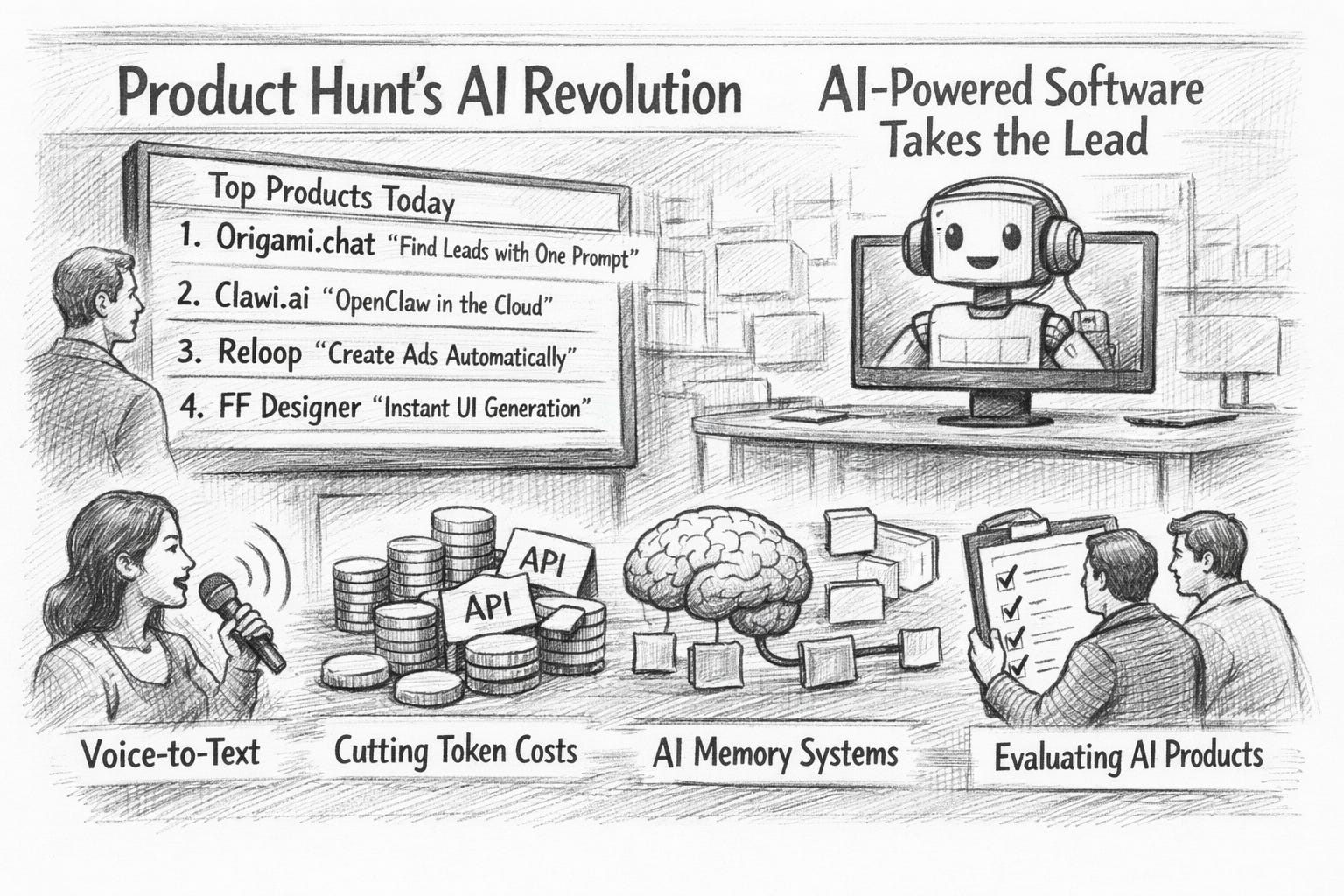
What’s actually changing: software is moving from “tools” to “teammates”
The easiest way to describe the transformation is this:
Old software: helps you do work.
AI-native software: does work with you — and increasingly for you.
This is why “agents” keep showing up: they’re the natural UI for delegated work. Product Hunt now even maintains category pages tracking “AI agents” as a mainstream software class.
But the more interesting part isn’t the word agent. It’s what it does to product strategy and market structure.
1) Interfaces are collapsing into a single entry point: language (and voice)
Look at the list again. The “front door” is often:
one prompt (Origami.chat),
one instruction (Reloop),
continuous dictation (Wispr Flow),
voice as a form (Kollect Voice Agent).
This matters because it kills feature differentiation faster than most teams expect.
When the interface becomes language, features become “verbs”. Users don’t want 17 buttons. They want:
“Find me leads like this.”
“Make this ad convert.”
“Turn my ramble into a clean memo.”
“Cut token spend without breaking quality.”
If you’re building a product strategy, treat this as a warning: your UI is no longer your moat. Your moat becomes workflow ownership, data advantage, distribution, and trust.
2) “Promptless AI” is a positioning play, and an adoption hack
Reloop’s line is the tell: “without prompts or skills”.
This is where the market is moving: not towards more powerful models (everyone will have those), but towards less cognitive load.
Prompting is friction. It’s also a skill tax. The best AI products are quietly doing three things:
They hide the model. Users buy outcomes, not tokens.
They pre-structure the task. The product becomes a “template factory” for decisions.
They ship opinionated defaults. That’s how you scale quality without training every customer.
The companies that win adoption won’t be the ones shouting “AI”. They’ll be the ones removing “AI work” from the user’s day.
3) Unit economics is now a product feature
AgentReady is blunt about it: “Cut your AI token costs by 40–60% with one API call.”
This is new. Historically, customers did not ask whether your database query cost £0.002 or £0.007. Now, buyers do ask what an LLM workflow costs at scale — because usage can explode overnight.
This pushes product teams into a different discipline:
cost-aware routing (small model vs large model),
caching and memory,
rate limits and guardrails,
evaluation pipelines as a permanent function, not a launch checklist.
In AI-native software, margin is designed, not negotiated.
Gartner’s forward-looking view aligns with this broader “AI everywhere” trajectory in engineering: it predicts that by 2028, 90% of enterprise software engineers will use AI code assistants, up from under 14% in early 2024.
Source: gartner.com
When the whole industry codes faster, what becomes scarce is not code. It’s judgment — and efficient systems.
4) “Memory” is becoming the next platform layer
Mengram’s pitch (“AI memory API… facts, events, workflows”) is more important than it looks.
In 2024–2025, the big race was: “Can we generate good output?”
In 2026, the race is: “Can we generate the right output for this company, this user, this context — repeatedly?”
That requires memory. And memory splits into three practical types:
Facts (stable): company names, product rules, preferences
Events (time-based): meetings, decisions, exceptions
Workflows (procedural): how things get done here
If your product touches knowledge work, you’re either building memory or integrating with someone else’s memory layer. And that choice will shape your roadmap, partnerships, and valuation multiples.
Why Product Hunt looks “AI-heavy” even outside AI categories
Some people misread Product Hunt and assume it’s just hype. A better explanation is structural:
AI makes shipping cheaper
More people can build. Faster. With smaller teams.AI makes demos more impressive
A 30-second video can show “magic” in a way traditional SaaS rarely could.AI makes categories blur
Is Wispr Flow productive? Audio? AI? All three. The tagging becomes messy because the product reality is hybrid.AI compresses time-to-competition
If a workflow can be modelled, five clones appear quickly. Product Hunt becomes the arena where differentiation is tested in public, in days, not quarters.
McKinsey has framed the macro version of this: generative AI is a broad productivity lever with economy-wide impact, but value depends on how work is redesigned, not on “using AI” in isolation.
Product Hunt is what that redesign looks like at ground level.
AI is eating software margins, not just software features
Here’s the uncomfortable executive-level point:
As models commoditise, feature premiums shrink.
When a competitor can replicate 70% of your feature set in weeks, pricing power moves away from “what it does” and towards:
proprietary distribution,
proprietary data rights,
trust and compliance posture,
embeddedness in a core workflow,
measurable ROI (time saved, risk reduced, revenue lifted).
So the question to ask about any “top Product Hunt AI product” is not “Is it cool?”
It’s:
What is the durable wedge?
What do they own that others can’t copy quickly?
Where does the workflow naturally expand next?
A practical checklist for evaluating AI-native products (and competitors)
Use this when you scan Product Hunt or assess potential partners/acquisitions:
Outcome clarity: Is the promise a measurable outcome, or vague “AI-powered” language?
Friction removal: Do they hide prompting and complexity by default?
Cost control: Is cost-per-task engineered, or left as “we’ll optimise later”?
Memory strategy: Do they learn safely over time, or repeat the same shallow outputs?
Workflow gravity: Does the product sit in a daily habit loop (email, docs, CRM, code, meetings)?
Trust surface: What happens when the model is wrong? Is there auditing, reversibility, and human-in-the-loop?
Distribution edge: Do they have a channel advantage, or are they renting attention?
If a product fails #3, #4, and #6, it might still go viral, but it will struggle to become enterprise-grade.
What to do next
Three moves tend to work right now:
Pick 2–3 workflows where “delegation” is realistic (not aspirational): lead research, customer support triage, marketing iteration, code review, internal knowledge search.
Treat AI spend like cloud spend: instrument it early, show cost-per-task, and design guardrails before you scale adoption.
Build a memory posture: decide what you will store, where it lives, how it’s governed, and how it’s deleted.
Because the market has already decided the direction. Product Hunt is just showing you the daily proof.