

A year can feel like a long time in digital infrastructure.
Atlantic Convergence closed today in Lisbon after three days bringing together the less visible layers of the internet: submarine cables, fibre operators, data centres, exchanges, energy companies, hyperscalers and, increasingly, the companies building the AI economy on top of them.

I wrote about the conference last year, when much of the conversation still revolved around the internet's physical expansion: where cables would land, where new data centres would be built, how Europe could improve connectivity across the Atlantic.
All of that still matters. But this year felt different.
The industry has moved up the stack.
The cables are increasingly discussed as AI infrastructure. Data centres are becoming AI factories. Connectivity is becoming part of the computing architecture. And the strategic question is no longer simply where can we build? But what services, intelligence and sovereignty can we create once the infrastructure exists?
That shift was visible throughout an event whose official theme was now explicitly about building sustainable and secure digital infrastructure for an “AI-enabled future”.
Source: Atlantic Convergence LinkedIn
AI has turned infrastructure into a growth industry
The reason is fairly simple: AI has injected an extraordinary amount of capital into what used to be a comparatively specialised infrastructure business.
According to the International Energy Agency, capital expenditure by just five large technology companies exceeded $400 billion in 2025 and is expected to increase by another 75% in 2026. The capacity of dedicated “AI factories” has more than tripled in only 18 months.
Electricity consumption tells the same story. Data-centre power demand rose 17% in 2025, while consumption by AI-focused facilities jumped around 50%. The IEA expects global data-centre electricity consumption to rise from roughly 485 TWh in 2025 to 950 TWh by 2030. (source: IEA)
This is why hyperscalers have become almost mythical characters at infrastructure conferences. Everyone wants one. Every region wants to become the next cloud and AI hub. Every large power connection suddenly looks like the beginning of a potential billion-euro project.
There is hype here, unquestionably. Not every announced data centre will be built and not every GPU cluster will generate an adequate economic return. Even the IEA explicitly warns that project pipelines are running far ahead of what will necessarily materialise.
But underneath the hype is a genuine structural change: intelligence increasingly requires industrial-scale physical infrastructure.
And that makes Portugal unusually interesting.
Source: Atlantic Convergence LinkedIn
The REN Telecom presentation made the Portugal case unusually clear
One presentation that stood out to me came from REN Telecom (today 1.30 pm), partly because it connected the different pieces into a coherent national argument.
Portugal already has the submarine cables.
It is building the data centres.
But those assets only become an ecosystem if terrestrial networks connect them to each other, to the energy system, to Spain and ultimately to customers.
REN Telecom sits in an unusual position because its fibre follows the electricity and gas transmission infrastructure operated by the REN group. Its current network comprises more than 8,000 kilometres of fibre, over 200 access points and cross-border connections into Spain. REN
That matters more in the AI era than it sounds.
REN’s presentation argued that AI is shifting traffic patterns from the traditional “north-south” architecture towards far more “east-west” traffic between computing clusters. Large AI facilities require enormous fibre counts, very low latency and route diversity. In that world, the network is no longer plumbing attached to the computer.
The network becomes part of the computer.
And this is where Portugal’s geography becomes technology strategy.
Sines and Lisbon sit naturally on Atlantic routes linking Europe with Africa and the Americas. Add terrestrial connections into Spain, competitive renewable electricity and an increasingly serious data-centre ecosystem, and Portugal begins to look less like Europe’s western edge and more like one of its possible digital entry points.
For my country, that is a rather attractive change of perspective.
Portugal also generated renewable electricity equivalent to 68% of national electricity consumption in 2025 — an important ingredient in an industry where access to power is rapidly becoming as important as access to land or fibre. REN
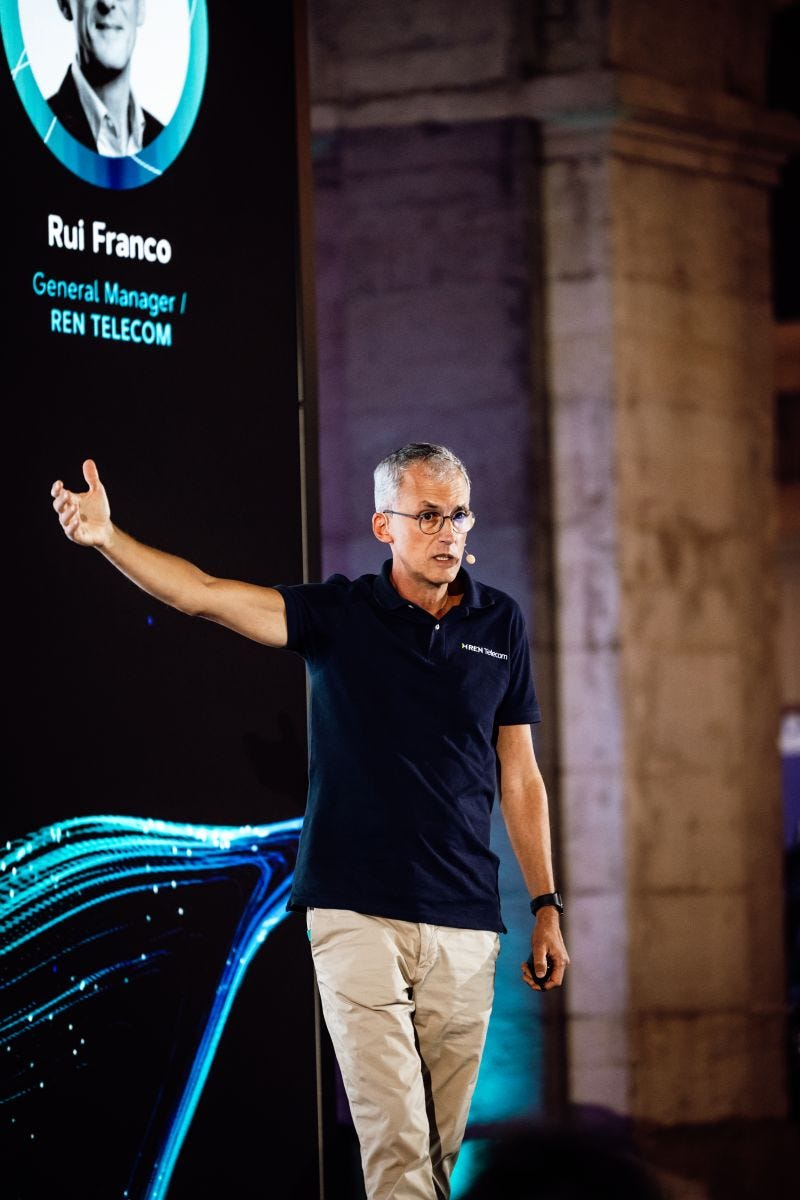
Rui Franco, General Manager, REN Telecom. Source: Atlantic Convergence LinkedIn
From data centres to AI factories
The scale of what could come next is significant.
A 2025 study commissioned by industry association Portugal DC estimates cumulative Portuguese data-centre investment at around €13 billion by 2031, potentially supporting about 9,400 jobs and contributing €3.7 billion annually to GDP by then. Those are forecasts rather than guaranteed outcomes, but they show how rapidly the industry’s expectations have changed. ECO News
Sines offers perhaps the most visible example. Nscale and Start Campus have announced plans to deploy more than 66,000 NVIDIA Vera Rubin GPUs for Microsoft from late 2027, building on an initial deployment of more than 12,600 Blackwell Ultra GPUs.
Europe is simultaneously trying to create its own layer of sovereign AI infrastructure. In July, the EU launched its tender for up to seven AI Gigafactories, backed by as much as €10 billion in European and national public funding and intended to mobilise at least €20 billion of private investment. Estratégia Digital da UE
Portugal wants one.
The government has committed up to €200 million to acquire computing capacity as part of an Iberian bid with Spain, with EuroHPC potentially matching that amount in the first phase. The government estimates that the Portuguese component of the overall project could eventually represent around €4 billion. Governo de Portugal
Earlier this year, Portugal approved a National Data Centre Plan with 15 initiatives covering regulation, energy infrastructure, demand, and territorial development during 2026–27. Governo Digital
Those pieces — cables, energy, land, fibre, data centres, GPUs and public policy — are starting to look less like separate industries and more like one integrated system.
That, for me, was the real story of Atlantic Convergence this year.
Last year the infrastructure itself was the story.
This year the more interesting question was what we can build with it.
And perhaps that is the clearest sign that this industry is maturing. Cables enabled data centres. Data centres enabled cloud. AI is now forcing energy, compute and networks to behave as one system.
Portugal happens to have a surprisingly good hand.
There is, of course, one final metric for judging the health of an industry that neither the IEA nor Portugal DC appears to track.
Conference parties.
And if party quality is a leading indicator of infrastructure investment, the sector is doing exceptionally well: yesterday’s Merlin Edge dinner at Lisbon’s Estufa Fria was brutal.
Possibly bullish enough to require its own gigafactory.
The east-west traffic point is underrated. Once AI clusters talk to each other more than to end users, fibre that follows the power grid, as REN's does, becomes a strategic asset rather than a connectivity product. Did anyone at the conference address who will actually operate the compute in these Portuguese AI factories: European operators, or mostly US hyperscalers renting the land and the power?