

Pokémon and Generative AI: a relationship that’s getting operational
If you felt “Pokémon Day” everywhere this week, you weren’t imagining it. Pokémon Day is 27 February, tied to the original 1996 launch in Japan, and 2026 marks the franchise’s 30th anniversary, with an official Pokémon Presents scheduled for 27 February.
That anniversary matters for one reason beyond nostalgia: Pokémon is now one of the clearest mirrors of what generative AI is doing to modern entertainment businesses.
Not in an abstract “AI will change everything” way—but in the boring, valuable, executive way: workflow, unit economics, IP posture, community governance, and product strategy.
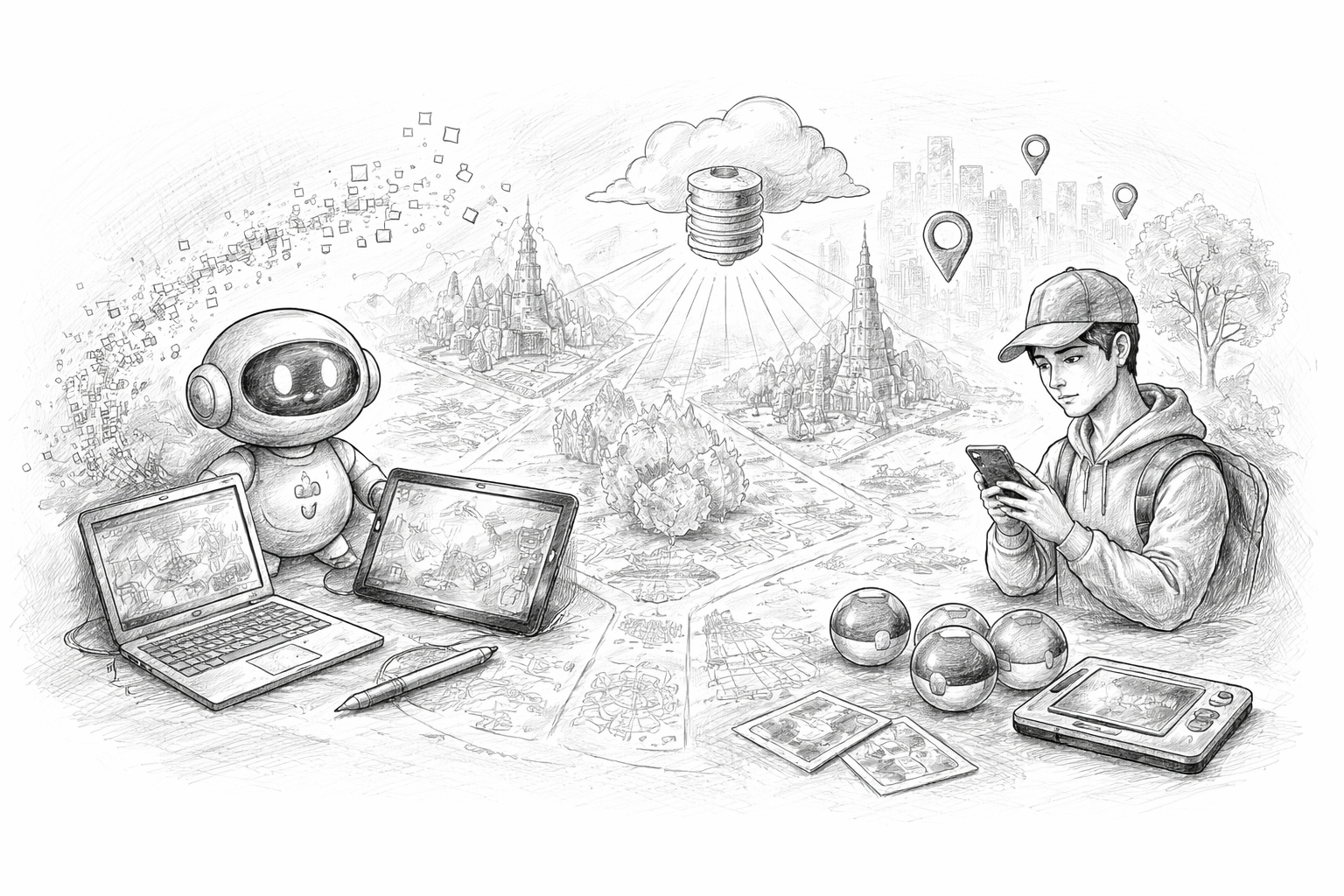
Pokémon sits at the intersection of three AI forces:
Generative creation (images, video, narrative, and “new creatures”)
Agentic gameplay (models planning and executing inside complex systems)
World capture (real-world scanning and location intelligence)
Each force creates opportunity. Each also creates a specific kind of risk.
1) Why Pokémon is a perfect “generative” franchise (and why that’s dangerous)
Pokémon has always been a generator—just not an AI one.
The core loop is combinatorial: types, moves, evolutions, regions, rarities, variants. The brand already thinks in systems that scale content. That’s exactly what generative AI is good at: producing endless variations that still feel “on brand.”
So the obvious executive temptation is:
“Could we generate more Pokémon-like things faster?”
Yes. But the minute you do it at scale, you hit three constraints:
Constraint A: Brand consistency is harder than novelty.
Most generative models can produce “a creature.” Very few can produce a creature that passes the Pokémon test: readable silhouette, iconic shape language, toy-friendly geometry, and a name that sounds inevitable. The constraint isn’t creativity. Its taste is encoded as a process.
Constraint B: The data provenance problem is existential for family brands.
If you can’t defend how something was made, you can’t ship it globally. That’s why many large franchises treat public “AI art” as a reputational hazard rather than a productivity boost.
Constraint C: Fan culture is part of the product.
Pokémon isn’t just IP; it’s a participatory economy: collectors, artists, cosplayers, competitive players, creators. Generative AI can look like an efficiency tool internally, while being interpreted as an extraction externally.
The best real-world signal here is not a think piece. It’s what organisations do when the stakes are high.
In 2024, The Pokémon Company disqualified entries in its official TCG illustration contest following rule violations tied to AI-related controversy—an indication that, at least in certain flagship contexts, the organisation is protecting the “human craft” signal.
For premium brands, the immediate value of “no AI” is not moral. It’s positional. It tells the market: our artefacts are scarce, authored, and defensible.
If you run a company with a premium brand layer, Pokémon is a case study in a simple rule:
Use generative AI to increase throughput behind the curtain.
Protect authored scarcity on the stage.
2) Pokémon as an “agent benchmark” for the AI industry
Here’s the twist: Pokémon isn’t only relevant because it’s a creative franchise. It’s relevant because it’s becoming a testbed for AI agents.
Why Pokémon Red in particular? Because it’s deceptively hard:
Long time horizons (you plan now for payoff hours later)
Mixed task types (navigation, resource management, puzzles, battles)
Partial information and uncertainty
Lots of “UI reality” (menus, inventory, map memory)
In other words, it behaves like work.
That’s why researchers keep using it. There are academic and applied projects positioning Pokémon as a structured environment for reinforcement learning and multi-agent planning.
And the mainstream signal got louder when Anthropic showcased model capability via Pokémon gameplay—framing it explicitly as evidence of improved reasoning and long-horizon planning. (If your model can operate coherently inside Pokémon for extended periods, it’s closer to operating inside an enterprise stack.)
Pokémon is effectively a “sandbox ERP.” Not because it resembles enterprise software, but because it forces the same meta-skills: state tracking, prioritisation, error recovery, and persistence.
So if you’re evaluating “agent readiness” in your organisation, stop watching abstract demos. Watch environments like Pokémon:
Can the agent form a plan and revise it?
Can it remember goals across interruptions?
Can it avoid reward hacking and local minima?
Can it operate with minimal prompting?
Those questions map cleanly to: sales ops, procurement flows, customer support tooling, and analyst workflows.
3) Pokémon GO and the quiet AI asset: the physical world
Generative AI gets the headlines, but the more durable asset is often data about reality.
Niantic has publicly described its work on machine learning, including the exploration of generative AI modules and mixed-reality characters.
Separately, Niantic has discussed building large-scale geospatial capabilities—work that has been linked to data collected through real-world scanning features in its products, including Pokémon GO.
This matters because it hints at the next competitive moat:
Not “we have the best model”
But “we have the richest world representation”
Pokémon GO is not just a game. It is a behavioural engine that motivates users to move, scan, and map. That’s a pipeline for spatial understanding—useful well beyond entertainment.
In the next decade, the rarest dataset won’t be text. It will be a high-quality, consented, well-labelled reality: spatial, embodied, and continuously refreshed.
Pokémon’s place in this story is uncomfortable but clear: it shows how beloved consumer products can become infrastructure for machine perception.
4) The executive playbook: how to use generative AI around Pokémon-like IP
If you manage brands, content pipelines, or product strategy, the most practical question is:
Where does generative AI create value without poisoning trust?
Here’s a workable operating model.
A) Separate “creation” from “production”
Creation is where taste, authorship, and scarcity live.
Production is where cost, speed, and iteration live.
Use genAI aggressively in production:
ideation variants
colourway exploration
background concepts
localisation drafts
trailer rough cuts
internal storyboards
But protect creation:
final character designs
flagship illustrations
key art
collectable-defining assets
This mirrors what Pokémon signalled with contest governance: the “hero artefact” layer must remain defensible.
B) Treat “AI content” like a supply chain with audits
If you can’t answer these, you can’t ship safely:
What model produced it?
What training data rights exist?
What prompts and edits were used?
What human approvals happened?
Can we recreate the asset deterministically?
Build an audit trail the same way you would for financial reporting. The ROI is not just legal safety. It’s crisis speed.
C) Monetise generative tools, not just generative outputs
Pokémon’s ecosystem suggests a better monetisation pattern than “sell infinite AI art”:
Give fans creative tooling with constraints
Make outputs shareable but governed
Create tiers (free play → paid polish → licensed publication)
The product isn’t the generated creature. The product is the creative loop—with guardrails.
D) Assume community reaction is a first-order variable
Your community will decide whether genAI is:
a fun extension of fandom, or
a betrayal of craft
So build explicit labels, opt-outs, and “human-made” lanes. If you don’t define the norms, your users will—usually during a controversy.
5) The real relationship: Pokémon teaches AI companies, and AI teaches Pokémon
Put simply:
Pokémon teaches AI about planning, memory, and long-horizon agency (because it’s a structured world with friction).
AI teaches Pokémon-like businesses how to scale production, compress iteration cycles, and build new creator economies—while raising the bar for provenance.
Pokémon Day is a good reminder that enduring franchises don’t win by chasing the newest tool. They win by protecting what makes them feel authored, while modernising everything around that core.
If you’re building a strategy right now, the clean takeaway is:
Use generative AI to accelerate the machine parts of your business, and invest even more in the human signals your customers actually pay for.