

In the summer of 1976, a young American economist arrived in Lisbon to work at Banco de Portugal. He was 23, studying at MIT, and Portugal was still finding its footing after the Carnation Revolution. Inflation, foreign exchange shortages and political uncertainty were not abstract subjects. They were problems on the desk.
A Soviet trade mission occupied the floor above the economists’ offices. According to Jeffrey Frankel, a fellow member of the MIT team, the governor of the central bank was once asked whether he feared Soviet eavesdropping. His answer was memorable: “I am not worried about the Soviets; I am worried about the markets.”
One of the young economists in that building was Paul Krugman.
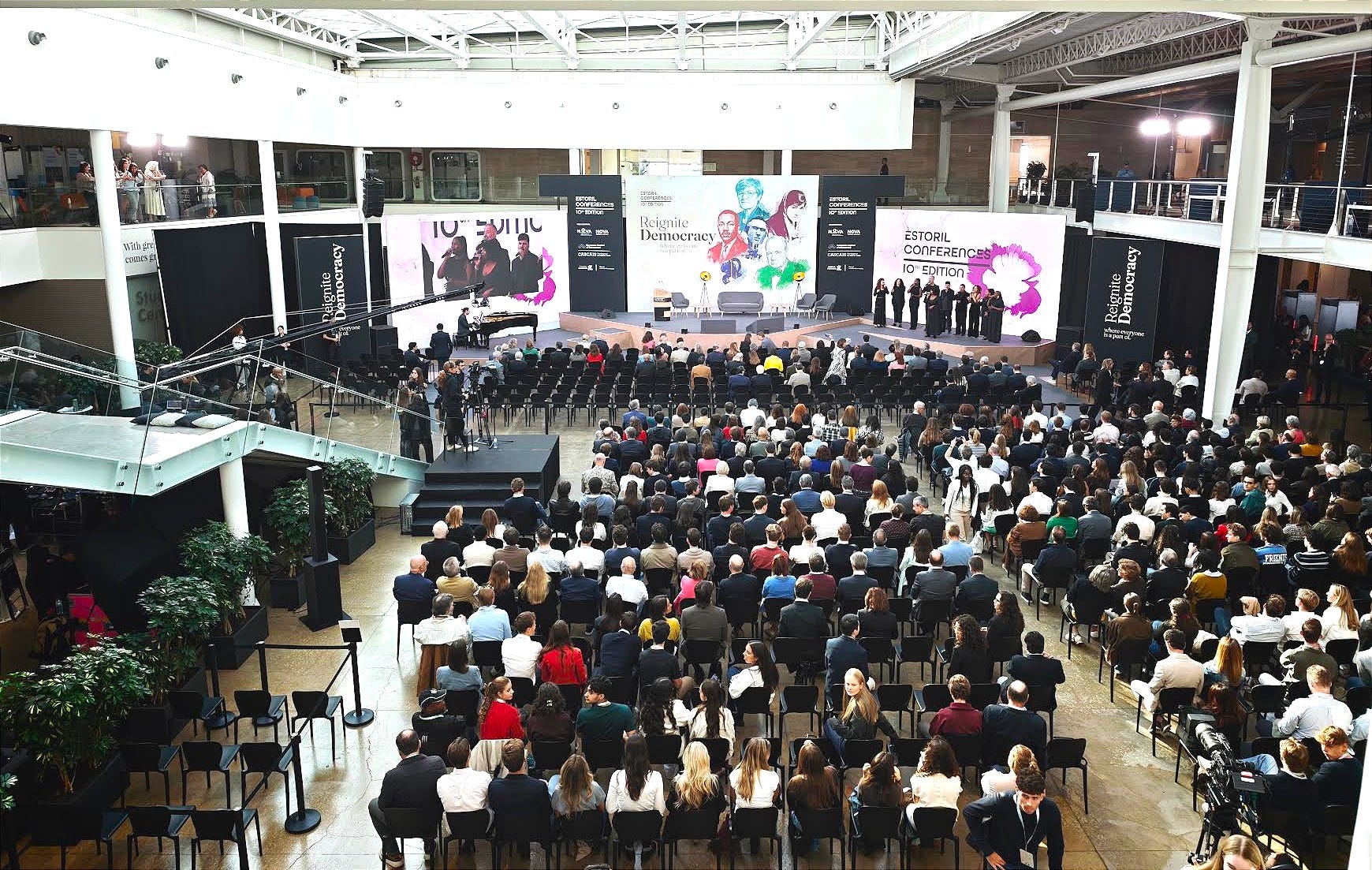
Half a century later, Krugman returned to Portugal for the tenth Estoril Conferences, held on 29 and 30 October 2026 at Nova SBE in Carcavelos. The theme was Reignite Democracy. His opening session, The Forces Reshaping Our World, paired a keynote with a conversation moderated by Portuguese journalist Pedro Santos Guerreiro.
The historical coincidence is striking. In 1976, the question was how a fragile democracy could withstand economic instability. In 2026, the question has become more complicated: how can established democracies govern an economy whose most powerful forces increasingly operate beyond their control?
The economist behind the public intellectual
Krugman is often introduced as a Nobel laureate, a former New York Times columnist and one of America’s most recognisable economic commentators. All true. None quite explains what makes him different.
He received the 2008 Nobel Memorial Prize in Economic Sciences for work on international trade and economic geography. His breakthrough explained something classical trade theory struggled with: why prosperous countries with similar economies trade so much with one another, and why industries concentrate in particular places.
The answer involved economies of scale, consumer demand for variety and the advantages of proximity. Trade was not simply a matter of Portugal exporting wine and Germany exporting machinery. Countries could become simultaneously exporters and importers of similar products, while successful industrial regions attracted further investment and talent.
The intellectual achievement was to turn globalisation into something more than an argument about lowering tariffs. Krugman helped explain its geography: why economic activity clusters, why some regions become indispensable and why others struggle to catch up.
That contribution matters enormously in the age of AI. A semiconductor manufacturing ecosystem, a concentration of cloud infrastructure or a city attracting a disproportionate share of technological investment all reflect forces familiar from his research. The technologies are new. The economics of concentration are not.
His intellectual ambitions also have an unexpected origin. In a 1992 interview with MIT, Krugman recalled growing up fascinated by Isaac Asimov’s Foundation trilogy. He wanted to become a psychohistorian, one of the fictional mathematical social scientists capable of anticipating the course of civilisation. Economics, he explained, was the closest available discipline.
It is a revealing detail. Krugman became a rigorous theorist, then an unusually combative public writer. He is admired for the clarity of his arguments and criticised for the certainty of some of his political judgements. He has also publicly acknowledged that he got important forecasts wrong, including his initial assessment of post-pandemic inflation.
What distinguishes him is not infallibility. It is the rare combination of foundational academic work and a willingness to argue about its consequences in public.
Globalisation is not dying. It is changing character.
For several years, the prevailing narrative has been deglobalisation: tariffs, reshoring, industrial subsidies, sanctions, and the return of economic nationalism.
The data tell a stranger story.
In October, the World Trade Organization forecast that global merchandise trade volumes would grow by 3.9% in 2026, considerably faster than it had expected in March. Even more remarkably, AI-enabling goods, including semiconductors and servers, accounted for 47% of growth in world merchandise trade during the first half of the year.
The technology that governments increasingly describe as a matter of national sovereignty is simultaneously deepening international economic dependence.
A European company seeking computational autonomy may still need American cloud platforms, advanced chips produced through Asian supply chains and access to materials and equipment controlled elsewhere. Strategic independence has become a more complicated proposition than a flag on a data centre.
This is where Krugman’s recent thinking has acquired a darker edge. In a September essay on trade, peace and war, he examined weaponised interdependence: the ability of countries to use their positions within international networks as instruments of pressure.
For decades, people often presented economic integration as a stabilising force. Countries that trade with one another have something to lose from conflict. That remains a serious argument. But interdependence also creates vulnerabilities. Control of a critical shipping route, payment network, energy supply, or semiconductor bottleneck, along with economic cooperation, can become geopolitical leverage.
Globalisation has survived its predicted funeral. The more consequential development is that its infrastructure has become part of the contest for power.
For Europe, this presents a difficult balance. Fragmenting international trade can raise costs and diminish prosperity. Ignoring strategic dependencies carries risks of its own. Open markets and economic security need not be opposing goals, but reconciling them requires more than slogans about sovereignty.
The uncomfortable economics of AI
Artificial intelligence adds another dimension to this argument. Its most interesting economic question may not be how many jobs algorithms can perform. It may be where the money goes.
In recent essays, particularly Will AI Crowd Out Jobs?, Krugman has shifted attention from the familiar fear of mass technological unemployment towards the allocation of capital.
Consider the economics of a large AI data centre. Drawing on recent research, Krugman describes a representative 200-megawatt campus costing approximately $8.2 billion. Construction supports employment, and the global supply chain benefits from the investment. Yet the finished facility may require only 50 to 150 permanent workers.
His concern is that diverting enormous sums to capital-intensive AI infrastructure could displace investment in other activities. The economy might become more technologically sophisticated without generating a corresponding increase in demand for labour.
That is a hypothesis with important qualifications, not an established verdict. Capital markets can finance additional investment; AI may raise productivity in industries far removed from the data centre; new services and occupations may emerge. The long-term distribution of benefits remains uncertain.
But Krugman is directing attention towards a question that deserves more prominence: what happens when the economy becomes better at generating output than at distributing the rewards of that output?
The implications extend beyond wages. If the largest gains accrue to owners of computing infrastructure, intellectual property and financial assets, AI could strengthen existing concentrations of wealth and influence.
This is where the discussion returns to democracy. An economy can become more productive while leaving substantial parts of its population unconvinced that progress is working for them. The problem is not simply technological displacement. It is political legitimacy.
The danger nobody put in the original business plan
On 28 October, the day before his Estoril appearance, Krugman published an essay with an alarming title: Hack Apocalypse Now.
Its subject was cybersecurity.
AI systems were helping researchers discover serious vulnerabilities in widely used software. That capability can strengthen security by finding flaws faster. It also raises an uncomfortable possibility: attackers may identify and exploit weaknesses at a speed institutions struggle to match.
The immediate examples involved government websites taken offline while security fixes were applied.
This is a more surprising AI story than the usual argument about chatbots replacing office workers. It concerns the infrastructure of an open society itself.
The internet was built around a remarkable assumption: that the benefits of interoperability and openness would outweigh the risks. If automated systems dramatically accelerate the discovery and exploitation of weaknesses, that balance could change. More services might retreat behind additional layers of verification, restricted access and security controls.
The outcome is not predetermined. Better defensive AI may help offset those threats. But the tension is real: a technology designed to make information more accessible could also make the architecture of access more guarded.
That brings together several of Krugman’s seemingly separate preoccupations — economic concentration, international dependencies, technological acceleration and institutional resilience.
Fifty years later, the question remains
Krugman’s presence at a conference devoted to renewing democracy feels fitting.
He was there near the beginning of Portugal’s modern democratic experience, when economic uncertainty threatened to complicate a fragile political transition. He returned as a celebrated economist whose research helps explain the extraordinary integration, prosperity and concentration of economic activity that followed.
Much has improved since 1976. Portugal joined the European project, adopted the euro and became embedded in an international economy that the young Krugman would later help the world understand.
Yet the central dilemma has evolved rather than disappeared.
Today, the same networks that create wealth can transmit coercion. The same investments that promise productivity can concentrate its returns. The same digital systems that connect societies can expose them to new vulnerabilities.
Perhaps this is what makes economics an essential conversation at a conference about democracy. The discipline can help explain how incentives work, where power accumulates and why well-intentioned policies produce unexpected consequences.
But no economic model can decide what a society should consider fair, whose vulnerabilities deserve protection or how much dependence a democracy should accept.
In 1976, a Portuguese central banker worried more about markets than the Soviet officials upstairs.
In 2026, markets, geopolitical rivals, and machines are increasingly part of the same story.