

Ask a simple question inside most organisations:
“How do we know our AI works?”
The room usually goes quiet.
There are dashboards. There are demos. There are vendor reports. There may even be accuracy metrics from a pilot. But very few companies can answer three basic questions with confidence:
Does it work in real conditions?
Does it work consistently?
Does it create measurable economic value?
The uncomfortable truth is that much of corporate AI today operates in a grey zone between plausible and proven.
And that is becoming a strategic risk.
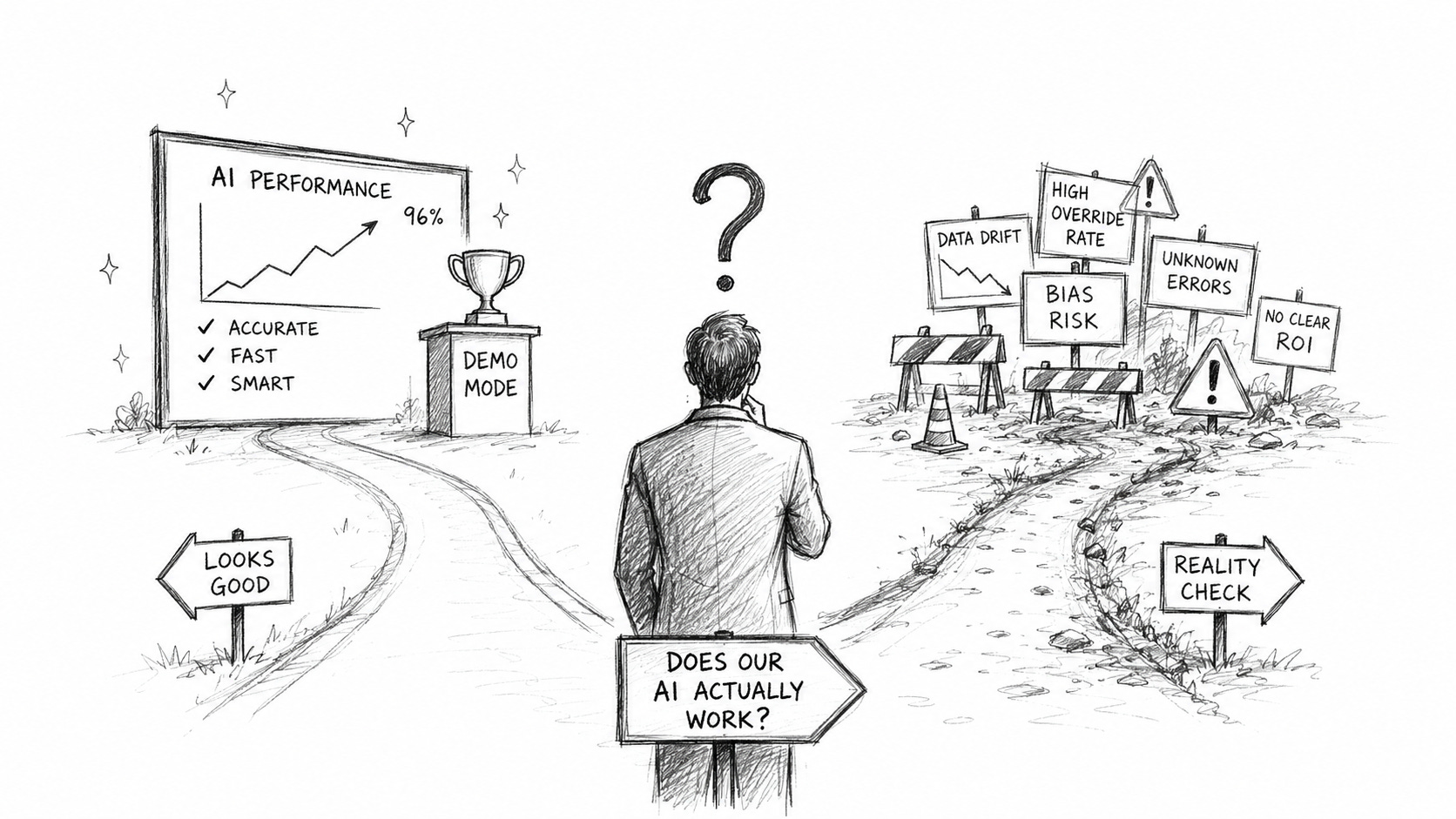
The Illusion of “It Works”
Most AI systems look impressive in controlled settings.
They summarise documents well.
They answer internal questions convincingly.
They classify images with high accuracy.
They draft emails faster than humans.
But production reality is different.
Real environments contain:
incomplete data,
contradictory inputs,
shifting formats,
regulatory constraints,
edge cases no one documented,
humans who override outputs,
and incentives that distort usage.
A model that achieves 92% accuracy in testing may generate operational friction if the remaining 8% creates compliance issues, reputational risk, or rework.
This is not hypothetical. According to Gartner, more than 40% of agentic AI projects are expected to be cancelled by 2027, largely due to unclear value and weak risk governance.
The issue is not intelligence. It is validation.
Accuracy Is Not Performance
A recurring mistake in AI deployment is confusing model accuracy with business performance.
A fraud detection model may achieve strong precision in isolation.
But does it reduce actual fraud losses?
Does it increase false positives and harm customer experience?
Does it require additional review staff?
A customer service LLM may produce helpful answers.
But does it reduce handling time?
Does it increase escalation rates?
Does it create inconsistent advice across channels?
An underwriting model may score risk well.
But does it improve portfolio outcomes after six months?
Or does it simply re-rank cases humans would have approved anyway?
Accuracy is a laboratory metric.
Performance is an economic one.
Very few boards receive the second.
The Silent Drift Problem
Even when AI works at launch, it may not work six months later.
Data changes.
Customer behaviour shifts.
Regulation evolves.
Competitors adjust pricing.
Fraud patterns mutate.
Models degrade silently.
This phenomenon, model drift, is well documented in academic and regulatory circles, but under-managed in corporate environments. The European Commission’s framework under the EU AI Act explicitly stresses ongoing monitoring and post-market surveillance obligations for high-risk systems. (Source: European Commission – AI Regulation)
In other words, compliance assumes drift will happen.
Many organisations do not.
The Measurement Gap
Here is a simple diagnostic.
Ask your AI team for:
Current model performance in production (not testing).
Error distribution by segment.
Human override rate.
Economic impact per decision.
Degradation trend over time.
If those metrics are not immediately available, you do not have an AI capability. You have an AI experiment.
According to research from MIT Sloan Management Review, a significant share of companies struggle to move from AI pilots to scaled impact, precisely because measurement and governance frameworks lag behind experimentation.
Most firms measure:
adoption,
usage,
satisfaction.
Few measure:
counterfactual outcomes,
avoided loss,
systemic risk exposure,
long-term behavioural shifts.
That gap is where value evaporates.
Why Nobody Can Prove It Works
There are five structural reasons why AI validation is weak across industries.
1. No Clear Counterfactual
To prove AI works, you must compare it against what would have happened without it.
Most companies do not run controlled experiments in production.
They deploy AI broadly and assume improvement.
Without A/B testing or staggered rollouts, causality becomes guesswork.
2. Humans Compensate Quietly
When AI outputs are imperfect, humans adapt.
They double-check.
They reformat.
They re-interpret.
They fix errors before escalation.
The system appears to function.
But hidden labour absorbs model weaknesses.
The dashboard looks stable.
The organisation is quietly paying for correction.
3. Incentives Favour Optimism
Project teams are rarely rewarded for declaring “this does not work”.
Budgets, promotions, vendor relationships, and reputation all encourage positive framing.
So AI systems are described as:
“improving steadily”,
“early but promising”,
“strategic capability building”.
Very few are shut down decisively.
4. Vendors Optimise for Benchmarks
External providers optimise for:
benchmark scores,
demo performance,
general capabilities.
Your business operates in:
messy workflows,
legacy systems,
regulatory boundaries,
political hierarchies.
The gap between benchmark excellence and operational excellence is rarely quantified before procurement.
5. No “Kill Metric”
Most AI deployments lack predefined failure thresholds.
Without a kill metric—an agreed performance boundary that triggers shutdown—projects linger indefinitely in a semi-working state.
They are too embedded to remove.
Too weak to celebrate.
Too risky to ignore.
The Real Risk: Decision Contamination
The most dangerous AI systems are not the ones that fail loudly.
They are the ones that influence decisions subtly while being partially wrong.
A pricing model that nudges margins down by 0.3%.
A hiring filter that skews candidate pools gradually.
A credit score adjustment that compounds bias over time.
A recommendation engine that shifts demand unpredictably.
Each effect is small.
Collectively, they reshape the organisation.
And often, no one can trace the outcome back to the model.
A Practical Framework: Prove or Pause
If you want to know whether your AI works, implement the five disciplines immediately.
1. Define Economic Output Per Decision
Not “model accuracy”.
Not “usage rate”.
Define:
cost per inference,
value per correct output,
cost per error,
downstream operational impact.
Translate AI into unit economics.
2. Install Live Production Monitoring
Track:
performance by segment,
drift indicators,
override rates,
anomaly spikes.
If you monitor financial systems daily, why monitor AI quarterly?
3. Introduce Counterfactual Testing
Run controlled comparisons where possible:
phased rollouts,
shadow modes,
controlled randomisation.
Prove causality before scale.
4. Make Override Visible
Track how often humans:
correct outputs,
ignore suggestions,
escalate cases.
Human distrust is data.
5. Agree a Kill Threshold
Pre-define:
minimum acceptable performance,
maximum tolerable risk exposure,
review cadence.
If thresholds are breached, pause deployment automatically.
This is governance, not pessimism.
The Strategic Advantage of Admitting Uncertainty
There is a counterintuitive competitive edge emerging:
The firms that admit they do not know whether their AI works are better positioned than those who assume it does.
Why?
Because they design measurement before scale.
They build governance before automation.
They treat AI as infrastructure, not marketing.
In a tightening regulatory environment, especially in Europe, this discipline will not be optional.
It will be audited.
The Question That Changes the Conversation
Instead of asking:
“Where else can we use AI?”
Ask:
“Where can we prove it works?”
That single shift transforms AI from a narrative into an asset.
Most organisations today cannot confidently prove that their AI works in economic, operational, and regulatory terms.
The ones that can will not necessarily have better models.
They will have better discipline.
And discipline—not intelligence—will determine who captures durable value from artificial intelligence.