

The “deadly Nipah virus outbreak” is trending again. Here’s what credible sources say about the current Nipah virus outbreak in India, why Bali is tightening airport screening, and what we learned (and still forget) from COVID; plus where generative AI can genuinely help.
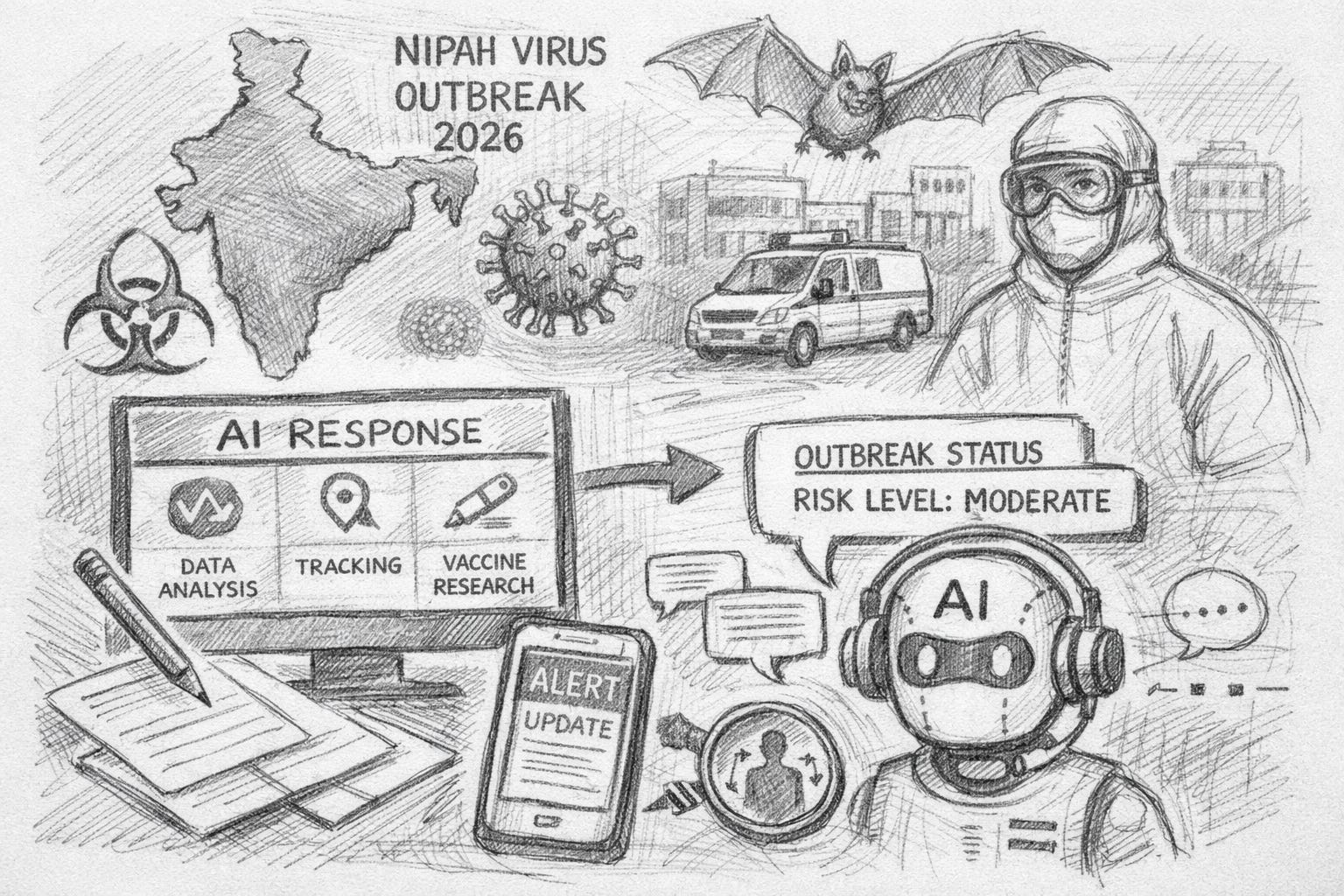
The trend: “deadly Nipah virus outbreak” (and why you’re seeing it everywhere)
If your feed is full of Nipah, new virus 2026, Nipah virus outbreak India, and even Bali, you’re not imagining it. But before we let social media set the narrative, here’s the clean, source-based picture:
As of late January 2026, India has confirmed two cases of Nipah virus in West Bengal. The World Health Organisation (WHO) says the risk of further spread from these cases is low and does not recommend travel or trade restrictions.
That’s the headline. The rest is about context—and how we communicate it well in a post-COVID world.
What we know right now (from WHO and public health agencies)
WHO’s regional update is unusually specific (a good sign: transparency helps reduce rumour fuel):
Location: Barasat, North 24 Parganas district, West Bengal, India
Who: Two 25-year-old nurses at the same private hospital
Timeline: Symptoms began late December 2025; isolation in early January; suspected on Jan 11; confirmed by India’s National Institute of Virology on Jan 13
Containment: 196 contacts identified, monitored, and tested—all negative and asymptomatic
Status (as of Jan 27): No additional cases detected
Risk assessment: Moderate at the sub-national level in West Bengal; low nationally/regionally/globally
Travel guidance: No travel or trade restrictions recommended
Europe’s public health risk readout is similarly calm: the ECDC assesses the risk for Europeans travelling to or living in the area as very low, noting the link to a single healthcare setting and no sign of community transmission. (source: ecdc.europa.eu)
Reuters reports that the WHO also emphasised there’s no evidence yet of increased human-to-human transmission, and that India has the capacity to contain such outbreaks. (source: Reuters)
Is Nipah a “new virus 2026”? No—and that detail matters.
Calling Nipah a “new virus 2026” is inaccurate. Nipah was first identified in Malaysia and Singapore in the late 1990s, and India has had multiple outbreaks since 2001 (including Kerala outbreaks since 2018). (source: Reuters)
Why this matters: novelty language drives panic. Nipah is serious, but it’s not an unknown mystery pathogen suddenly appearing out of nowhere.
Why the phrase “deadly Nipah virus outbreak” spreads so fast
Nipah has a scary profile on paper:
High case fatality rate (often cited ~40–75%)
Can cause severe respiratory illness and encephalitis
No licensed vaccine or specific treatment (supportive care is key)
Those facts are real. The missing nuance is that person-to-person transmission is typically limited and requires close/prolonged contact, often in healthcare or household settings—very different from the early dynamics of SARS-CoV-2.
Why “Bali” is in the trend (and what it does not mean)
You’ll see Bali paired with Nipah because airports in parts of Asia are adding screening measures after India confirmed cases—not because there’s a Nipah outbreak in Bali.
Indonesia has implemented thermal scanner screening at major airports, including Bali’s I Gusti Ngurah Rai International Airport, with symptomatic passengers referred for further medical evaluation.
So: “Bali” = precautionary border health measures, not a Bali outbreak.
The COVID bridge: the real lesson isn’t “panic early”; it’s “signal early”
COVID taught us two conflicting instincts:
Don’t dismiss early warnings (complacency is costly)
Don’t amplify uncertainty as certainty (panic + misinformation is also costly)
Nipah is where those instincts collide. Two cases can be:
a contained spillover event handled well (often the case), or
the start of something larger if surveillance is weak, trust is low, or healthcare transmission isn’t controlled
WHO’s current assessment—low broader risk, no evidence of increased human-to-human spread—leans toward the first scenario.
The COVID-era twist is that our information ecosystem is now optimised to turn “possible” into “inevitable” in a single algorithmic hop.
Where AI can help
AI won’t “stop Nipah.” But it can reduce two chronic failures that COVID exposed:
1) Speeding up trustworthy situational awareness
In outbreaks, teams drown in PDFs, bulletins, and fragmented updates. Generative AI can help by:
summarising official guidance (WHO/ECDC/health ministries) into plain-language briefs
translating risk communications into local languages quickly
generating role-specific checklists (clinicians vs. travellers vs. hospital IPC teams)
But: this only works if systems are constrained to trusted sources and audited, because hallucinated health advice is worse than no advice.
2) Improving infection prevention and control (IPC) execution
WHO emphasises strict IPC in healthcare settings for Nipah.
AI can support IPC by:
converting protocols into micro-workflows (what to do at triage, isolation, PPE steps)
creating adaptive training simulations for staff (scenario-based drills)
generating posters, signage, and reminder systems tailored to local context (the “creativity” angle that actually moves behaviour)
3) Strengthening surveillance and rumour control
One of the biggest COVID failures was letting rumours fill the silence. Here, the goal isn’t censorship; it’s fast, verifiable counterspeech:
monitor trending claims (“new virus 2026,” “outbreak in Bali,” inflated case numbers)
publish a “what we know / what we don’t” update daily
provide shareable explainers that don’t talk down to people
Reuters notes India’s health ministry warned about “speculative and incorrect figures” circulating—exactly the kind of information hazard AI can help triage and correct. (source: Reuters)
4) Supporting research workflows (carefully)
Nipah remains a “priority pathogen” partly because of the lack of licensed vaccines and treatments. (source: Reuters)
AI can assist with:
literature mapping (“what do we know about spillover routes in this region?”)
hypothesis generation for field investigation (not conclusions—hypotheses)
drafting study protocols and ethics paperwork faster (with expert oversight)
This is unglamorous work—exactly why it benefits from automation.
The bottom line
The 2026 Nipah virus outbreak in India is serious, but the most credible public health signals right now say: watch closely, respond rigorously, don’t panic.
The COVID lesson isn’t “treat every alert like an apocalypse.” It’s: build systems that turn early signals into fast, trustworthy action—and don’t let the algorithm write your outbreak narrative.
Use generative AI to reduce confusion—not to generate heat. Put it to work summarising official guidance, translating accurately, and helping communities act on what’s true today (with timestamps), not what’s trending this hour.