

AI has rapidly evolved from a technological curiosity into an economic powerhouse, significantly reshaping industries and redefining global business landscapes. Enterprises around the globe are investing billions of dollars into various AI initiatives, driven by the promise of unprecedented efficiency, innovation, and competitive advantage. Yet, despite substantial financial commitments, many companies find themselves stuck in perpetual pilot phases, struggling to unlock the full transformative potential of AI and realise meaningful, enterprise-wide benefits.
Amid this widespread challenge, a pivotal new executive role is emerging—the Chief AI Officer (CAIO). The CAIO stands as a crucial bridge between strategic vision and tangible execution, serving not merely as a technologist but as a dynamic strategic leader whose impact spans the entire organisation. The growth of this role reflects a broader trend toward acknowledging the complex, interdisciplinary nature of AI integration, emphasising the necessity of having dedicated leadership with both technical mastery and strategic vision.
Recent insights from a comprehensive global survey by IBM’s Institute for Business Value underline the growing significance and measurable impact of the CAIO. According to their research, organisations with a dedicated CAIO experience an impressive 10% greater return on their AI investments compared to their counterparts. Despite these convincing benefits, currently only 26% of companies have formally established the CAIO role. However, adoption rates are poised for rapid growth, with two-thirds of existing CAIOs anticipating the role will become prevalent across most companies within the next two years.

Main Source: IBM, Solving the AI ROI Puzzle, July, 2025
What distinguishes CAIOs goes far beyond technical expertise. Successful CAIOs uniquely blend a deep understanding of technology with sharp business acumen and visionary strategic thinking. Notably, 57% of CAIOs report directly to their company's CEO or board, underscoring their strategic importance and influence within the organisation's hierarchy. Their pivotal role is characterised by translating complex AI strategies into clear, operational realities—effectively aligning technology initiatives with broader organisational objectives, orchestrating cross-functional collaboration, and ensuring sustained value creation.
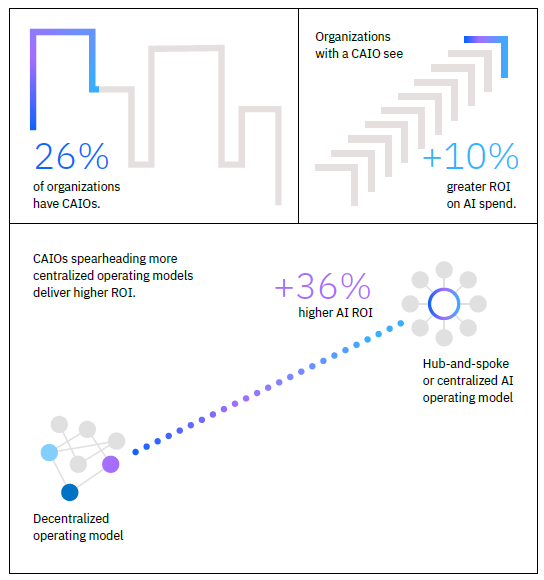
Image: CAIOs help organizations deliver higher AI ROI. IBM, Solving the AI ROI Puzzle, July, 2025
One particularly compelling finding from the IBM report is that centralised AI leadership models, directed by a CAIO, significantly outperform decentralised approaches, achieving up to 36% higher ROI. Centralised leadership provides clearer ownership, streamlined decision-making, and better resource allocation. As a result, CAIOs operating within these centralised or hub-and-spoke structures are better positioned to transition AI initiatives from isolated pilots into scalable, organisation-wide solutions, generating significant competitive advantages.
Yet, the CAIO role does not exist in isolation. To truly succeed, CAIOs must actively foster and sustain strong partnerships and collaboration across the C-suite. This cooperative leadership approach involves close alignment with the CEO, Chief Technology Officer (CTO), and Chief Human Resources Officer (CHRO). Such collaboration ensures AI strategies are fully integrated into business planning, technological development, operational efficiency, innovation initiatives, and workforce readiness and acceptance.
Additionally, effective measurement and transparent monitoring of AI's impact on business outcomes are critical. Clearly defined KPIs and robust monitoring systems are essential tools for evaluating AI performance, facilitating continuous improvement, and guiding strategic decision-making. Nevertheless, some of the most transformative AI opportunities often elude traditional metrics and predictable benchmarks. Visionary CAIOs understand and accept this complexity, boldly pursuing innovative projects despite initial uncertainties or challenges in precise impact quantification.
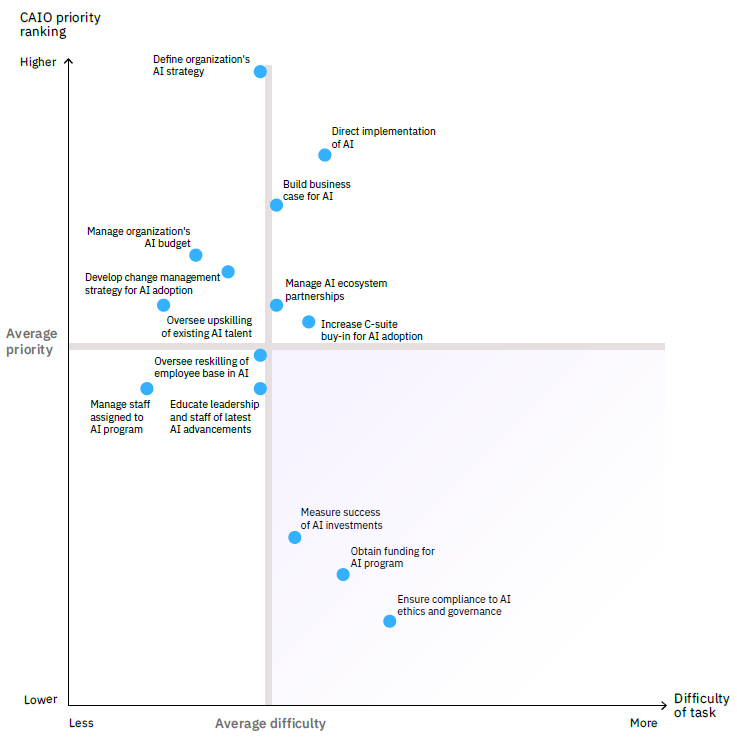
Image: There are several critical AI-related tasks that don’t seem to be top priorities for CAIOs. IBM, Solving the AI ROI Puzzle, July, 2025
For organisations serious about harnessing AI’s full potential, establishing and empowering the CAIO role is no longer optional—it's strategic and essential. Organisations that proactively create and robustly support this executive position today stand to gain significant advantages, positioning themselves at the forefront of innovation and market leadership tomorrow.
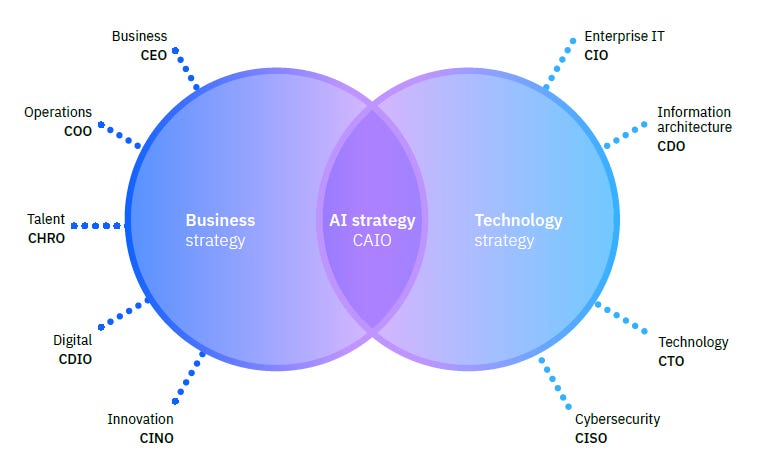
Image: CAIOs align C-suite strategies to amplify AI impact. IBM, Solving the AI ROI Puzzle, July, 2025
The rise of the Chief AI Officer represents not merely a passing trend, but a fundamental shift in executive leadership that is becoming crucial for future-proofing businesses in an AI-driven world.