

Artificial Intelligence (AI) is no longer a futuristic concept—it’s here, reshaping industries and solving problems once deemed insurmountable. While much of the spotlight has been on Large Language Models (LLMs), a parallel revolution is underway in the form of Large Quantitative Models (LQMs). These AI systems specialize in crunching numbers, predicting outcomes, and uncovering insights from massive datasets, promising breakthroughs in fields that hinge on quantitative analysis.
This article explores LQMs, why they matter, and how they can shape a more sustainable and efficient future across industries.
What Are Large Quantitative Models?
LQMs are advanced AI systems engineered to process, analyze, and predict using numerical data at an unprecedented scale. Unlike LLMs, which focus on understanding and generating human language, LQMs excel in tasks that require mathematical precision, such as statistical analysis, forecasting, and optimization.
Key Features:
Domain-Specific Applications: Unlike general-purpose LLMs, LQMs are tailored for specific fields, such as finance, healthcare, or environmental modeling.
Sophisticated Architectures: Combining deep learning, traditional statistical techniques, and optimization algorithms, LQMs can handle complex datasets precisely.
Real-Time Analysis: LQMs quickly process vast amounts of data, enabling real-time decision-making.
Why LQMs Are Relevant Today
Three converging factors drive the rise of LQMs:
Data Explosion: The world generates over 2.5 quintillion bytes of data daily. LQMs are uniquely suited to process this deluge of quantitative information.
Advances in Computing: Enhanced computational power, including the emergence of quantum computing, allows LQMs to handle previously infeasible tasks.
Interdisciplinary Challenges: Complex issues like climate change, financial instability, and healthcare optimization demand sophisticated tools to model multifaceted systems.
Simplified comparison: LLMs versus LQMs
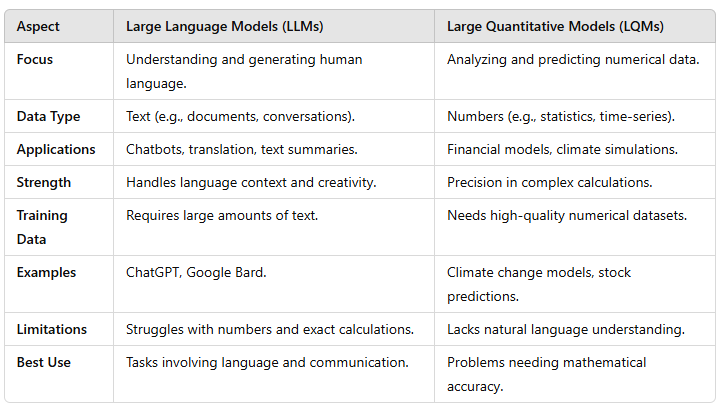
Source: Building Creative Machines 2024
Business Applications of LQMs
1. Finance and Risk Management
Use Case: Stock market prediction and portfolio optimization.
Impact: LQMs analyze financial trends and risks with unprecedented accuracy, enabling better investment strategies and fraud detection.
2. Healthcare Analytics
Use Case: Predicting patient outcomes and personalizing treatment plans.
Impact: LQMs help healthcare providers deliver more effective and tailored care by analysing vast datasets like genomic information and clinical records.
3. Supply Chain Optimization
Use Case: Route planning and resource allocation.
Impact: LQMs optimize logistics, reducing costs and improving efficiency in industries from e-commerce to manufacturing.
4. Environmental Sustainability
Use Case: Climate modelling and pollution tracking.
Impact: LQMs simulate climate scenarios, predict the effects of human activities, and propose mitigation strategies.
LQMs in Action: Driving Environmental Sustainability
Environmental applications showcase LQMs' potential to tackle some of the world's most pressing challenges:
Climate Change Simulation: LQMs model greenhouse gas emissions and predict their effects on ecosystems, helping policymakers devise more effective interventions.
Biodiversity Conservation: They analyze the intricate interdependencies in ecosystems, pinpointing where conservation efforts can be most effective.
Pollution Management: By integrating sensor data worldwide, LQMs enable real-time pollution tracking and mitigation.
Challenges and Ethical Considerations
1. Data Quality and Bias
LQMs depend on accurate and comprehensive datasets. Incomplete or biased data can lead to flawed predictions, potentially harming critical areas like healthcare or environmental policy.
2. Interpretability
LQMs' complexity can make their outputs difficult to understand. Ensuring transparency and providing clear explanations are essential for user trust.
3. Security and Privacy
With access to sensitive data, robust encryption and access controls are crucial to prevent misuse.
The Future of LQMs
Quantum Computing Integration
The advent of quantum computing could revolutionize LQMs, allowing them to process even larger datasets and solve problems that are currently computationally prohibitive.
Hybrid AI Models
Integrating LQMs with LLMs opens new possibilities, combining numerical precision with contextual understanding. For example, an LQM could analyze medical data in personalised medicine while an LLM generates patient-friendly explanations.
Broader Accessibility
As computational costs decrease, LQMs will become more accessible, empowering businesses of all sizes to leverage their capabilities.
The Bottom Line: A Quantitative Leap Forward
Large Quantitative Models represent a pivotal advancement in AI, enabling industries to make better decisions faster. From saving lives in hospitals to mitigating climate change, LQMs hold the key to solving problems that require a combination of scale, speed, and precision.
As we step into a future defined by data, embracing the power of LQMs will drive business success and contribute to a more sustainable and equitable world.