

Keeping up with AI increasingly feels like a second job. Every week brings another model, another extraordinary comparison and another reason to reconsider the tools we adopted last Tuesday. A useful technical advance arrives, and the conversation immediately promotes it into a replacement for everything that came before.
This week, Jev has occupied that space. TypeSafe AI introduced it on 15 September as a model for fast, structured decisions. It is an impressive proposition. It also illustrates how easily we confuse doing one class of work efficiently with making a whole category of technology obsolete. TypeSafe AI Blog
Jev gives us a useful way to think about the market opening between ordinary software rules and the most capable general-purpose AI models (aka “frontier models”). There is a great deal of business in that space.
Consider what a decision model actually does. Give Jev some information and a defined question, and it returns a choice, a score or a probability for a yes-or-no judgement. Software can use those results directly. There is no essay to interpret and no conversational answer to turn back into a business decision.
TypeSafe’s documentation recommends narrow-scope questions. Where a judgement involves several factors, developers should separate them and combine the answers in code. That division of labour matters: the model supplies judgements; the surrounding system determines how they become an action.
These decisions can be elementary in structure without being trivial in consequence. Recognising a cancellation request is a small task. Missing one across thousands of customer messages can become expensive.
The economics are attractive. TypeSafe’s launch announcement lists $0.042 per million input tokens, with no output-token charge. Its architecture produces outputs in parallel rather than generating a response token by token. That is a meaningful advantage for suitable workloads.
The dramatic comparisons still need their footnotes. TypeSafe says its largest advertised speed and cost gains are likely towards the upper end of real-world gains. Its workflow evaluations use powerful models’ predictions as reference answers, rather than independently established ground truth. These are promising results in a particular comparison, but production performance is still to be established for each application.
Nor does a guaranteed output format make a judgement correct. A model restricted to choosing “billing” or “technical support” cannot invent a third department, but it can choose the wrong one. Confidence estimates become useful when experience with the actual workload shows which decisions can proceed safely.
For a classification task, Jev may replace an LLM call entirely. In a larger workflow, it may decide whether an LLM is needed, which one to use, or whether a result requires review. Work that still requires writing, synthesis, or extended reasoning retains its own costs.
That makes the familiar argument about frontier models more concrete. Using the most powerful general-purpose model for every routine decision can be like deploying a cannon against a fly. The cannon remains useful. The purchasing mistake is assuming that every problem requires one.
I expect the market for intermediate options to expand sharply. Small language models offer generation with less computational weight. Industry-specific models aim to improve performance within a defined domain. Decision models supply constrained judgements. Routing systems allocate work based on requirements such as capability, cost, and response time. These categories overlap, and several may belong in the same application.
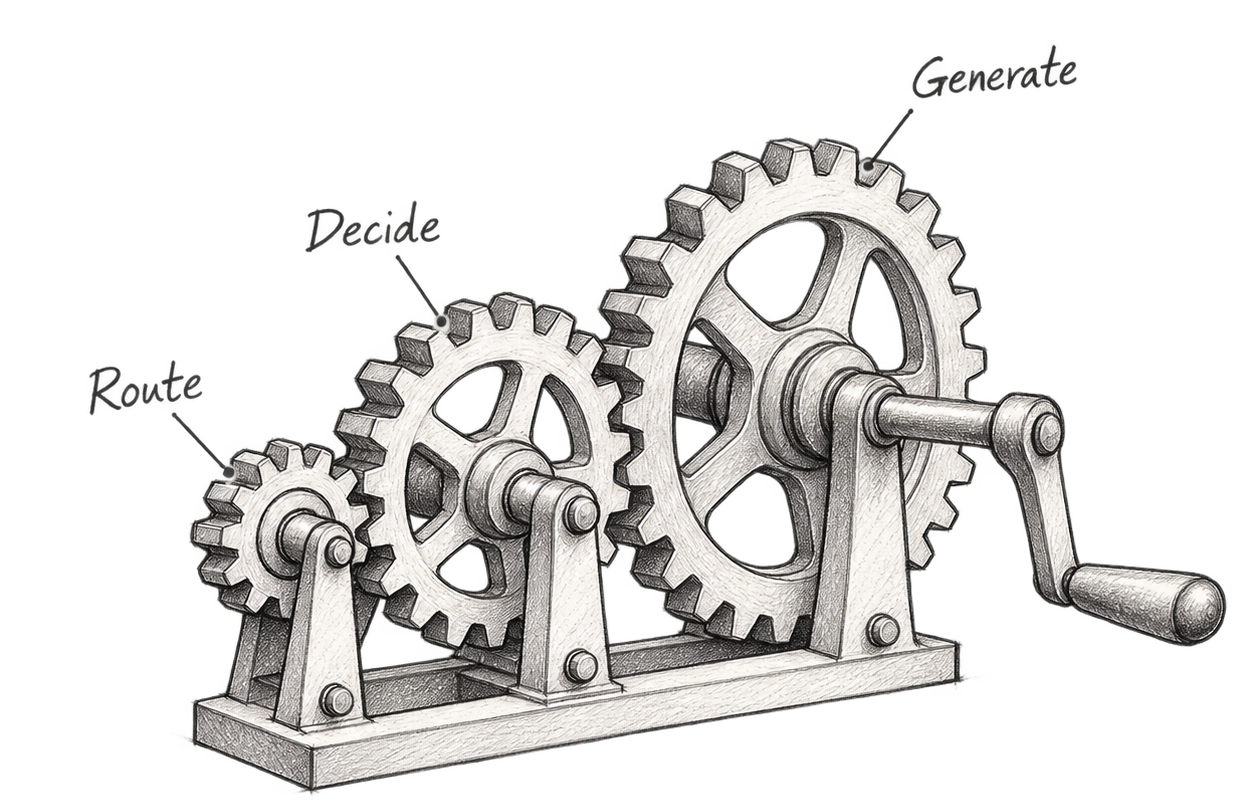
Laya illustrates that overlap. It is an open-source decision model with routing capabilities, including examples for selecting between smaller and frontier models. Its built-in router also selects among its own checkpoints. Calling it simply a routing solution understates the component underneath; treating routing as solved overstates the surrounding engineering.
The project’s documentation is refreshingly explicit about another limit: its shipped models can be overconfident, and thresholds need validation on the data they will operate on. A cheap decision about where to send work can still be wrong.
Imagine a retailer handling a customer’s complaint about a damaged delivery. Ordinary software retrieves the order and delivery record. A decision model identifies the request and flags uncertainty. Rules establish whether a standard replacement is available. A small language model drafts the routine reply. A more capable model handles a complicated exchange involving several products and contradictory messages, with unresolved cases reaching a person.
This is an illustrative architecture, not a claim that every retailer needs five components. The benefit depends on how work is distributed. If most requests are predictable, reserving expensive reasoning for exceptions may produce substantial savings. If nearly everything needs escalation, the preliminary stages may simply add delay and cost.
Every additional component also creates maintenance work. Someone must manage interfaces, test changes, and investigate failures. For a low-volume service, a single capable model may be the cheaper overall design. Architecture earns its complexity through measured improvements in the cost and speed of successful outcomes.
I argued in The Model Is No Longer the Product that advantage increasingly depends on the system around the model. Jev brings a sharper economic mechanism into view: expensive general intelligence can be purchased selectively, at the points where the workflow benefits from it.
For many applications, model capability is becoming a commodity input. That does not mean all models perform equally or can be swapped without testing. It means that buying access to one increasingly offers little distinction by itself. The harder work is understanding the problem, connecting the right information and deciding how much intelligence each step deserves.
The next release will arrive before most organisations finish evaluating this one. A well-designed system should make that less exhausting: a new model becomes a candidate for a specific job, assessed against a known requirement.
That is the opportunity behind the Jev excitement. As the menu of intelligence grows, knowing exactly how little is enough for each task becomes an increasingly valuable skill.