

One of the most rewarding things about Building Creative Machines is discovering people whose work changes not only what we think, but how we think. I first came across Beatriz Costa Gomes after reading her work on Nature Health. The name immediately caught my attention! It sounded unmistakably Portuguese. Curiosity won, and I started digging. What I found was an inspiring journey.
Born in Portugal, Beatriz trained as a biomedical engineer before moving to the UK to pursue a PhD in computational neuroscience and bioimage analysis. She later became a Research Fellow at the Alan Turing Institute, where she helped bridge AI, biology and health, while also becoming one of the voices behind the highly regarded Turing Podcast. Today she is part of Microsoft’s MAI Futures team, exploring how AI will shape the years ahead. What fascinates me most isn’t only the science. It’s her rare ability to explain difficult concepts through simple stories and memorable metaphors, a skill that is becoming just as valuable as building the technology itself.
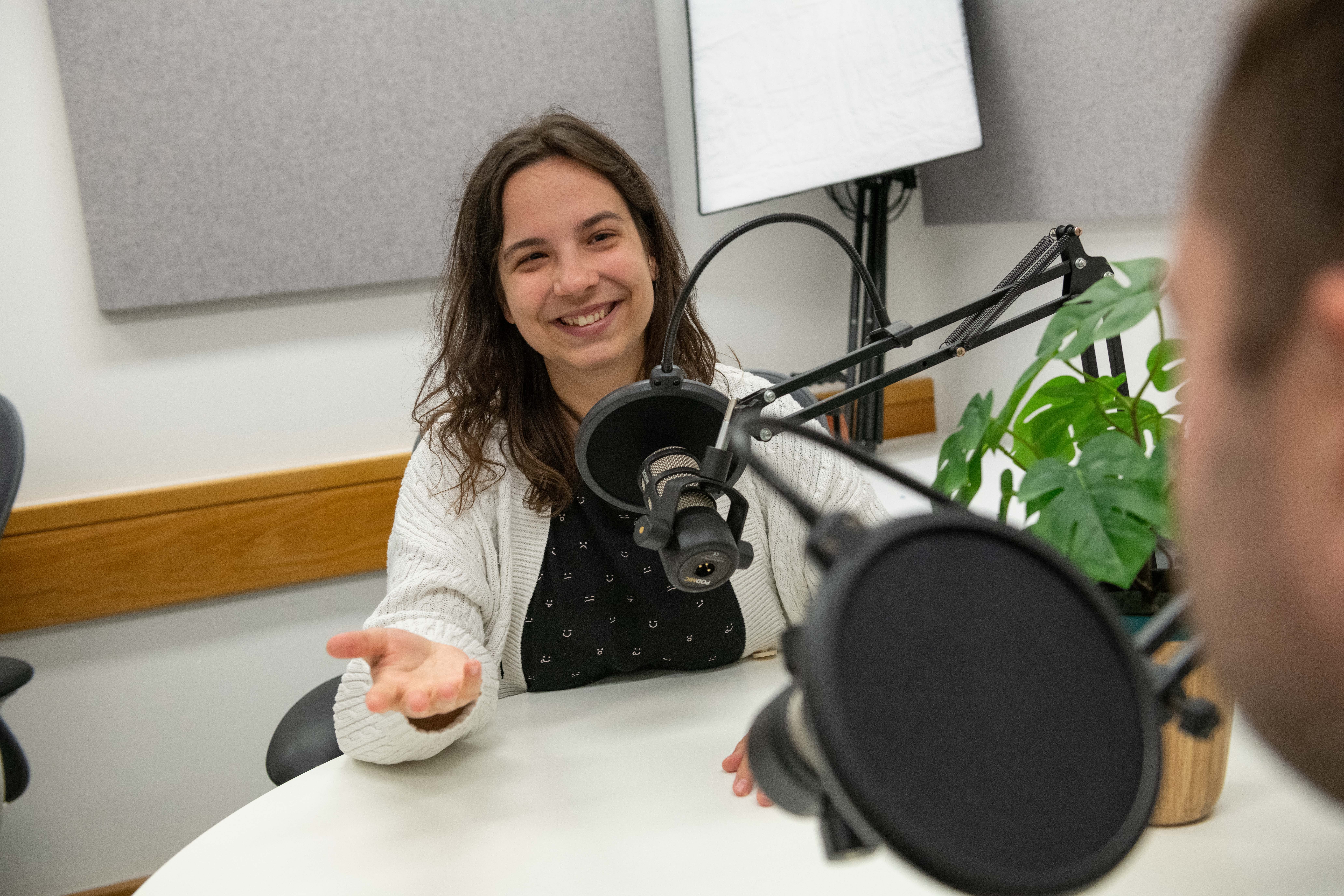
So, what can we learn from someone who sits at the intersection of neuroscience, AI, research, communication and the future?
I have a feeling this conversation won’t just be about artificial intelligence. It will be about curiosity, learning, communicating ideas that matter, and building a career by connecting worlds that rarely meet.
You started in biomedical engineering in Coimbra, Portugal, moved into neuroscience, in the UK, then AI research, and now you’re helping shape Microsoft’s vision of the future. Looking back, what were the turning points that completely changed your career?
The first turning point was actually before even choosing what degree I wanted in Coimbra. I have been coding since I was 9 so I thought I was going to follow computer science. However, my paternal grandmother got diagnosed with Alzheimer’s, and I became fascinated with the brain. How come we knew so little about something so fundamental in us? So, I wanted to somehow combine my love for computers with neuroscience - it shaped most of my career. The other turning point, however, isn’t as positivity driven - I was tired and burned out after working and studying in academia, so at that point I wanted to have a complete change of course and started applying for industry jobs. I would’ve taken any job, and I was hoping my transferable skills (like communication!) would actually help - and they did. That’s how Microsoft AI found me.
WOW. That is quite powerful! Thank you for sharing so openly. That helps to understand the drive and the urge!
You’ve successfully moved across engineering, biology, neuroscience, machine learning and now future thinking. How do you approach learning entirely new fields without feeling overwhelmed?
I’ll start my answer to this question from the end: it is not without feeling overwhelmed but despite. And this syntactical difference is one of the most important things I’ve learned. Whenever faced with a new challenge, I just want to learn more and more, as much as I possibly can. I am an extremely curious person, and I try to answer one question at a time. The rest comes later. I also want to point out that while being extremely good in one field is important and relevant, becoming adaptable and diverse in what we learn is in itself a skill. Some jobs/careers only make sense if people can mold and adapt their knowledge to a new field, question, query. When I moved to the UK, I thought having a diverse set of skills was a disadvantage… and maybe it was, for the career I thought I wanted for myself. But it has been my greatest asset in the career I’ve built so far.
One thing that immediately stood out in our first conversation was how naturally you translate difficult ideas into everyday language. How did you develop that amazing skill? Can you share with us the spaghetti story?
I have my niece to blame. She was born when I was 15, and by the time she was talking she started asking me questions about anything and everything (I was her favourite grown up, as per her own 3yo words). I spent my time trying to find ways to explain to her toddler self whatever difficult topic she wanted to know that day (why does the sun go up? Why do we need traffic lights? Can the moon be collected? And the most difficult one - what is light?). When I started my PhD, which was a niche topic, in a niche field, I wanted to be able to explain it to my mum so she could tell her friends. So I used all of the ways I used to practice with my niece now for adults too (who have, luckily, a far more complex vocabulary than a 4yo that really wants to know why things fall down and not up).
My process to explain my work to someone is to try and find a common ground with them, and this works for any age, any career stage. What is something that I know they will visualize in their mind easily? I won second place in a science communication competition during my PhD because I managed to find how to explain the work I was doing by comparing it to spaghetti. If people really want to know what you’ve been working on, they are already trying to meet you where you are, so meeting them half way is only a few short steps. But it does take practice, and it takes looking at what you do from the outside, from the other person’s perspective.
You have done research looking into how people interact with AI in their day to day. What surprised you the most?
How fundamentally human our patterns of behaviour are. I had the impression people would use AI for work, but what I found is that despite that, they also use AI for their personal ups and downs, every day query. Conversations about philosophy went up at night. February had a spike on conversations about personal growth before the 14th and relationships on that day. How incredibly human these are!
And that really seems to be a super power seeing that AI evolves literally daily. How do you stay current? What does your personal learning system look like?
There’s not enough time in a day to read about all the new things that I want to learn about. So, my personal learning system includes a lot of conversations with my colleagues from other fields - we all research the edge of the topics we know about, so when we talk, we exchange this knowledge. This is the biggest advantage of working in such an interdisciplinary team, I always have something new to learn from someone. As for my specific topic, it depends on what I need to research, so I do a deep dive on the current literature (scholar, or sometimes using AI to pool together lists of recent publications that I might have missed, always double checking the sources).
Many professionals outside computer science want to learn about AI but don’t know where to begin. If someone had just 10 minutes per day to invest in learning AI, how would you recommend they spend it?
That’s a great question and I just realized I need to adapt the answer I would usually give when it used to be about learning to code. I think it’s a matter of starting with using AI but realizing its shortcomings. AI is fallible and needs to be fact checked at every step, so I would say try to evolve from there. To learn about how AI is built, there is a lot of useful information and resources. But mostly - try it out with positive skepticism and build from there.
The more I listened to Beatriz, the more I realized that this conversation wasn’t just about AI. It was about something much more fundamental: curiosity.
Her journey reminds us that careers are rarely linear, that our most valuable skills are often the ones we never planned to develop, and that the ability to explain complex ideas simply may become one of the defining leadership skills of the AI era.
As artificial intelligence becomes increasingly accessible, technical knowledge alone will no longer be enough. We will need people who can bridge research and society, engineering and humanity, innovation and understanding. People who ask better questions before rushing to answers.
And if she can explain computational neuroscience with a plate of spaghetti, maybe there is hope for all of us 😊 After all, making AI more powerful is an engineering challenge. Making AI make sense is a profoundly human one.