

Who owns the internet when machines become its users?
For three decades, building a business on the internet has followed a relatively familiar logic.
Register a domain. Create a website. Attract visitors. Build relationships with customers.
Artificial intelligence is beginning to challenge that sequence.
As AI agents become capable of discovering businesses, comparing products, interpreting information and executing transactions, the relationship between entrepreneurs, consumers and the digital infrastructure connecting them is changing.
What happens when the visitor to a website is no longer necessarily a human being?
And what happens to digital independence when the relationship between a business and its customers is increasingly mediated by artificial intelligence?
These questions are particularly relevant to GoDaddy, a company whose history is closely connected with making the internet accessible to entrepreneurs and small businesses.
At Web Summit 2026 in Lisbon, Building Creative Machines met Aman Bhutani, GoDaddy’s Chief Executive Officer.
Before joining the company in 2019, Bhutani spent nearly a decade at Expedia, where he held senior technology and executive leadership positions. He also serves on the board of The New York Times Company.
His professional trajectory connects three particularly relevant dimensions of the contemporary internet: digital infrastructure, online commerce and the economics of information.
Today, GoDaddy faces a transformation that extends well beyond domain registration or website creation.
The question is whether artificial intelligence will make independent businesses more capable of participating in the digital economy — or introduce another layer of dependency between entrepreneurs and their customers.
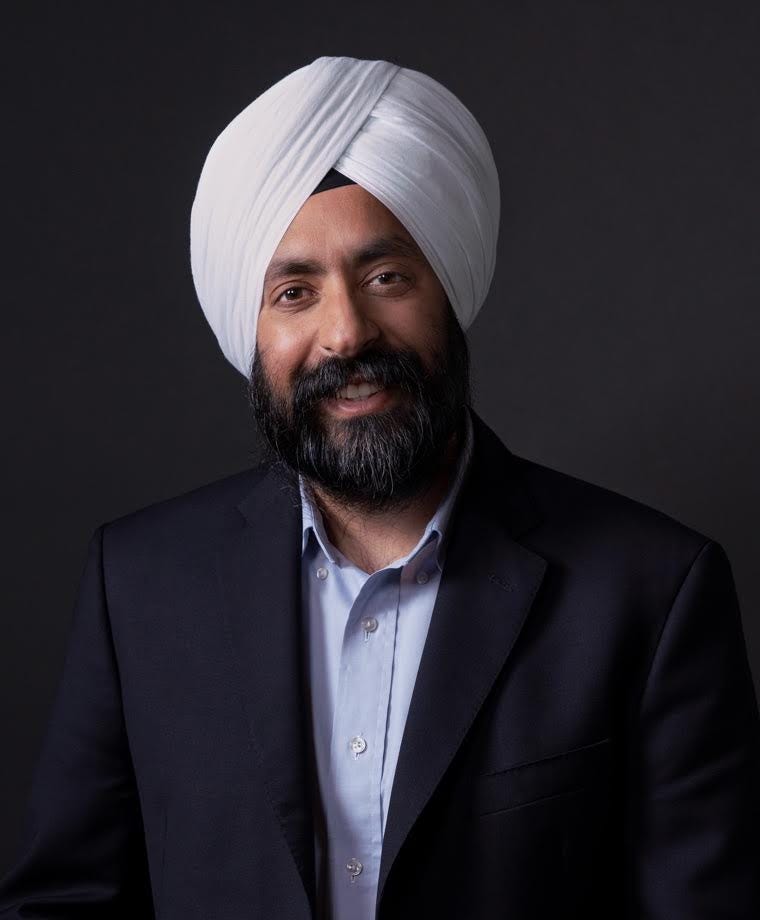
Aman Bhutani - Chief Executive Officer at GoDaddy
The interview
GoDaddy helped millions of people build websites. What happens when AI agents, rather than humans, become their main visitors?
In 2027, every micro and small business will have a demanding new customer. And that customer will be AI Agents – or many AI Agents. A human that is looking for a birthday cake might ping two or three bakeries, but an agent could easily ping twenty.
At GoDaddy, we are doing two fundamental things that can help us all prepare for the Agentic Open Web:
All agents should be registered so when agents interact, they can trust each other and humans can set clear boundaries for them. GoDaddy is championing an open standard – ANS (Agent Name Service) to make this easy for all of us.
We are evolving GoDaddy Airo to not just build websites or help entrepreneurs with marketing or operations; we are evolving it to be a business agent that can handle all the agents coming to our customers.
With ANS and Airo, millions of micro and small businesses can be ready for the Agentic Open Web.
With GoDaddy Airo, launching a business can take minutes. When anyone can build something, what makes a business truly different?
Ease of use of technology has been a secular tailwind for adoption by businesses for the last few decades. The real AI shift is that AI is abstracting technology. What that means is AI Agents hide all the complexity of technology and expose only the outcomes for the humans. This is a dramatic shift and helps create a new set of builders across the world.
When customers work directly with Airo (GoDaddy’s AI Agent), they can express what is in their mind and have Airo build it. Suddenly the constraints of having to explain it to multiple people, or being limited to what one can pay, melt away - it is just the customer’s idea and Airo trying to build it. The differentiation comes from the core idea of the founder, their branding, and their service. It can all be customized at a level that would have been very expensive in the past.
If AI agents start choosing what we buy, how can small businesses make sure they get chosen?
For a long time, businesses have thought about how to show up in search results. Increasingly, they’ll also need to think about how they show up in an AI agent’s decision-making process. That starts with having a strong, credible digital presence that enables agents to easily understand what a business offers, what makes it different from competitors, and how to interact and transact with it.
The opportunity for small businesses extends well beyond discoverability. At Web Summit, I joined Mazin Gilbert, Executive Director of the Agentic AI Foundation, for a conversation about building an open web for AI agents beyond walled gardens. Imagine an agent tasked with finding the perfect gift for someone. In an open ecosystem, that agent could discover a local artisan or an independent retailer that the customer might never have found otherwise, introducing entirely new avenues for small businesses to reach customers and grow.
To realize that potential, we need to build an agentic open web where agents can operate freely across platforms, rather than being confined to proprietary ecosystems. If only a handful of platforms control what agents can see and access, we risk limiting the very opportunity this technology creates. That’s why open standards – like Agent Name Service (ANS) - and industry collaboration are so important. We want to create an environment where small businesses can compete on the quality of their products and services, not on whether they have access to the right gatekeeper.
You’ve said you won’t read AI-written work. In a world increasingly run by AI, what must remain human?
For me, it comes down to original thought. When someone brings me an idea, what I’m really interested in is, “What was the original observation? What was the original hypothesis? What got you interested in this idea, and why do you think it matters?”
The reason I encourage people to write their own narratives is because it forces them to organize their thoughts, challenge their assumptions and practice the art of iteration. That’s how we continuously get better. If we outsource that process to AI, we risk losing an incredibly valuable skill.
I’m a huge believer in AI, and I encourage our teams at GoDaddy to use it where it adds value. But AI doesn’t know what we know deep inside us. It doesn’t have our lived experiences, our individual perspectives or the curiosity that leads us to develop new ideas.
The same principle applies to entrepreneurs. Use AI to eliminate friction, become more productive and do things you couldn’t do before, but don’t give away the things that make you different.
As AI becomes more capable, I believe original human thought will become more valuable, not less.
Looking ahead to 2030, what will the internet look like that most people cannot yet imagine?
I have a thesis that all software will be rewritten with the agent at its core, rather than AI simply being a layer on top of existing software. This was one of the ideas I brought to Web Summit, and it represents a fundamental shift in how technology is built and how people interact with it.
Today, if you’re planning a trip, starting a business or buying something online, you might visit a dozen websites and use several different applications. Well before 2030, we will be able to have agents work across businesses and platforms and achieve outcomes for us. For entrepreneurs, the implications are significant. Imagine a small bakery whose AI agent is interacting with customers’ personal agents, coordinating orders, managing inventory and identifying new business opportunities, resulting in the owner having more time to focus on what they do best.
Realizing that vision requires us to establish the right foundations today. We need to know who an agent is, who it represents, what it’s authorized to do and how we can trace its actions when something goes wrong. Just as important, we need open standards that enable agents to operate across the agentic open web so that businesses of all sizes can benefit from this transformation.
What excites me most about the future isn’t simply what AI agents will be capable of by 2030, but who will have the opportunity to participate in the economy they create. If we get identity, trust and openness right, the agentic open web could unlock an entirely new era of entrepreneurship.
The next chapter of digital independence
The original promise of the open web was remarkably simple: anyone could establish a presence on the internet without necessarily asking permission from an intermediary.
That promise has never been fully realised.
Search engines, social networks, advertising platforms and digital marketplaces have progressively concentrated the mechanisms through which businesses reach their audiences.
Artificial intelligence introduces another potential redistribution of power.
An entrepreneur may soon be able to operate with capabilities that previously required an entire organisation. Yet the same entrepreneur may become increasingly dependent on the AI systems through which customers discover, evaluate and purchase products.
The opportunity and the risk emerge from the same technological transformation.
For GoDaddy, the challenge is not simply to help entrepreneurs build better websites. It is to remain relevant in an internet where websites increasingly serve both human visitors and autonomous machines.
For society, however, the question is broader.
Will artificial intelligence make the internet more accessible, decentralised and economically inclusive? Or will it consolidate control over discovery, visibility and commercial relationships within a handful of intelligent intermediaries?
The answer will depend not only on the capabilities of AI agents, but also on the architecture of the digital environments in which they operate.
The future of entrepreneurship may ultimately depend on something the internet has been negotiating since its earliest days: the difference between having access to a platform and owning a place in the digital world.