

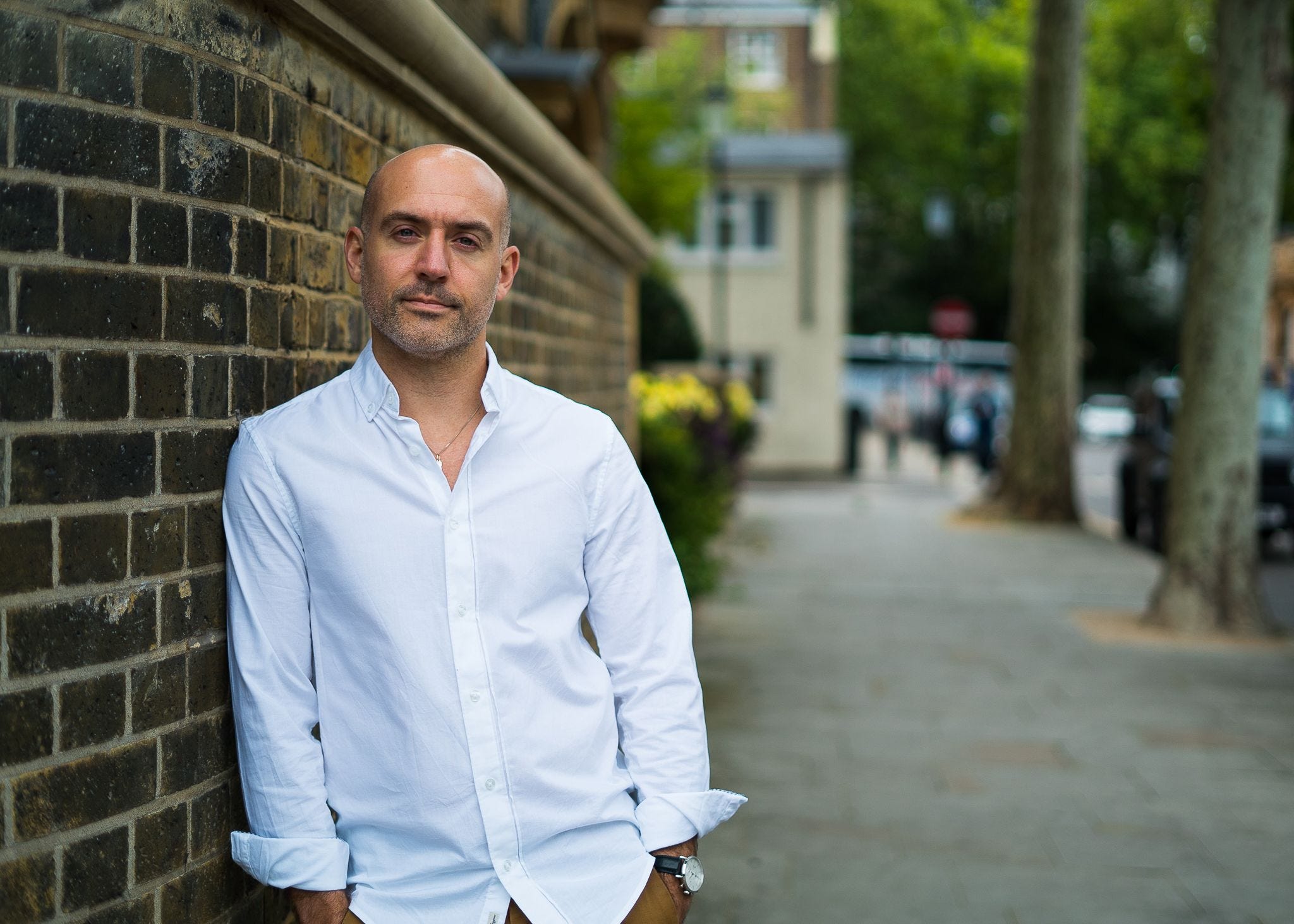
There is no single way to introduce Adib Bamieh. His path moves across arts, healthcare, nutrition, food and beverage, sport, events, and entrepreneurship,…. and that is exactly what makes him such a compelling thinker. He brings together unusual combinations of experience, with stories and insights shaped by work across continents and cultures. That breadth shows in the way he sees change: not as a narrow shift inside one industry, but as a wider transformation in how people live, create, work, and adapt.
Now based in Lisbon, I had the pleasure to meet Adib and even though our conversation started with AI, quickly became something bigger: a challenge to some of our deepest assumptions about society, jobs, value, prosperity, and what human life might look like when the old structures of work begin to loosen.
What if the future of AI is not a leap into something new?
We’ve spent the last two hundred and fifty years building an economic machine that runs on human labour. That machine is about to become obsolete. And what comes next isn’t some alien future we can’t recognise. It’s a return to something older and, I’d argue, more natural than the world we’ve been living in.
The question everyone keeps asking about AI is: what happens to jobs? But that’s the wrong question. The better one is: what did humans do before jobs existed?
You call it the “250 years old experiment”. Can you elaborate on that?
Here’s something we rarely stop to consider. For most of human history, a ‘career’ wasn’t a concept. The idea that your identity should be defined by what you do for money is an invention of the Industrial Revolution. Before that, if you had secured the basics of food and shelter, life was about learning, creating, building relationships and pursuing curiosity. Work existed, obviously. But ‘a job’ as we understand it today did not.
The Industrial Revolution needed bodies. It needed people showing up at factories at fixed times, performing repetitive tasks, going home, and coming back the next day. So we built an entire social architecture around this requirement. Schools that trained children to sit in rows, follow instructions, and respect the bell. Career ladders. Pension systems. The whole apparatus of modern employment. We didn’t build it because it was the best way for humans to live. We built it because the economic machine needed fuel, and that fuel was people.
That machine is starting to sputter. Not because of some catastrophic failure, but because we’re building something better.
And what happens when that machine stops needing so much human fuel?
If you want to see what humans do when they don’t have to work, you don’t need to speculate. You just need to look backwards.
Ancient Athens is the most striking example. Athenian citizens were freed from manual labour (by a system we’d rightly condemn today) and given time. What did they do with it? They invented democracy. They created Western philosophy, theatre, and formal mathematics. They didn’t sit idle. They built the intellectual foundations that the rest of civilisation has been borrowing from for two and a half thousand years.
The pattern repeats. The Medici family bankrolled the Renaissance not because they needed a return on investment, but because they had surplus wealth and a fascination with what humans could create when given space to think. Leonardo da Vinci, Michelangelo, Galileo, Brunelleschi. None of them were ‘employed’ in the way we’d recognise. They were funded, supported, given room to be curious.
If people are freed from work, do they really create, or do they simply drift?
Charles Darwin never needed to work a day in his life. He was independently wealthy, and he used that freedom to spend twenty years developing a theory that rewrote our understanding of life itself.
Benjamin Franklin retired rich at forty-two and then, freed from commercial obligation, invented the lightning rod, bifocal lenses, the Franklin stove, and helped design a new form of government.
The Victorian and Edwardian middle classes offer a less dramatic but more relevant example. Freed from survival-level labour, they poured themselves into music, amateur science, literature, philosophy, and civic projects.
The entire structure of learned societies, public lectures, and amateur naturalism that characterised the 1800s was built by people who didn’t need to work and chose to do something interesting instead. The worry that people without jobs will simply do nothing has almost no historical support. Given time and basic security, people create. They always have.
So why does the argument suddenly turn to the price of a phone, a house, or a loaf of bread?
Pick up your phone. It’s made of glass, aluminium, lithium, rare earth minerals, silicon. You might think the cost of the phone is partly the cost of those materials. But what is the cost of aluminium? It’s the energy expended to mine bauxite ore, transport it, and refine it through electrolysis. What’s the cost of the mining? It’s the diesel in the excavators, the wear on the machinery, and the wages of the people operating them. What’s the cost of the machinery? Steel, which required energy to smelt, shaped in factories by people earning wages, transported by trucks burning fuel driven by people earning wages.
Every time you pull at the thread, you arrive at the same two things: energy and labour. The raw materials themselves are just rocks in the ground. They’re everywhere. What makes them expensive is the human and electrical energy required to extract, move, and transform them. This is true of almost everything you can buy. The cost of a house isn’t really the cost of bricks and timber. It’s the labour to manufacture those materials, transport them, and assemble them on site. The cost of food isn’t the seed or the soil. It’s the labour of planting, tending, harvesting, processing, and distributing. Strip away the layers and the price of virtually every physical good is a labour cost wearing a series of disguises.
What changes when those costs start falling together?
Now three forces are converging that attack this cost structure at its root.
The cost of intelligence. AI can already perform cognitive work that would have required a team of graduates five years ago. That cost curve isn’t flattening. It’s steepening.
The cost of physical labour. Robotics is moving from factory floors into the real world. We’re approaching a point where the cost of physical work drops the same way computation costs have been dropping for decades.
The cost of energy. Between solar, advancing fusion research, and improving battery technology, we’re heading towards an era where energy is so cheap it barely registers as an expense. When all three fall together, the effect cascades through every supply chain on earth. If robots mine the ore, AI systems manage the logistics, and cheap energy powers the whole process, the cost of aluminium doesn’t just fall. It collapses. And so does the cost of everything made from it. Multiply that across every material, every manufacturing process, every service, and you get something economists rarely see: structural deflation. Not the destructive kind where demand disappears and economies spiral. The productive kind, where things become cheaper because they genuinely cost less to make.
This isn’t speculation. It’s already visible. The cost of sequencing a human genome dropped from $100 million to under $200 in just over twenty years. Solar energy is now cheaper than coal in most of the world. AI capabilities that cost thousands per hour in compute two years ago can now run on a laptop. These aren’t isolated anomalies. They’re early signals of a pattern that will spread to physical goods as robotics matures.
If production becomes dramatically cheaper, what happens to income? Is that just theory, or is there already a real-world example?
Extend those curves forward and something interesting appears on the horizon. Governments, even inefficient ones, could afford to provide every citizen with a meaningful income. Not as charity. As a rational response to an economy that simply doesn’t need most people to show up and do things anymore. Let’s stop calling it Universal Basic Income. ‘Basic’ implies scraping by, surviving on the bare minimum. That’s not what this is. What we’re talking about is Universal High Income: a share of the enormous wealth generated by automated systems, distributed to every citizen. Not survival money. Prosperity money.
Before anyone dismisses this as fantasy, it’s already happening. Alaska has been doing it since 1982. The Alaska Permanent Fund takes revenue generated from the state’s oil reserves and pays an annual dividend to every resident. It’s been running for over forty years.
The principle is simple: the economy generates wealth from a shared resource, and citizens receive a cut. Today that resource is oil. Tomorrow it’s compute and energy. The logic is identical, the scale is just larger. Think of it as a dividend from the economy itself. If automated systems are generating enormous wealth with minimal human input, distributing a share of that wealth to every citizen isn’t radical policy. It’s basic accounting.
Is there a “new money” to a “new world”?
This is where an old technology finds its real purpose. Blockchain has spent the last fifteen years trying to find a problem worth solving. It found plenty of speculation and fraud along the way, but the core technology, a decentralised ledger that doesn’t need anyone’s permission to operate, was always waiting for the right moment. That moment arrives when governments need to distribute universal income across borders, instantly, without the friction and cost of existing banking infrastructure.
A currency underpinned not by gold (a shiny metal with limited practical use) but by something genuinely valuable in this new world: compute and electricity. The actual raw materials of the AI economy. Gold backed currency in an era when gold meant something.
The future demands a currency backed by what actually matters now. Processing power and energy are the new scarce resources, and a global currency anchored to them would carry real, functional value rather than the collective fiction that props up most financial instruments today.
Blockchain won’t change the world by replacing your credit card. It’ll change the world by becoming the invisible plumbing through which a new kind of economy flows.
If machines take over more of the grinding work, what remains distinctly human?
Here’s where the speculation gets interesting. Science won’t disappear, but it’ll change character. AI will increasingly handle the grinding, combinatorial work of discovery. Scanning millions of protein structures. Running billions of simulations. Identifying patterns in datasets too vast for any human team.
What humans will do is the creative part. Finding applications. Asking new questions. Making the lateral, intuitive leaps that turn a raw discovery into something that matters to actual people. Think of it this way. AI will be the telescope. Humans will decide where to point it.
Entertainment will become a much larger part of how people spend their time, both consuming and creating it.
Art made by humans will carry a premium precisely because it was made by a human. We already see this with live music versus recordings. People pay more for the concert not because the sound quality is better (it usually isn’t) but because there’s a person up there, doing it, in real time, with all the risk and imperfection that implies.
The same logic will extend outward. Extreme sports, live performance, physical feats. Anything where the thrill comes from knowing a real person is doing something extraordinary will become more valued, not less, as AI gets better at generating synthetic content.
The human element becomes the rare ingredient. Community will matter more. When work no longer provides your social structure, your daily routine, your sense of belonging, people will need to build those things for themselves. Local communities, interest groups, creative collectives, maker spaces, philosophical societies (a direct echo of those Victorian institutions). The infrastructure of meaning will shift from the office to something more intentional.
Are we really moving towards this faster than most people realise? Will the transition be smooth?
Here’s the thing that should give even the sceptics pause. We’re already absorbing this faster than anyone predicted.
A year ago, the idea of getting emotional advice from an AI chatbot would have been a punchline. Now millions of people do it daily without thinking twice. AI companions aren’t science fiction anymore. They’re an app on your phone. Someone recorded an AI calling a restaurant to make a reservation. The staff member didn’t panic. Didn’t refuse. Didn’t call the newspapers. She chuckled, took the booking, and told her colleagues she thought it was cool. That reaction is everything. It tells you how quickly the ground is shifting beneath us. Not with resistance and fear, but with a chuckle and a shrug.
This isn’t a technology that society is struggling to absorb. It’s being integrated almost as fast as it’s being invented. Most people don’t know or care about the technical details, and the ones who do are using it to build things at a pace that would have felt absurd even in science fiction. We wouldn’t have written this rate of change into a screenplay for fear the audience would find it ridiculous. Yet here we are.
None of this will be clean. Right now, there’s a tension between three forces. The exponential acceleration of technology pulling us forward. The existing power structures trying to capture and control that acceleration, bending it towards their own centres of influence. And the slow, heavy mass of old economic systems that weren’t designed for any of this. Something has to give. The old systems won’t adapt fast enough. The power grabs won’t hold. The technology is too distributed, too accessible, too fast.
AI and blockchain together represent something that’s very hard to centralise permanently: intelligence and value transfer in the hands of anyone with a phone. There will be turbulence. Institutions that exist primarily to extract rent from inefficiency will fight hard to survive. Financial systems designed around human intermediaries will resist automation. Governments will struggle with the gap between old tax structures and new economic realities. Some of this will get messy. But the direction of travel is clear. Power disperses. Capability distributes. The tools to create financial independence and intellectual abundance end up in everyone’s pocket.
So what is the real argument underneath all of this?
There’s a persistent, dreary conviction that without jobs, people would simply fall apart. That we need the discipline of employment to keep us from dissolving into listlessness and vice.
I think that tells you more about the person making the argument than about humanity.
We have thousands of years of evidence that people, given security and time, create extraordinary things. They paint. They compose. They build. They investigate. They form communities and pursue questions that fascinate them. The idea that the average person is one missed Monday morning away from total collapse is not just pessimistic. It’s ahistorical.
We are entering the age of abundance. The age of community, culture, and creative purpose. The moment where we collectively remember that jobs were invented to serve an economic machine, not the other way around. That machine is being replaced by something that doesn’t need human fuel.
Now we get to find out what people do when they’re free.
I believe in people. I believe we’ll do what we’ve always done when given the chance. Create, explore, connect, and build something worth caring about. Not because a boss told us to. Because that’s what humans are. The future doesn’t look like science fiction. It looks like Florence in 1490, Athens in 450 BC, London in 1850. It looks like what happens when enough people have enough freedom to follow their curiosity.
We weren’t built for cubicles. We’re about to remember that.
And what should we do with a future like this? Remember what we’re made of.
The most powerful idea here is not that machines will become more capable. It is that people may have the chance to become more fully human. More able to create without permission. More able to learn without immediate utility. More able to build communities not because a system requires them, but because meaning does.
If that happens, the future will not feel like a cold science-fiction rupture. It will feel like something older, returning in a new form: a world in which more people have enough room to think, make, explore, and care.
fascinating
As usual @adib is right - and his perspectives are unusually lateral with a perspective of history and philosophy.