

In the fast-evolving software development landscape, updating foundational software is one of the most mundane yet critical tasks. It’s the type of work that’s often overlooked—necessary but not glamorous. Yet, as businesses increasingly rely on their digital infrastructure, such updates become imperative, albeit time-consuming and resource-intensive. Amazon’s GenAI assistant, Q, is changing this narrative by bringing unprecedented efficiency to software development, explicitly upgrading applications to modern platforms like Java 17.
The Power of Amazon Q: 4,500 Developer-Years Saved
Amazon Q, designed to assist in software development, sets a new standard for what’s possible in this domain. According to Amazon CEO Andy Jassy (source Linkedin), integrating Q into Amazon's internal systems has resulted in remarkable efficiencies. The average time required to upgrade an application to Java 17 has plummeted from the typical 50 developer days to just a few hours. In practical terms, this transformation has saved Amazon the equivalent of 4,500 developer years—a figure that underscores the immense value of such tools in large-scale enterprises.
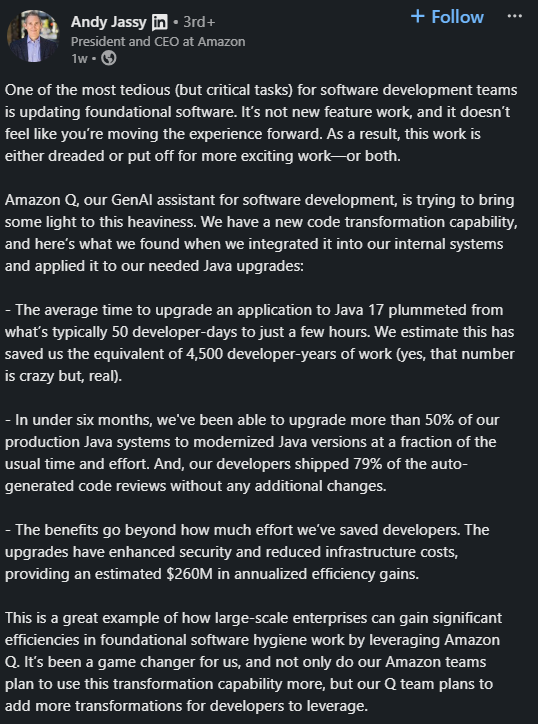
These savings are not just theoretical; they translate directly into significant financial and operational benefits. For instance, the upgrades have led to enhanced security and reduced infrastructure costs, with Amazon estimating annualized efficiency gains of $260 million. These numbers demonstrate the transformative potential of GenAI tools like Q in reducing the burden of routine software maintenance, allowing developers to focus on more innovative and value-added tasks.
Broader Implications for the Industry
Amazon Q is just one example of the broader trend towards AI-powered coding assistants, a space attracting substantial investment. Startups like Magic, which recently raised $320 million, are making headlines alongside Augment, Cognition AI, and Codeium. These companies are collectively reshaping the software development landscape, promising to automate and streamline tasks that traditionally require substantial human effort.
The impact of these developments extends beyond just time savings. With the cost of processing 1 million tokens dropping 240-fold over the last 18 months (source CB Insights), the economics of building on large language models (LLMs) are becoming increasingly favourable. As these costs continue to decline, adopting GenAI tools across industries is expected to accelerate, driving further innovation and efficiency.
Business Relevance: Why Enterprises Should Care
The implications of these advancements are profound for businesses. Companies that embrace GenAI tools like Amazon Q can expect to cut costs and significantly reduce the time to market for their software products. This competitive advantage is critical in today’s fast-paced digital economy, where agility and speed are key differentiators.
Moreover, the efficiency gains achieved through these tools enable organizations to reallocate resources towards more strategic initiatives. Instead of dedicating thousands of developer hours to mundane tasks like software upgrades, companies can focus on innovation, customer experience, and other areas that drive growth.
Use Cases Across Industries
The potential applications of GenAI coding assistants extend far beyond software upgrades. Industries from finance to healthcare can benefit from these tools, such as automating compliance checks, optimizing workflows, and developing new AI-driven products and services. In sectors where regulatory compliance is critical, for instance, GenAI tools can ensure that software systems remain up-to-date with the latest standards, thereby reducing the risk of costly non-compliance.
In the healthcare sector, these tools could streamline the development of medical software, ensuring that critical systems are up-to-date and secure, which is essential for patient safety. The possibilities are vast, and their impact will likely grow as these tools become more sophisticated.
Conclusion: The Future of Software Development is Here
As Amazon’s experience with Q demonstrates, GenAI tools are not just a futuristic concept—they are already delivering tangible benefits in the present. For businesses, the message is clear: those who adopt these tools early will be well-positioned to outpace their competitors regarding efficiency, innovation, and overall market responsiveness.
In a world where the cost of computing power continues to drop, and AI capabilities continue to expand, the question is no longer whether to adopt these technologies but how quickly and effectively they can be integrated into existing workflows. The era of GenAI in software development is here, and its impact is only beginning to be felt.
At Algorithm G, our certified software-as-a-service GAIA© is already powering 80+ applications across diverse industries.
By embracing this shift, companies can unlock new productivity levels and reenergize their digital transformation agendas.