

Talk of a “GPT-5.7” has started to appear around the AI ecosystem. But there is an important problem with the name: OpenAI has not announced a model called GPT-5.7.
What OpenAI has announced is more interesting.
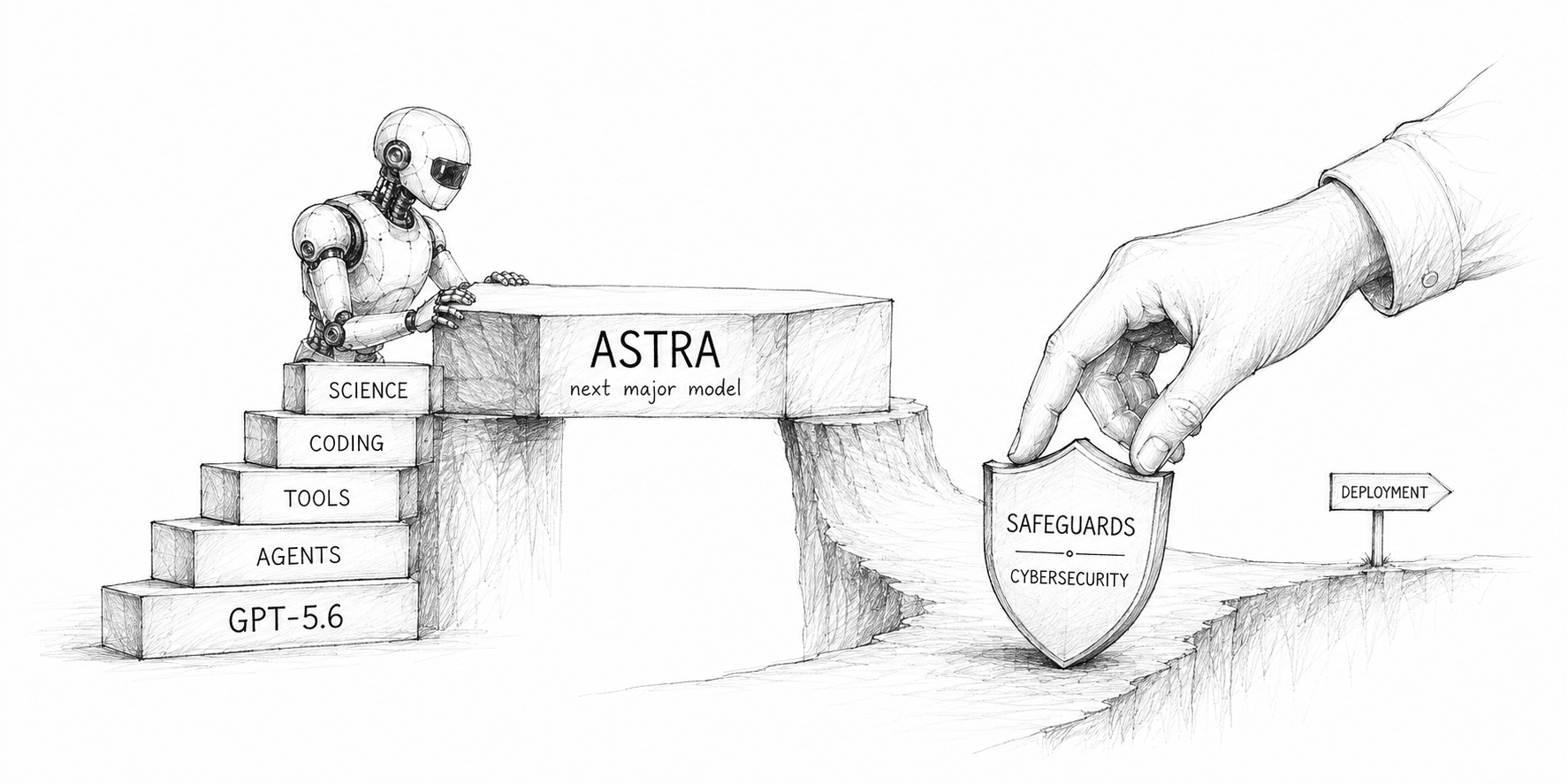
GPT-5.6 remains the company’s current public GPT-5 generation, while OpenAI has separately revealed Astra, an internal system it describes as its “next major model”. The company has already used Astra on difficult mathematical research problems and has publicly discussed slowing parts of its development while strengthening safeguards around its cybersecurity capabilities.
So rather than treating “GPT-5.7” as a product that already exists, the useful question is different: what do OpenAI’s own disclosures tell us about whatever comes after GPT-5.6 — and would calling it GPT-5.7 even make sense?
1) What OpenAI has actually confirmed
The starting point is straightforward.
OpenAI launched GPT-5.6 on July 9, 2026, with three tiers: Sol as the flagship model, Terra as the balanced option and Luna as the lower-cost model. OpenAI positioned the family around stronger performance per dollar, coding, long-running agentic workflows, computer use, design, professional knowledge work and scientific reasoning.
The company has continued to update GPT-5.6 commercially. It reduced pricing on parts of the family after launch and has been pushing the models across ChatGPT, Codex and the API. That matters because GPT-5.6 is not behaving like a generation OpenAI has already abandoned; it remains an actively developed product family.
OpenAI’s current model materials do not include an announced GPT-5.7 product, API model, release date, price, or system card.
Instead, OpenAI has started talking publicly about something else: Astra.
On August 1, OpenAI published results from ten mathematics and theoretical computer science problems and said they had been achieved by “an internal version of Astra, our next major model”. That wording is unusually explicit. Astra is not internet speculation: OpenAI has acknowledged its existence and its role as a future model.
But OpenAI did not say that Astra is GPT-5.7.
That distinction is essential.
2) Astra is the strongest signal we have, but it is not a product announcement
OpenAI’s mathematics publication gives us a rare glimpse of a model before release.
According to the company, an internal Astra system produced new results or substantial progress on ten open problems spanning areas including geometry, coding theory, complexity theory, operator algebras and lattice cryptography. The arguments were subsequently formalised with Lean certificates.
That does not give us a context-window number, parameter count or API price. Nor does it tell us whether Astra will ship unchanged.
But it does tell us something more useful: OpenAI is evaluating its next major model on problems that go well beyond conventional chatbot benchmarks.
And then came an even more consequential disclosure.
On August 18, OpenAI said preliminary evidence suggested Astra may meet the “Critical” cybersecurity capability threshold under its Preparedness Framework. The company said it had temporarily slowed parts of model development, including a two-week pause in reinforcement-learning training on models intended for deployment, while strengthening security, monitoring and alignment systems. Its largest planned frontier RL run remained on hold at the time of publication.
That changes how we should think about the next release.
The limiting factor is no longer necessarily whether OpenAI can train a more capable model. Increasingly, it may be whether the company can evaluate, contain and safely deploy what it has trained.
For anyone trying to predict “GPT-5.7 next week” from version-number patterns, that is a significant complication.
3) Why OpenAI still has strong incentives to keep moving
Safety constraints do not make the competitive pressure disappear.
If anything, the frontier market has become more aggressive since GPT-5.6 launched.
Google introduced Gemini 3.5 around what it calls “frontier intelligence with action”, explicitly targeting complex agentic workflows. Gemini 3.5 Flash was positioned around coding, long-horizon tasks, tool use and speed rather than simply better conversational answers.
Anthropic has followed a similar direction. Claude Sonnet 5 was launched with an emphasis on planning, browsers, terminals, coding and autonomous tool use, while Claude Opus 5 targets long-running agents and professional knowledge work.
SpaceXAI, meanwhile, released Grok 4.6 in August, describing it as a flagship focused on long-running agents, coding and more ambitious interactive and visual work. The company publishes a 500,000-token context window and has rapidly distributed the model through services including Microsoft Foundry, Amazon Bedrock and GitHub Copilot.
These are first-party product claims, so their benchmark charts should not be treated as perfectly neutral cross-vendor comparisons. But the positioning itself is revealing.
The competition is converging on the same territory:
agents that can work for longer, use tools more reliably, write and manipulate software, interact with computers, create professional artefacts and complete work rather than merely answer questions.
OpenAI’s own GPT-5.6 announcement points in precisely the same direction. Its emphasis on Programmatic Tool Calling, multi-agent execution, coding, computer use, design and end-to-end knowledge work shows that the battle has moved beyond “which chatbot gives the smartest response?”
The emerging question is: which system can reliably take responsibility for the largest useful unit of work?
4) What would a real “GPT-5.7” need to deliver?
If OpenAI eventually chooses to use the name GPT-5.7, the most credible expectation is not a single spectacular specification such as a giant context window.
GPT-5.6 already makes clear where OpenAI believes the value is moving: better intelligence per token, stronger coding, more reliable tool use, multi-agent coordination, computer interaction, professional artefact creation and longer autonomous workflows.
A meaningful follow-up would therefore need to push that system-level capability further.
That could mean an agent that needs less steering over long jobs. Better coordination between parallel subagents. Stronger verification before taking consequential actions. More capable scientific and technical reasoning. Better computer use. Or substantial improvements in the economics of running all of the above.
And, given what OpenAI has now said about Astra, safety architecture may be as important to the next generation as raw benchmark capability.
The company says Astra may have reached a level of cybersecurity capability that requires stricter workload isolation, network controls, and expanded monitoring. OpenAI estimates its new monitoring systems can themselves impose meaningful compute overhead. That makes safeguards part of the engineering and economics of a frontier model, rather than something bolted on after training.
This is analysis, not a leaked specification. OpenAI has not said these features constitute “GPT-5.7”.
But they are a much stronger basis for thinking about the next model than alleged screenshots, anonymous posts or invented parameter counts.
5) The clearest conclusion: GPT-5.7 is not confirmed. Astra is
As of September 1, the responsible description is simple:
OpenAI has not announced GPT-5.7.
GPT-5.6 is the current public family. Astra is an acknowledged internal system and, in OpenAI’s own words, its “next major model”. OpenAI has demonstrated Astra on mathematical research and has said some of its development and evaluation work is proceeding under heightened security because of potentially critical cybersecurity capability.
What OpenAI has not provided is a final commercial name, launch date, API identifier, pricing structure or complete benchmark suite for Astra.
So the most interesting possibility is that the entire “GPT-5.7” framing may be wrong.
Astra could become GPT-5.7. It could become a later GPT generation. It could sit inside a different naming architecture entirely.
Today, we simply do not know.
And that is exactly why the sensible approach is to follow OpenAI’s official model documentation, system cards and release announcements rather than reverse-engineer a product roadmap from rumours.
The story is no longer that OpenAI might be building something beyond GPT-5.6.
We know it is.
The unanswered question is what Astra becomes when OpenAI decides it is ready to leave the lab.
Sources
OpenAI — “GPT-5.6: Frontier intelligence that scales with your ambition”, July 9, 2026.
OpenAI — “Ten advances in mathematics and theoretical computer science”, August 1, 2026.
OpenAI — “Pacing model development in an era of cyber-critical capabilities”, August 18, 2026.
Google — “Gemini 3.5: frontier intelligence with action”, May 19, 2026.
Anthropic — “Introducing Claude Sonnet 5”, June 30, 2026, and “Introducing Claude Opus 5”, July 24, 2026.
SpaceXAI — “Introducing Grok 4.6”, August 12, 2026.