

Imagine a team preparing a campaign. Everyone receives the same brief, asks a similar AI tool for suggestions and brings three polished options to the meeting. There is plenty to read. Yet the options keep returning to the same customer, the same promise and the same visual metaphor.
This is an illustrative scene. It points to a question that is easy to miss when each proposal is assessed separately: how much genuine choice does the whole collection contain?
My starting point is practical. Before asking AI to improve an idea, give people room to decide what the idea should be. A person who approves the final result still has responsibility. But responsibility at the end is different from influence over the direction at the beginning.
Recent research makes that distinction worth testing. It does not establish a universal formula for creativity, nor a reason to ban AI from brainstorming. It suggests that where we place assistance can matter as much as whether we use it.
A stronger story can belong to a narrower collection
Anil Doshi and Oliver Hauser’s 2024 Science Advances experiment asked participants to write short stories, with no AI ideas, one AI idea or access to up to five. Access to five ideas improved average novelty ratings by 8.1% and usefulness ratings by 9.0% relative to the no-AI condition. Yet AI-assisted stories were more similar to one another. These are ratings of a specific writing task, not measures of commercial success or of creativity in general. [1]
There is no contradiction here. Picture a shelf of beautifully made books that all tell a similar story. Each book may be better than its earlier draft. The shelf can still offer less variety than readers need. A creative director, publisher or product team has to care about both levels.
That changes what a good review looks like. Asking which proposal is strongest is necessary. Asking whether the proposals explore meaningfully different directions is a separate job. More versions do not automatically provide more choice.
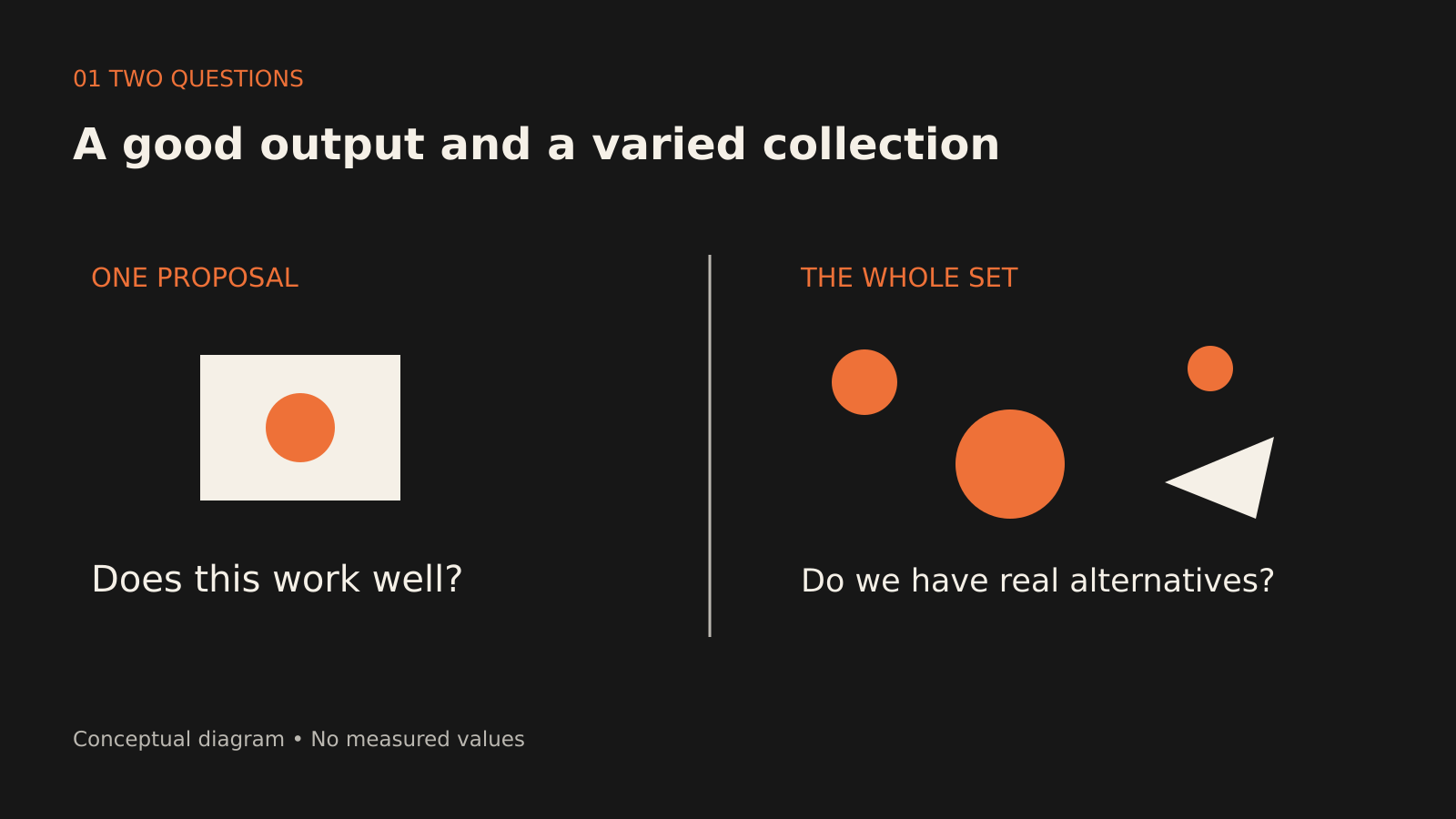
Two different review questions. This conceptual diagram distinguishes the quality of one output from the variety across a collection.
The place we give people matters
An October 2026 preprint by Chenyi Li and colleagues tested human roles in otherwise AI-driven writing chains: planning, writing, review and revision. [2]
Human planning and revision yielded more final-story diversity than review. Creativity differences among hybrid conditions were not statistically significant after correction. The chart shows study-specific semantic distances, not percentages. [2]
This preprint used short stories and non-expert participants. It does not prescribe agency staffing, but warns against treating all human involvement as interchangeable. [2]
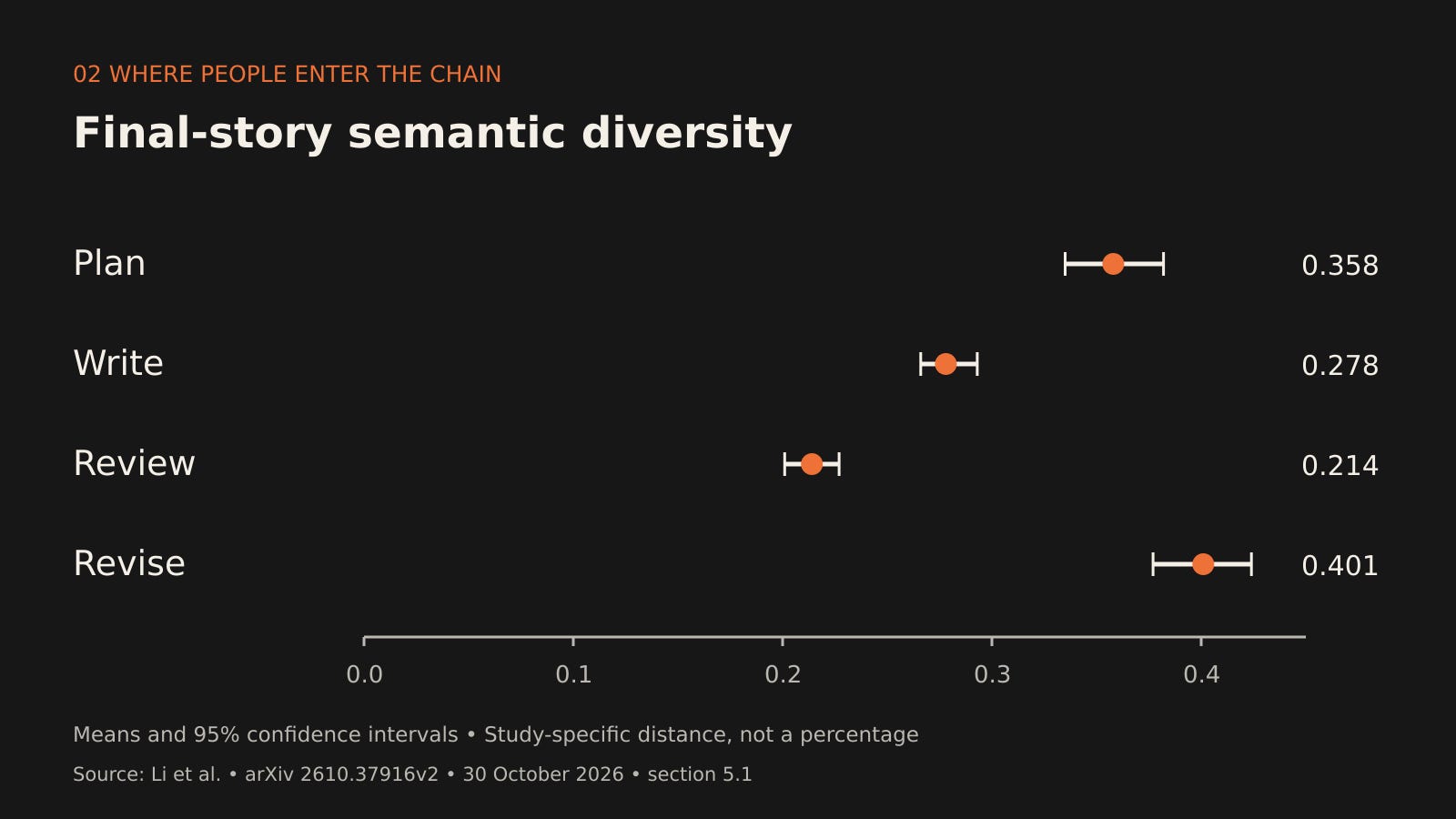
Final-story semantic diversity by human role. Points are means; lines show reported 95% confidence intervals. Study-specific measure, not a percentage. Li et al., preprint, 30 October 2026, section 5.1. [2]
Language can carry the idea rather than merely package it
A July 2026 preprint by Mengchen Dong and Hiromu Yakura separates another pair of activities. Participants created metaphors with AI-generated ideas, with AI refining explanations of their own metaphors, or without AI. The study compared native and non-native English writers. AI ideation narrowed the collective range; refinement produced no detectable reduction in diversity in the metaphors themselves, though the combined metaphor-and-explanation text became more similar. The non-native writers’ diversity advantage was detectable in the human-only and refinement conditions, but not with AI ideation. [3]
This is a metaphor experiment, not evidence that every multilingual team will obtain the same result. Still, it raises a useful possibility for organisations working across languages: use assistance to make a contribution understandable without asking the system to supply its starting point.
Consider a designer explaining a public service through an image familiar from their own city. Translating the explanation may help colleagues understand it. Replacing the image with a more familiar global cliché may make it easier to read while removing the reason it was interesting. Neither fluency nor familiarity is a sufficient test of value.
For a European team, I would try letting people record their initial observation in the language in which it comes most naturally. Translation and editing can follow. That is a workflow proposal, not a finding that multilingual work is always better.
There is no automatic law of sameness
The counterevidence matters. Joshua Ashkinaze and colleagues ran a dynamic idea-generation experiment with more than 800 participants across more than 40 countries. People encountered ideas from AI or earlier participants before producing their own. High exposure to AI ideas increased collective diversity, with no detectable improvement in individual creativity. The paper was accepted at ACM Collective Intelligence 2025. [4]
The task and social process differ from writing a story from an AI suggestion. We should not average these results into a single claim that AI increases or decreases creativity. They instead give us a reason to examine the arrangement: who sees which ideas, when they see them, and what they are asked to do next.
That leaves plenty of room for AI in exploratory work. It can offer an unfamiliar analogy, expose an assumption or help a team understand a direction nobody has the vocabulary to describe. The question is whether the resulting process expands the search or simply makes the first plausible answer easier to finish.
Try a different order before buying another tool
For the next brief, I would keep the experiment small. Ask each person to bring an independent starting point before showing the group any generated suggestions. It might be an observation from a customer conversation, a sketch, a question or a deliberately awkward proposition. It need not be polished.
Then use AI to develop those starting points separately. Ask what each one assumes, what would make it fail and which evidence would strengthen it. Keep the original notes alongside the developed versions. If an unusual detail disappears, somebody should decide whether that was an improvement.
When the team reconvenes, compare the collection before choosing a winner. Which audience does each option serve? What problem does it assume? What would have to be true for it to work? Two proposals with different words but identical answers to those questions may belong to the same direction.
The diagram below is a proposed sequence, not an experimentally validated recipe. The final review still needs to check accuracy, suitability, rights and practical constraints. Early human input does not excuse a weak final result.
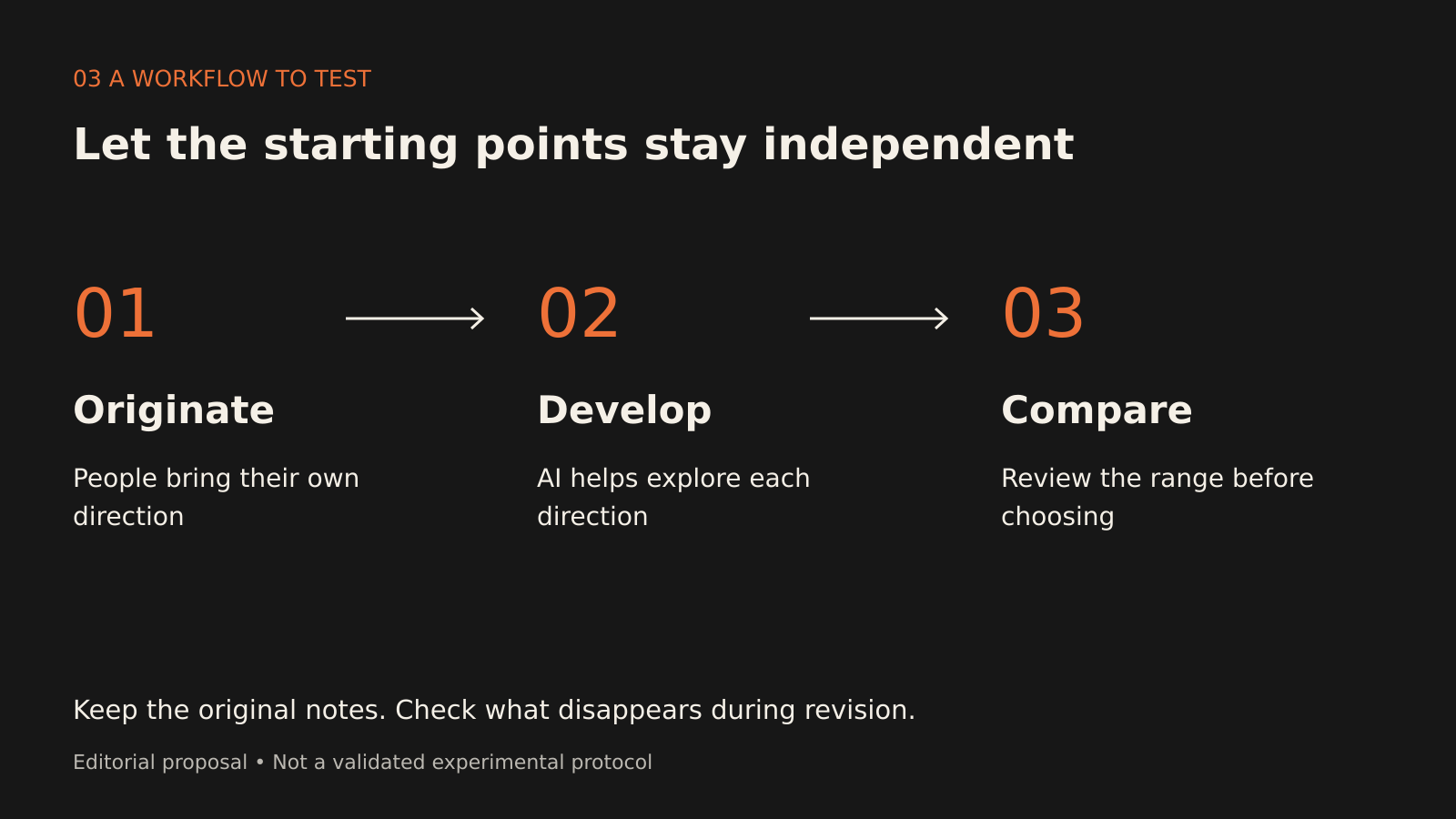
A proposed workflow to test. Independent starting points precede assistance; comparison examines the collection as well as each proposal. This is editorial guidance, not a measured result.
Protect the choice before polishing it
A useful pilot would compare two similar briefs, keeping the time budget and review criteria visible. Record which proposals survive, why they are distinct and what useful ideas disappear during revision. Ask reviewers to assess the work without knowing how it was produced where practical. Small trials will be noisy; repeat them before declaring a winner.
I would resist turning this into a quota of human words or a rule that AI must always arrive late. Those are easy things to count and poor substitutes for examining the work. Some projects need consistency. Others exist precisely to find a direction nobody has considered. The workflow should reflect that difference.
The broader choice is about the kind of contribution we reserve for people. If their only task is to approve finished options, they may remain accountable while having little influence over what gets explored. Give them the first move as well, and the tool has something more particular to work with.
A polished answer is useful. A worthwhile alternative is harder to replace.
Follow us on Youtube and LinkedIn.
Sources
[1] Doshi and Hauser. Generative AI enhances individual creativity but reduces the collective diversity of novel content. Science Advances, 12 July 2024.
[2] Li et al.. What Is the Role for Humans in Creative Writing. arXiv preprint v2, 30 October 2026.
[3] Dong and Yakura. Human diversity fuels collective creativity that large language models cannot simulate or sustain. arXiv preprint v1, 29 July 2026.
[4] Ashkinaze et al.. How AI Ideas Affect the Creativity Diversity and Evolution of Human Ideas. ACM Collective Intelligence 2025; arXiv v3, 31 July 2025.
Doshi and Hauser finding that each AI-assisted story got better while the whole set got more alike explains a lot about the feeds right now. If a tool is trained on the average and the lowest common denominator, letting people go first before it touches anything is how you keep the thinking only they can do. A shelf of beautifully made books that all tell the same story is my nightmare bookstore lol