

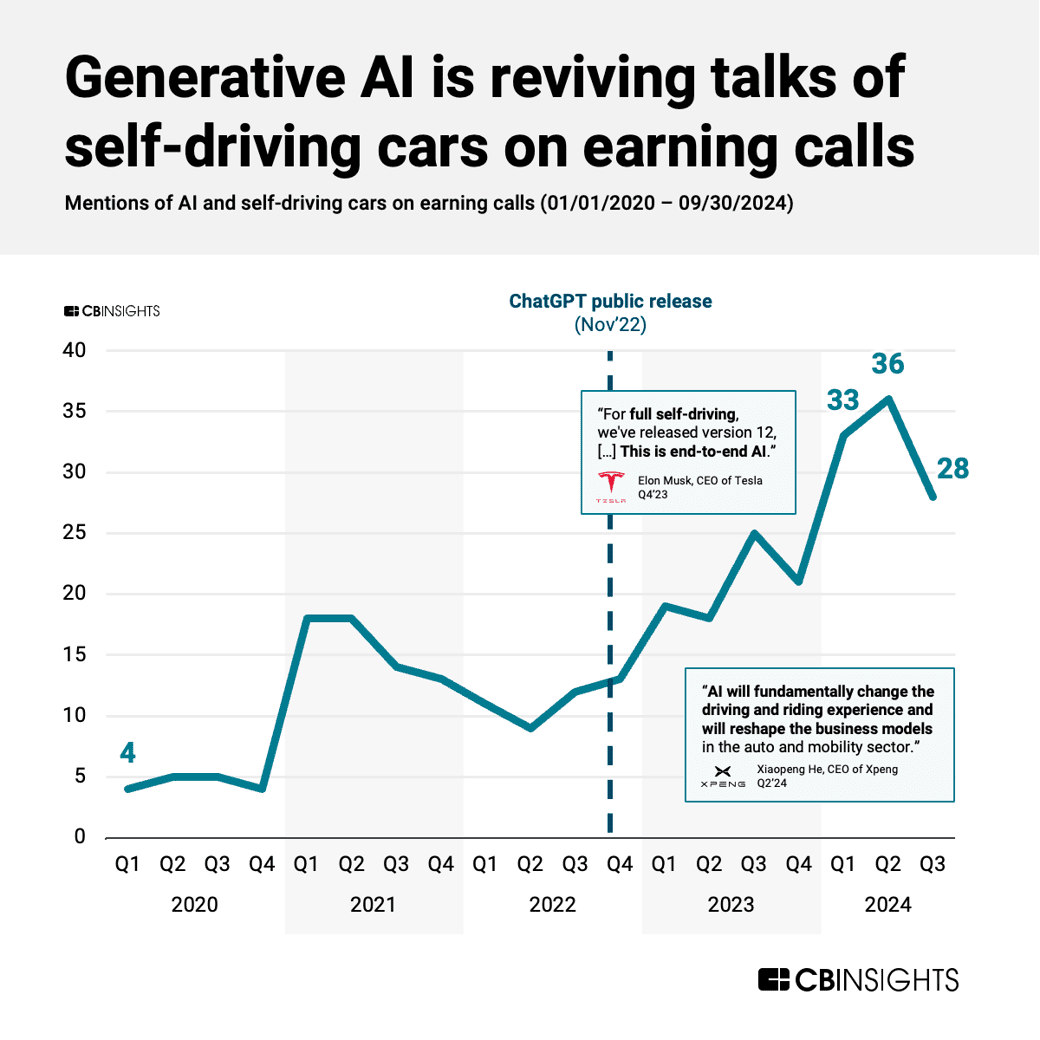
The automotive industry is at a transformative crossroads, driven by advancements in generative AI (GenAI) that fast-tracks autonomous vehicles (AVs) capabilities. GenAI's impact redefines everything from training environments to safety protocols and how passengers communicate with self-driving cars. Last week’s record-setting $5.6 billion investment in Waymo, Alphabet’s autonomous driving unit, underscores the market's high-stakes bet on AI-driven autonomy. With major players, from startups to established mobility giants, leveraging GenAI for autonomous vehicle advancements, the journey to fully self-driving cars is becoming shorter and more tangible.
But what exactly does this innovation look like in action, and why is it so crucial for the automotive and mobility sectors?
The Technological Edge: How GenAI is Shaping Autonomous Vehicle Development
Generative AI has opened new avenues for developing, testing, and deploying autonomous vehicles. Key applications include:
1. Synthetic Training Environments for Cost-Effective Development
Training autonomous vehicles to navigate real-world environments traditionally requires extensive—and expensive—physical testing and data collection. GenAI-powered synthetic environments, or virtual training grounds, allow developers to simulate various real-world scenarios without leaving the lab. This process offers immense savings and accelerates development, as self-driving algorithms can be tested and refined at scale and in situations as varied as adverse weather, unpredictable pedestrian behaviour, and complex urban infrastructure.
Impact: Using generative models to recreate diverse and challenging driving conditions, developers reduce training costs significantly while improving the algorithms’ robustness and responsiveness to real-world events.
2. Enhanced Safety Through Predictive Motion and Behavior Modeling
One of the most exciting developments is how companies like Waymo are using language models to enhance road safety. Language models can analyze vast amounts of data on human behavior—whether pedestrian movements, cyclist patterns, or other road agents—to help predict how individuals might act in any given scenario. This predictive capability reduces the likelihood of accidents and enables autonomous vehicles to make quicker, safer decisions.
Impact: Improved safety and transparency in AV interactions with human road users, minimizing potential hazards and fostering public trust in AV technology.
3. Personalized Passenger Experience and Enhanced In-Car Interactions
Generative AI is also poised to redefine the relationship between passengers and vehicles. Instead of rigid, rule-based commands, passengers can engage with the vehicle through nuanced, complex interactions. Imagine asking your car to "go home" and "take the scenic route with minimal traffic." Generative models can interpret these requests, tailoring the journey to individual preferences and making each ride feel more intuitive and personalized.
Impact: Enhanced user experience, where vehicles are more responsive to passengers' specific needs and preferences, offering a greater sense of control and comfort in autonomous travel.
Why GenAI Matters in the Automotive Sector
Integrating generative AI into the automotive industry is more than just a technological leap; it’s a business necessity. The potential for cost savings, safety improvements, and customer satisfaction creates a strong incentive for established manufacturers and new entrants in the AV market. The competitive landscape is rapidly evolving, with significant stakeholders like Alphabet, Tesla, and many tech startups investing in GenAI.
For business leaders, generative AI represents a significant differentiator in a crowded and competitive field. As AVs become more sophisticated and ubiquitous, consumers will look for vehicles that offer safety, efficiency, and a seamless and personalized experience.
Use Cases Across the Automotive Industry
Beyond passenger vehicles, generative AI offers transformative applications across other sectors of the automotive industry, including:
Freight and Logistics: By avoiding high-risk driving conditions, self-driving trucks can leverage GenAI for long-haul routes, using predictive models to optimize fuel efficiency and reduce wear and tear.
Public Transportation: Autonomous shuttles can adjust routes dynamically based on passenger demand and traffic conditions, making city transit systems more efficient and responsive.
Emergency Services: AI-driven autonomous vehicles can be programmed to navigate complex scenarios and respond quickly in emergencies, mainly when human drivers are unavailable or cannot respond as fast as needed.
The Road Ahead: Challenges and Opportunities
The promise of generative AI in autonomous vehicles is substantial, yet challenges remain. Regulatory hurdles, data privacy concerns, and technological limitations still need addressing. However, with recent advancements, such as Waymo's adoption of language models for road safety, these challenges appear increasingly surmountable.
The automotive sector could look drastically different in a few years, with GenAI as the foundation for safer, more affordable, and customizable transportation solutions. For businesses and consumers alike, generative AI in the automotive industry represents an exciting, innovative frontier that will drive the next era of mobility.